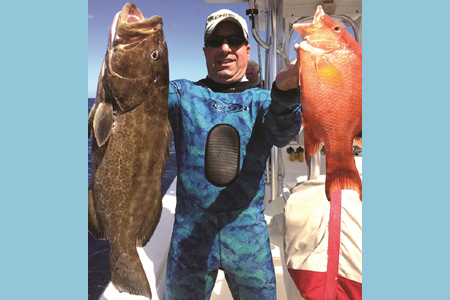
Most offshore anglers in South Florida are focused on catching dolphin in the month of June. The colorful fish — not the mammal — are popular because they fight hard and jump a lot, they can be caught on a variety of baits and lures, and people love to eat them.
Although dolphin are caught year-round locally, this is the time of year when they are plentiful. The bag limit is 10 fish, a minimum of 20-inches long— per person per day or 60 fish per boat, whichever is less. Many anglers keep only enough dolphin for a few meals — the fish are terrific fried, blackened or in tacos — and safely release everything else back into the water.
Late spring and summer are when dolphin are often found in schools ranging from half a dozen to dozens of fish. Locating those schools is usually a matter of locating birds, weedlines, or floating debris.
Weedlines, patches of grass and debris such as tree trunks and wooden pallets, attract baitfish, which attract dolphin. Birds often hover over dolphin, hoping they’ll chase bait to the surface. Like serious bird-watchers hoping to spot a species they’ve never seen before, dolphin fishermen are always on the lookout for frigate birds.
Also known as a man-o’-war bird, a frigate bird has a forked tail and a wide wingspan that allows it to soar over the ocean, then suddenly swoop down to catch a fish with its long, hooked bill. The bird does not dive into the water. Instead, it waits for dolphin to send flying fish and other small fish fleeing to the surface. When a baitfish goes airborne, the frigate zips in and snags it. (A frigate also scores easy meals by harassing other seabirds so that they drop their catch, which the frigate grabs before it hits the water.)
When running offshore, some captains will stop every five minutes or so to scan the horizon with binoculars in the hopes of spotting birds or debris. Others will designate crew members to keep an eye on the sky.
If frigate birds are swooping, that’s a good sign. If birds are sky-high, they’re looking for dolphin, so it might not be worthwhile to race over to them.
“High birds, if they’re way up there, they’re taking advantage of their eyesight to look for something to play with,” said Capt. Bouncer Smith, a legendary charter fishing captain in Miami Beach. “If they’re 200 feet high, they’re probably into something. When they start to dive, then they’re really in the game.”
Smith added that anglers must pay attention to the direction a frigate bird is flying.
“If birds are working to the north, they’re over smaller dolphin or tunas,” Smith said. “If a bird is on good-sized fish, he’s going to be going south, because good-sized fish go against the current. The big dolphin are swimming just fast enough to hold their position in the current — the Gulf Stream is moving north at 3-4 mph — and eat what comes by.”
Smith, who runs charters out of Miami Beach Marina on Bouncer’s Dusky 33 (CaptBouncer.com), said anglers need to get ahead of a frigate flying south to have a shot at catching the dolphin the bird is following. If they stay to the north of a south-flying bird, the fish have already passed their boat.
“A lot of times when you’re on frigate birds, you’ve got to wind the lines in and get ahead of the frigate and let the dolphin catch up to you,” Smith said.
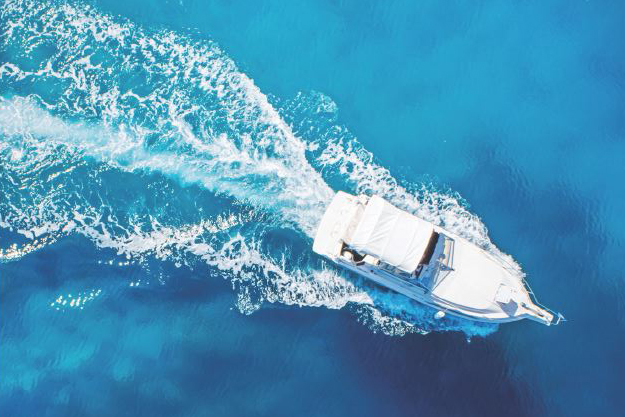
Once his boat is in position, Smith rigs two spinning outfits with live baits — pilchards, goggle-eyes, small blue runners, or cigar minnows — hooked through the nose. He has his anglers cast the baits 50-100 feet behind the boat. They leave the reel bails open and control the lines with their index fingers while Smith idles ahead of the bird.
“When a fish eats, give him a short drop-back, close the bail and wind,” said Smith.
Once you’re hooked up, it’s not unusual for the rest of the school to appear behind the boat. That’s when fishing can get frantic, with multiple anglers fighting fish and trying to not tangle their lines. Like a choreographer, Smith often has to tell anglers to go over or under another angler’s line.
To keep dolphin around the boat, many anglers leave one or more hooked fish in the water, which attracts other dolphin. When the next fish is hooked, the first one can be boated, and so on. If, after you’ve boated several dolphin, the school disappears, try splashing the water with a gaff to get the fish to return because it sounds like a feeding frenzy that they’re missing out on.
When the schoolies are solid behind the boat, you can catch them on dead bait, jigs, topwater plugs, and even flies. Smith recommends buying a 1-pound box of squid and casting the 3- to 4-inch baits to the fish. A one-ounce kingfish jig retrieved as fast as possible also entices strikes from dolphin. But Smith’s favorite way to catch schoolies is on a fly rod. “Better too small a fly than too big a fly,” said Smith, adding that yellow is an effective color. It also helps to toss out a few glass minnows every once in a while, to keep the fish turned on.