
From “Kansas City” to South Florida: The Beat Goes on With Groove 2.0

At 71, drummer Lionel Harrison has more energy onstage than musicians half his age — and his band, The Groove 2.0, feeds off every bit of it. He’s proud of his 8 to 10 minute drum solos. 

Billed as one of Florida’s funkiest, high‑energy party bands, The Groove 2.0 performs as a five‑ to ten‑piece ensemble, depending on the venue. “We’re not a tribute band,” band leader Lionel Harrison says. “We play everything.” And he means everything — from Bruno Mars to Earth, Wind & Fire to Stevie Ray Vaughan and from R&B, rock, funk, hip-hop, reggae, Latin, jazz and the blues.

The band has become a staple across South Florida and beyond, performing regularly at Margaritaville (both the restaurant and the bandshell), the former Tavolino Della Notte’s in Coral Springs, Seed to Table in Naples, the Biergarten in Boca Raton and Johnny Brown’s in Delray Beach, where they made their debut in 2022. No matter the stage, the mission is the same: get people moving.

That movement starts with the musicians themselves. Guitarist Shawn Tarver (Shawn Tarver Project) is the band’s resident showman — a whirlwind of charisma and controlled chaos. “He jumps around, plays solos with his teeth, his tongue, throws his guitar behind his back and over his head,” Harrison says. “There’s a lot of movement in this band.”

The core lineup includes Tarver on guitar, Brett Brown on bass and Noel (“Pianoman”) Torres on keyboards. Vocals rotate among four women — Alana Joy Page, Astrid Voxx, Alexis Krystal, and Heather Davis. The result is a band that can shift genres, moods, and eras without dropping a beat.

Torres, the band’s 64‑year‑old keyboardist, brings his seasoned musicianship to Groove 2.0. The New Jersey native moved to Palm Beach County in 1997 and eventually found his musical home within the group.

He is also a member of the Shawn Tarver Project — a mix of rock and R&B — and performs in the TNT Connection duo with Tarver every Tuesday at Aruba Beach Café in Fort Lauderdale.

Over the years, he has worked with artists such as Gwen and George McCrae and Nestor Torres. His musical heroes include Ramsey Lewis — whom he once opened for — as well as Chick Corea and George Duke, both of whom he met.

He also admires Lyle Mays of the Pat Metheny Group and Austrian keyboardist Joe Zawinul of Weather Report. With roots in Puerto Rico, he has a special place in his heart for Latin jazz, especially Eddie Palmieri and Papo Lucca.

Torres learned to play in a Pentecostal church and, without a keyboard at home, practiced there whenever he could, determined to master the instrument. Over time he expanded his skills to include guitar, piano, organ and synthesizer. His original music, including “Noel’s Hot Sauce” and “El Rumbero,” is available for download on iTunes.

What keeps him committed to Groove 2.0, he says, is the mutual respect, professionalism, and joy of the music they create together. “It’s how tight we are — how great the band sounds,” he says. Looking ahead, he hopes the band can take on more corporate events, broaden their reach, and even record some originals.

While Torres brings his own musical lineage to the group, Lionel Harrison’s story begins even earlier.

For Lionel Harrison, music isn’t just a career — it runs in the family. His cousin, Rev. John P. Kee of Charlotte, N.C., known as the “Prince of Gospel,” is a major figure in the genre. His son, Chris Kee, is a drummer. And the legacy stretches back even further.

His dad, Wilbert Harrison, was a one‑man band. “With his right foot he hit the bass drum, with his left foot he hit the snare,” Lionel says. “He had a harmonica in his mouth, singing and playing guitar.” He pauses for a moment. “Can you imagine one guy opening a whole show for a crowd that came to see Creedence Clearwater Revival? That takes courage.”

In 1959, Harrison recorded the original version of “Kansas City,” written by Jerry Leiber and Mike Stoller. The song shot from the bottom of the Billboard Hot 100 to No. 1 in both the R&B and pop charts, where it remained for seven weeks — the only track to do so at the time. “He was bigger than Elvis Presley that year,” Lionel says. In 2009, Harrison was inducted into the North Carolina Music Hall of Fame.

Of special significance for Lionel Harrison is the date October 26.  Both his parents passed away on that date, in different years. His father in 1994, his mother in 2006. The days still resonate with him.  And, another of his dad’s songs, “Let’s Work Together,” became a big hit and Lionel Harrison received a royalty check from it on Oct. 26, 2007. 

Lionel Harrison’s own musical journey began in Carrol City, Miami, where he grew up. At age three, he was banging on his grandmother’s pots and pans. She kept a sewing tin filled with coins, and he’d shake it like a tambourine.

His father bought him an organ when he was four, but he didn’t get his first real drum set until he was 13. He admired Buddy Rich, Ringo Starr, Billy Cobham and — he confesses — Micky Dolenz of The Monkees.

His career took him on the road with Betty Wright, a two‑time Grammy winner known for “Clean Up Woman” and “Where Is the Love.”

He also toured with and played drums for Clarence Clemons, former saxophonist for Bruce Springsteen and the E Street Band.  Many of the band’s members have played with the likes of Bob Marley, Buddy Guy, George Benson, Jaco Pastorius and Joe Bonamassa, among others.

In 1978, with his band Rivage, Lionel Harrison recorded a soul/funk album called “Sittin’ On It,” where he served as both lead vocalist and drummer. The record has since become a collector’s item and is being re‑released — something he hopes will introduce his early work to a new generation.

Today, in addition to The Groove 2.0, Lionel Harrison leads a fusion project called TranZFusion, with whom he hopes to record a new album.

Married to Dede Dyer, an academic advisor at Palm Beach State College and living in West Palm Beach, Lionel Harrison keeps busy with The Groove 2.0.

Married to Dede Dyer, an academic advisor at Palm Beach State College, and living in West Palm Beach, Lionel Harrison keeps busy with all his musical projects. Father of three boys and grandfather of six, Lionel Harrison — nicknamed “Freight Train” for his unrelenting drumming style — lights up when he talks about performing.

“We’re an entertaining band,” he says simply. And with a lifetime of rhythm and a musical legacy behind him, he knows exactly how to make a crowd get up and dance.

Visit them on Facebook at TheGrooveFunk

A Taste of Italy, Built on Family: Flora’s Italian Eatery and Angela’s Bar & Kitchen Set to Open in Coral Springs

When the doors open this January at Flora’s Italian Eatery and Angela’s Bar & Kitchen, at 12335 West Sample Rd., Coral Springs will gain more than a new dining destination — it will gain a full-fledged Italian experience, crafted by a family that has spent 50 years bringing the flavors of Italy to South Florida.

The two-story, 15,000-square-foot space in an office park with plenty of parking, just across from the Panthers IceDen, is the newest venture from Flora Fine Foods, the nationally recognized importer known for supplying everything from Italian wines to cruise line gelato.

For founder and owner John (Giovanni) Flora, 73, the vision is simple: create a market and restaurant that feels like Italy, tastes like Italy, and operates with the heart of a true Italian family.

A Parkland resident for the past 28 years, Flora was born in Bari, in Italy’s Puglia region, and immigrated to New York with his family in 1962 at the age of ten.

“We’re excited to open our doors and welcome the community into an extension of our home,” says Flora. “This is a true family business, and everything we do — at the eatery, the restaurant, and beyond — is inspired by the values we grew up with around the table.”

He raised his family in Parkland, and his daughter Angela Flora, 42, now a new mom, is a graduate of Coral Springs Middle School and Marjory Stoneman Douglas High School. It was her vision to expand the business into a market and restaurant.

“It’s an ambitious undertaking, but a labor of love,” says Angela, who is juggling her roles with the business and as a mother to a nine‑month‑old son. “We cannot wait to meet you all and welcome you into our family.”

A Market That Starts at Breakfast and Ends at Dessert

Kenny Rodriguez, vice president of operations, sums it up simply: “Think Joseph’s — on steroids.”

On the ground floor, Flora’s Italian Eatery will function as an all-day market and café, offering breakfast, lunch, and dinner. Café tables invite guests to sit and relax, or they can order items to go.

The space will feature a wine room, a full deli, and shelves lined with specialty items imported directly from Italy. Fresh turkey and roast beef will be prepared in-house, sliced on top-of-the-line imported Berkel machines designed specifically for prosciutto and mortadella.

Guests can expect fresh breads, paninis, focaccia, bagels, and Roman-style pizza — both regular and gluten free — along with house-made sauces, soups, pastries, and gelato flown in from Italy. Brand-new Lavazza cappuccino machines will anchor the coffee program, ensuring every espresso tastes like it came from a café on Via del Corso.

“It’s about giving people the same culinary experience they’d have in Italy,” says Flora. “I want them to go, ‘Wow.’

Upstairs: A Bar, a Kitchen, and a Family Legacy

One flight up, Angela’s Bar & Kitchen will offer a more intimate, full-service dining experience. Named for Flora’s daughter, Angela, the restaurant will serve Italian-inspired small plates (piatti piccoli), craft cocktails, and a curated wine list in a warm, comfortable setting.

The kitchen will be led by executive chef Francesco Cavarretta, whose global culinary background brings a worldly touch to the family’s traditional recipes.

But the real secret ingredient is the family itself.

Flora Fine Foods is a true Italian-style family business, with multiple generations working side by side. Angela and her two brothers are involved in daily operations. Flora’s sister, Rose Farruggia, serves as human resources director. His wife, Irene, is a vice president of the company. His sons, John and Christopher, oversee food distribution and sales. Angela Flora’s uncles, Gregg and Mark Alpern, are directors of food service and export and complete the feeling of famiglia.

“Culture comes from passion and love in preparing your product,” Flora says. His passion is evident as he speaks about this labor of love. “I get my passion from my mother.”

A Half Century of Italian Flavor

Long before Flora Fine Foods became a national importer, Flora imagined a different future. He planned to become an electrical engineer, but a part-time job at a local Italian bakery changed everything, sparking a fascination with food that would shape the rest of his life.

While vacationing in Miami Beach in the early 1970s, Flora realized there was no good Italian pizza. If he wanted the real thing, he’d have to make it himself. In 1972, he bought a small property on the 79th Street Causeway and opened Flora’s Drive-Thru Pizza Parlor — his first entrée into the food business.

He later opened Flora’s Italian Restaurant in Hollywood, Fla. When other restaurateurs began asking about the products he used, Flora started importing tomatoes — then other goods — directly from Italy.

As demand grew, he ran out of storage space, eventually draining his backyard pool and filling it with cases of tomatoes. That makeshift warehouse marked the unofficial birth of Flora Fine Foods.

The opening of the eatery and restaurant is the natural evolution for a company that has spent five decades shaping the Italian food landscape in America.

Flora Fine Foods is now the largest distributor of Italian wine in the country and supplies cruise lines with ice cream and cookies. Their products appear on the shelves of Costco, Total Wine, and Publix — but the Coral Springs location will be the first time the public can experience the brand in a full culinary setting.

In addition to retail and dining, the new space includes a private function room and a large catering kitchen, allowing Flora’s to serve corporate events, private gatherings and celebrations throughout the region.

Bringing Italy Home

For Flora, this project is more than a business expansion — it’s the fulfillment of a lifetime of memories and a devotion to food and family that began with a boy from Bari, a drive‑thru pizza place and a dream that wouldn’t die.

“I’m not just bringing the food,” he says. “I’m bringing the culture of Italy. I want to bring that passion, that love, that experience here to South Florida.”

So, soon, when the first cappuccino is poured and the first slice of Roman pizza comes out of the oven, Parkland and Coral Springs residents will taste the culmination of one man’s journey — a vision and a love affair with a place where food, family and tradition come together under one roof.

Buon appetito!

For more information, visit florafoods.com or follow @FloraFineFoods on social media.

From the Miami beat to the music beat—meet the MTVJ’s

When former Miami police officer Tom Braga, 63, traded his badge for a microphone, he didn’t just start a band—he created a tribute group inspired by memories of his youth. His newest project, the MTVJ’s, brings the biggest hits of the 1980s and ’90s back to life with a nostalgic nod to the era that shaped a generation.

A labor-of-love tribute band, the MTVJ’s play venues across South Florida, including Crazy Uncle Mike’s in Boca Raton, Galuppi’s in Pompano Beach, and Sharkey’s Bar & Grill in Coral Springs.

In addition to Braga, the core lineup includes guitarist Pete Lauria, bassist Lou Carollo, drummer Tom Gress, and keyboardist Lesley Gent. Many of the musicians also perform in Braga’s two other tribute bands: Jaded, an Aerosmith tribute founded in 2015, and Shake It Up, a Cars tribute launched in 2022.

Braga’s path to music was anything but traditional. A longtime hockey player, he was hanging out at a rink in North Miami wearing black-and-gold Boston Bruins gear when another Bostonian struck up a conversation. That fellow fan turned out to be Robbie Merrill, former bassist and founding member of Godsmack. The two hit it off, and Merrill soon began teaching Braga to play bass guitar.

“Before I knew it, I was playing at open mics and then in various bands,” Braga says. “I guess you could say I was gobsmacked.”

After five years on bass, Braga realized he had an unexpected gift: He was a stronger singer than player. He began learning how to command a stage, work a crowd, and replicate the tone and timbre of singers like Alice Cooper, Steven Tyler, and Ric Ocasek of the Cars.

Braga is still amazed by the discovery. “Who the hell knew I could sing?” he says. He performed his first show at age 44.

“It’s a lot of fun,” he adds. “People bring me hats and album covers to sign, and I get to dress up. I’m just a frustrated actor who happens to be able to sing.”

His musical influences include Led Zeppelin, the Beatles, and the Rolling Stones, and he admires Steven Tyler for his showmanship. Although he came to music later in life, Braga approaches it with the same drive that defined his law enforcement career.

“I was loved by the Grove,” he says, referring to his years as a community police officer in Coconut Grove. “Now we want to be loved by our audiences.”

Braga isn’t the only band member with a long musical journey. Guitarist Pete Lauria, 59, has been with the MTVJ’s for three years, though he has played with Braga and several of the other musicians for a decade through their Aerosmith and Cars tribute bands. Now living in Port St. Lucie, the Boston native works by day as an outside sales rep for Plusco Supply, a plumbing supply company in Boca Raton.

Lauria received his first guitar at age 8 from his grandfather, though he didn’t get serious about playing until high school. He began writing songs, and by 2001 he was part of Superbone—a band performing original music (the name references oversized trombones). The group even released a record.

“I enjoy writing music and spending time in the studio,” Lauria says. He loves playing songs by Tears for Fears, U2, and Bruce Springsteen, and while the band sticks to the hits, they also dig deeper to revive tunes that audiences haven’t heard in a while. His guitar heroes include Ace Frehley of Kiss, Randy Rhoads of Ozzy Osbourne’s band, and Joe Bonamassa. On his own time, he gravitates toward hair metal and hard rock bands like Mötley Crüe.

Inspiration, he says, “just happens.” It often finds him while he’s out on his boat.

Coming from a nonmusical family, Lauria didn’t have early influences at home, but his relatives quickly embraced his passion and still come out to see him play. He’s a divorced father of five grown sons—one who’s a guitarist, another a drummer.

For Lauria, the best part of performing is simple—“jamming with my friends, smiling, playing music, having a great time and a night out. I enjoy the camaraderie.”

Rounding out the rhythm section is drummer Tom Gress, 70, who brings a lifetime of musical experience to the band. He spent 44 years as a high school choral and band teacher, including serving on the original staff at Marjory Stoneman Douglas High School, where he was choral director from 1991 to 1997. He also taught at Stranahan High School, NSU University School, and St. Thomas Aquinas in Fort Lauderdale, where he directed the marching band.

A voice major in college, Gress loves singing backup harmonies and jokingly calls himself “the singing drummer.” He admires drummers Danny Seraphine of Chicago and John Bonham of Led Zeppelin.

Outside of music, Gress loves golf and believes that both music and golf are vocations one can enjoy for life. Recently, he began playing acoustic guitar with singer-guitarist Ninowtzka (Nosh) Mier-Soika, forming a duo called Nosh and Gress. He also enjoys Americana artists such as Amos Lee, Jason Isbell, and Ray LaMontagne.

Listening to other genres, he says, “cleans my ears out.”

About his time drumming with the MTVJ’s, Gress says, “We have a passion and commitment to each other,” a spirit that shows every time they take the stage.

The MTVJ’s will perform on Thursday, Feb. 19, at Sharkey’s Bar & Grill, 10365 Royal Palm Blvd., Coral Springs; call (954) 341-9990. To learn more about the MTVJ’s, visit them on Facebook and Nosh and Gress at NoshandGressMusic.com.

Subliminal Doubt: A Tribute to No Doubt 

            No Doubt About It:   Monica Leamy Channels Gwen Stefani with Talent & Charm

A double-shot of punk-pop nostalgia takes center stage as Subliminal Doubt channels the spirits of Blondie and No Doubt with gleeful exuberance.

On a recent Friday night, the central Florida-based tribute band headed to Lakeland, Fla. for a repeat performance at Union Hall.

With a setlist spanning two decades of pop rebellion, the group aims to capture the raw energy of Blondie’s disco-punk anthems and the ska-infused spirit of No Doubt’s ’90s hits.

At the center of it all is lead singer Monica Leamy, 48, – a doppelganger for Stefani – known to fans as “Fake Gwen,” channels the charisma of both Debbie Harry and Gwen Stefani as the eyeliner-clad crowd dances and sings along to “Just a Girl,” “Don’t Speak,” and “One Way or Another.”   

In the 1990s, No Doubt had hit songs with “Hollaback Girl,” “Spiderwebs,” “Underneath It All,” “Sweet Escape,” “Don’t Speak,” “Hella Good,” and “Hey Baby.”

Leamy and the Subliminal Doubt band, Danny Siper (drums), 29, Jonathan Leamy, 40, (bass) and Steve Osborne, 42, (lead guitar) took to the stage with an enthusiasm and mission to resurrect two decades of pop rebellion, the swagger of Blondie’s disco-punk sounds and the spirit of No Doubt.

The group travels the state and the northeast, recently playing in New York City at Sony Hall and has played at Revolution Live in Fort Lauderdale, Crazy Uncle Mike’s in Boca Raton and Sharkey’s Bar and Grill in Coral Springs.

“I’m a huge fan of both Debbie Harry and Gwen Stefani,” says Leamy, a formally trained dancer and singer who grew up in Florida and has performer at Disney, Universal Studios and Sea World.  “When I heard Gwen Stefani’s “Just a Girl,” I was spellbound; I didn’t leave my tape player for weeks.”

Leamy, who, when dressed in character, has a strong resemblance to both Harry and Stefani, says she loves Stefani’s whole vibe, her retro look, her fashion sense, her vocal style and “everything about her.”

She was dubbed “Fake Gwen,” by the real Gwen, at a No Doubt concert in Las Vegas, when she and her bandmate, Jonathan Leamy, married and went to Las Vegas for their honeymoon in 2019.

She was dressed in her best “Fake Gwen” hair and makeup, in jeans and a T-shirt reading, “Blonde Rebel,” from Stefani’s “This is What the Truth Feels Like Tour,” in 2016.  Stefani asked her, “Have I met you before?” before bringing her up on stage and bestowed the nickname of “Fake Gwen.”

With the recent announcement in October that No Doubt will reunite for a residency at the Sphere in Las Vegas in 2026, both Leamys plan to be there, coincidentally, coinciding with their wedding anniversary.

Born in Guam, where her father was a musician in the U.S. Navy, Leamy knew from an early age she wanted to be a performer. 

She took gymnastics from the age of three, started dance class at the age of six, took singing lessons in high school and majored in flute at Edison College (now called Florida SouthWestern State College) in Ft. Myers, earning her associate’s degree from Valencia College in Orlando in 2004.

‘I never saw another option,” she says.  “I wanted to be Madonna.”

Not only Madonna, but Paula Abdul, Katy Perry, Audrey Hepburn, Marilyn Monroe and Taylor Swift (her impersonation is called “Taylor Thrift”). She has been listening non-stop to Swift’s latest album, “The Life of a Show Girl,” and, despite mixed revieiws, loves it

In later years, Leamy developed personas for these performers and uses them as inspiration for her shows.

“I’m not sure, exactly,” she says when asked how she channels each singer, “but something just happens.”

Once she warms up her voice, puts on her costume, listens to their music or watches a music video, she gets in the mood and is able to express herself organically as Debbie Harry or Gwen Stefani.

Jonathan Leamy, who was born in France and grew up in Hawaii, says he loves working together as a team with his wife, Monica Leamy.

He showed an early aptitude for music and began playing guitar as a child.  Later, he played the trombone in his high school marching band.

He joined 69 Fingers, a punk-ska band, where he met Osborne and performed at Disney Springs for ten years.  He taught music theory and music production at the private, for-profit Full Sail University in Winter Park, Fla.

Among his musical influences are jazz, funk, classic rock, the Beatles and he got into ska reggae and punk music in his late teens.

“It’s still a big part of what I do,” he says, admitting that he sometimes slips an Allman Brothers riff into one of their Blondie or No Doubt performances.

With career highlights, including the recent performance in Times Square at Sony Hall, New Haven’s iconic Toad’s Place and an appearance on “Live from Daryl’s House,” an award-winning on-line music series created by Daryl Hall (of Hall & Oates renown), Jonathan Leamy says the band is happy with their success.

“We’ve met and exceeded our goals,” he says.

They hope to keep on making music and to grow the Blondie shows.  Jonathan Leamy has a new appreciation for No Doubt’s bass player, Tony Kanal, and hopes to meet him one day.

“I’m surprised by how much his music has affected my life,” says Jonathan Leamy.  “I thought I’d make it as a ska or punk rocker.  I never thought my success would come as part of a No Doubt tribute band.”

The group has recently released their first original song and video, “Cutdown Culture,” (“You don’t know me; but you say you hate me”), a commentary on social media, available on streaming sites, and hope to create an original body of work.

“I feel fortunate to work every day with Monica, and Steve and Danny are like brothers to me.  We’re all very close,” he says. “Who else can say they get to work and travel with their wife and best friends?”

“It’s a rare thing and I’m grateful for it,” says Jonathan Leamy.

For Monica Leamy, stepping into the spotlight each night as “Fake Gwen” or “Fake Debbie” is more than a tribute — it’s a rallying cry for women’s empowerment.

And while Gwen Stefani once belted “I’m Just a Girl” sardonically and with irony, Leamy has claimed the refrain as her own — proving that being “just a girl” means you can be anything you want to be.

Visit them on Facebook or at https://subdoubt.com.

Project 1841 8 generations of students helping teens age out of foster care

When Marjorie Stoneman Douglas students Brianna Bango, 17, Mia Bono, 16, Amanda Bilsky, 16, and Samantha Shortz, 16, handed over a duffel bag filled with essentials and a handwritten birthday card as part of Project 1841, they knew they were giving more than supplies—they were giving hope.

From competitive dancing and sports to volunteering for Project 1841, a grassroots effort supporting teens aging out of foster care, these local girls are proving that age is no barrier to making a difference.

Across the city of Parkland, the newest members of this charitable organization, Martina Velez, 14, and Graciela Wilson, 14, make the eighth generation of volunteers—each group passing the torch as they graduate high school and welcome new members.

Together, they’re using their time and talents to support local causes and inspire others to do the same.

Founded in 2007 by then–Weston student Alexandra “Alex” Rubin and her peers, Ilana Wolpert, Alexandra Kaplan, and Alli Weiss, Project 1841 raises funds and collects donations to pack starter kits in duffel bags for youth turning 18 and aging out of the foster care system.

Prior to the duffel bags provided by Project 1841, these kids usually packed up their belongings in plastic garbage bags when setting out on their own.

Nearly two decades later, a new generation continues the tradition—packing duffel bags filled with essentials and hope.

“These girls are a blessing,” says Kaydion Watson, director of youth services at ChildNet, a nonprofit advocacy agency serving vulnerable children in Broward and Palm Beach counties. “We’re very appreciative of all they do for our foster youth.”

As director of youth services for the past six years, Watson has spent most of her 20-plus-year career working with foster youth, beginning as an independent living specialist. Committed and loving what she does, Watson says she’s happy to have a positive impact on these kids’ lives and is grateful to Project 1841 for their commitment and generosity.

“The girls of Project 1841 choose to be impactful with their time and energy and to give our kids a feeling of being valued,” she says. “We’re forever grateful for them.”

Teens in foster care “age out” of the system on their 18th birthday. Many will face challenges without the support of family or relatives or a safety net. Compared with their peers, young people who have aged out may face particular hurdles, including behavioral, mental, and physical health issues and challenges with housing instability, interrupted education, joblessness, and substance abuse.

The transition to “emancipation” can be daunting. Project 1841’s mission is to make that transition less daunting.

The name 1841 denotes three things: “18” is the age that youth age out of the foster care system, beginning their journey toward independence. “Four” signifies the original four girls who worked with ChildNet to collect donations and pack starter kits for the youth. “One” symbolizes the one cause that unites the girls—helping foster teens to transition from foster care to independent living.

According to figures provided by Project 1841, more than 120 teens age out of Broward County’s foster care system each year, and some of those teens age out when they are still in high school.

The first delivery of bags was in April 2008. Each month, ChildNet forwards to Project 1841 a list of names of youth who are aging out of foster care on their 18th birthday. Every month, the girls pack bags filled with sheets, towels, a pillow, utensils, plates, toiletries, snacks, detergent, and more, as well as a handwritten birthday card to each teen.

Brianna Bango’s mother, Maggie Cicarelli, a licensed clinical social worker and 18-year Parkland resident, says, “In this day and age, it’s particularly inspiring to see high school girls who are privileged to live in an amazing community in Parkland step up and give back to their counterparts.”

She says, “It also teaches them to be part of a community.”

The impact is tangible, but not without cost. Each bag costs about $100 to fill, and with prices rising, Cicarelli says they are always looking to host fundraisers or accept donations to support their efforts. Each generation adds its own touches to the bags, such as gift cards to fast-food restaurants or something to make the teens’ first night on their own more comfortable.

Since inception, more than 1,500 bags have been packed and delivered, thanks to the group’s fundraising efforts. Additionally, as each volunteer graduates high school, a new generation steps up to further the cause.

While Cicarelli acknowledges that the foster youth have a long journey ahead of them, and the volunteers’ efforts are “but a blip on the radar of their journey,” she knows from her professional experience as a social worker that kids who go on to do well and be successful, independent, contributing adults had someone who stepped up and showed an interest in their life.

“Sometimes a small act of kindness can make a difference in someone’s life,” she says.

All the donated items are stored at Cicarelli’s home, and once a month Project 1841 members gather to prepare the bags. ChildNet provides the group with the first names of those who will age out the following month.

Bango, a rising senior at MSD High School who hopes to apply to the BS/MD program at the University of South Florida and one day become an orthopedic doctor, says she’s motivated by her “love for our community” and a desire to make it better.

She also volunteers with Parkland Buddy Sports and created an organization that promotes health through dance called “Groove for Goodness,” which brings dancers to nursing homes, hospitals, assisted living facilities, and shelters to dance alongside the residents.

“Project 1841 is for a great cause, and I think it’s important to give back,” says the straight-A student, who is the primary coordinator and in her fourth year as a volunteer.

Over the past 2½ years, Bango has forged close friendships with two of the other volunteers, Bilsky and Shortz, both lacrosse players at MSD, and the girls say they are grateful for the friendships they’ve made.

As yet undecided on where they plan to go to college, Bilsky excels in history and Shortz, who also prepares sandwiches for Our Father’s House Soup Kitchen in Pompano Beach, excels in math. Both also volunteer their time at Parkland Buddy Sports.

Shortz enjoys the physical act of packing the bags, knowing that these are necessities that will give the foster students a fresh start.

The girls all agree that being part of something greater than themselves is a good feeling. “It’s very rewarding,” says Bango.

“We all feel fortunate for what we have and grateful for the life we were given,” she says in a “There but for the grace of God, go I” moment.

A fact not lost on these young students is that the bags they are preparing are for teens similar to themselves.

Bango visited ChildNet in person to see firsthand where her contributions and donations were going. “It changed my perspective,” she says. “I saw that we are making a concrete contribution and making an impact on young people’s lives.”

After a summer of travel for Bilsky and Shortz, some SAT prep, a Cold Play concert at the Seminole Hard Rock Hotel & Casino, and a national dance competition in New York for Bango, these teens geared up for back-to-school, college prep, and future careers.

Going forward, they bring with them more than their academic and extracurricular achievements—they carry the experience of having made a difference in someone’s life. And for the foster youth receiving their care packages, a show of support from their peers can be a small but significant gesture, and one that can be life-changing.

To help with this cause, please go to gofund.me/9161253f, and visit Project 1841.

Savoring 360° views above Ft. Lauderdale

It’s 17 floors up on 17th Street where we watched the world spin around. Slowly. The Pier Sixty-Six high-rise has a rooftop lounge that’s fancy, elegant, and reservation only. Pier Top Lounge rotates in a slow circle for a full 360 degrees, where patrons can experience panoramic views from the top, looking out on the Intercoastal Waterway and the yachts docked there, Port Everglades and its cruise ships in the distance, stately buildings of Fort Lauderdale, and treetops below. A little further away, one can see the Atlantic Ocean.

Pier Sixty-Six is located on 32 waterfront acres in a designated historic landmark at a beach gateway in the Harbor Beach district. The property was built in 1957 and originally owned by Phillips Petroleum Co., sellers of Phillips 66 gasoline. In the early days, a Philips 66 gas station was out front and a fuel dock in back. This site has come a long way since then, and it’s now a completely renovated, multibuilding resort and condominium complex. It was announced earlier this year that the original revolving hot spot was finally back atop the iconic tower on the 17th Street Causeway. Closed in 2017 and reopened in January 2025 after a billion-dollar reconstruction, the property is back in business.

I’d heard that the famous Pier Sixty-Six had reopened, with the Pier Top Lounge at the top, and I wanted to go check it out. I had never been to a revolving rooftop bar before. My husband Art and I decided to go there on our anniversary, and we also reserved a table at a fine-dining restaurant on-site, Calusso, which serves food inspired by the French and Italian rivieras. Our plan was to first visit Pier Top (which has a dress code), sip cocktails and take some photos, and then head down to dinner.

When we arrived, we found out that Pier Top Lounge was not yet open for the evening, so we went to sit in the beautiful hotel lobby overlooking the outdoor pool. Art walked over to Calusso to see if we could move our dinner reservation a little later, and he told them it was our anniversary and we were going to do Pier Top first. Calusso’s general manager graciously offered to call Pier Top and let them know we were going up there on our anniversary night and to give us complimentary prosecco. Nice touch!

When Pier Top opened at 5 p.m., we got in the first elevator traveling up with the maître d’ from the lobby to the top of the tower. Walking out of the elevator into the fully windowed, circular structure above the city, we were greeted with striking sights, both inside and out. The host took us to seats at a plush couch with two elegant cocktail tables close to the windows, and we scanned the menu of hors d’oeuvres and decided to try the veggie appetizer to go with our prosecco. Then we strolled around the big, round room, circling the lush retro bar in the center, to get the full 360-degree views of the surrounding area outside the windows.

We stepped through a door outside to a large balcony area overlooking the waters of the Intercoastal, for some closer views. A few patrons were hanging out there in cozy seats. Walking back inside, we realized that our original seats had moved to a different location over Fort Lauderdale, as the whole Pier Top rotated! We now had a new view from our windows. At first, we had been overlooking a marina of boats; later, our view looked out on a city skyline.

It takes about 66 minutes for the rooftop lounge to make a full revolution, not enough to send your drinks flying. If you look down at the floor, you can see it slowly turn. We enjoyed our hour in the rotating bar, savoring our prosecco and the spectacular views, and then it was time to head down to Calusso for our dinner reservation.

Our evening of impressive elegance continued as we were seated in a very comfortable semicircle booth, with views of Calusso’s patio and the marina. The ambiance, service, food, and wine were all first-rate. The server and sommelier treated us like royalty. They knew it was our anniversary and provided us with champagne at the beginning of the meal and a special dessert at the end—both complimentary again! We also shared the Lobster Parmigiana and other delectable dishes.

From the spinning top of the tower to the decadent gourmet meal in the restaurant below, we had a night we’re not likely to forget.

MindTravel – The Sounds of Silence Updated

A handful of white flags blow in the breeze against the blue of the skies.  Two cherry blossom trees and a sprinkling of yellow daffodils set the stage as pianist Murray Hidary, 53, dressed all in white, sits down at a grand piano set up in the sand on the beach last April in Deerfield Beach as part of his MindTravel series.

A few hundred people sat on towels and blankets in the sand or reclined in chairs; many brought coolers of food and drink with them.

MindTravel, an immersive, “silent” musical journey created by Hidary is designed to stimulate inspiration and awakening and foster connection to ourselves, to nature and to others.  Participants wear headphones to hear the music and are free to roam around the beach, dip their toes in the water or sit back on the sand and relax.

“Welcome to a continuous, uninterrupted musical journey and a real-time improvisation at the piano,” Hidary says through the headphones.

“Every time is different,” he says.  “Isn’t the seeing different? Isn’t the sky different?  Aren’t the waves different?  We are continually evolving and shifting.”

“I invite you into this conversation,” he says.  “All we have to do is take a moment to listen.”

Taking that moment to listen is something Hidary knows firsthand.

A multi-disciplinary artist, award winning photographer and tech pioneer, Hidary grew up in a large Sephardic Jewish family in Brooklyn, N.Y. where music was omnipresent.

“I always knew I wanted to be composer,” he says.  “I had my own thing to say.”

He studied music and composition at NYU and went on to perform at both Carnegie Hall and Lincoln Center.

Finding music both meaningful and meditative, Hidary says music became a portal into creating deeper connections and a way for him to deal with the stress of everyday life and of running a company.

During his 20s and 30s, Hidary kept a piano in his office and at the end of every day would play to de-stress and reset.

In 2006, after the unexpected death of his sister Mariel, a dancer, at the age of 23, Hidary turned more to music to help him deal with the loss.

“Music opened me up in a beautiful way and allowed me to connect to the love for my sister,” he says.  Steering him in a new direction, he says he saw how the power of music can be used for healing and to create deeper connection and decided to make this his life’s work.

After reading Siddhartha by Herman Hesse as a teen, Hidary incorporated the practices of Zen Buddhism into his music.

“When we don’t have the words to express our feelings, we turn to music,” he says.  “Music can give expression to the feelings that are hard to communicate and can help us navigate these circumstances in life.”

As Hidary’s relationship with music deepened, he began to see it not just as a tool for his own healing, but as a way to help others in their healing journey.

This realization led him to share his classical, jazz and musical improvisations beyond himself, bringing the experience to others who seeking solace, reflection and connection — thus, MindTravel was born.”

The first MindTravel took place 10 years ago on the beach in Santa Monica, Calif.

Hidary says he was the first to pioneer this communal way to experience music and nature and to bring people together for healing and community.

“I founded MindTravel,” he says on his website, “to create transformational experiences using music to share the wisdom and tools that helped me to achieve greater personal fulfillment, healing, and deeper connection with all things.”

Since then, MindTravel has performed in more than 100 cities, including Miami, Fort Lauderdale and Deerfield Beaches.  He performs approximately 150 concerts each year, including in Austin, TX, Southern California and in Central Park in New York City.

He has performed in such disparate areas, from the deserts of the Middle East to the continent of Antarctica.

“I haven’t looked back,” he says about his musical journey.   Part of his goal is to create a community where ever he plays and to do repeat performances in those cities.

“I want to make a space for reflection; a space people can just ‘be,’” he says.

In each of his concerts, Hidary creates a theme, such as courage, joy or love.

In Deerfield Beach, the theme was “wild.”

After an hour into the music, Hidary began a spoken word meditation on that theme.

“Imagine a place in you that was never meant to be tamed,” he says softly.  “They told us to be good – not wild.”

“To be wild is to be dangerous,” he says.   “To be wild means that you belong to something larger.  What if wildness was never the enemy?”

He talks about “a silence so complete, your breathe forgets it’s rhythm.”

One of Hidary’s favorite parts of the evening is the open mic section at the end of the concert where people get up and express how they’re feeling.

“People share the most heartwarming and fulfilling stories and emotions,” he says.  “It’s so human.”

In Deerfield Beach, a young man named Pedro got up to express his happiness at meeting his girlfriend, Amanda, and told her he loved her and was grateful for their two years together.  Another couple expressed their love for each other, while another participant who said they were in the military and leaving for Korea, expressed appreciation to Hidary for the special evening.

“Offering ways to destress and find deeper connections and healing makes me happy,” says Hidary, who now lives in Miami.

He’s motivated by the Jewish concept of “tikkun olam,” or, repairing the world.

“We can each bring a bit of “tikkun olam” in our own lives,” he says.  “As long as my fingers still work and people show up, I’ll do this until I’m 100 years of age.”

Visit mindtravel.com

Hidary will perform in Deerfield Beach on July 13.  Visit Eventbrite for tickets.


The Politzer Saga – One Woman’s Journey from Secrets to Self-Discovery

“You are the sum of your ancestors,” says a Jewish proverb, expressing the sentiment that each individual is a living continuation of those who came before them.

In the wake of the Holocaust, it’s not unusual for people to unearth long-lost Jewish roots, and a lineage they may not have known about. Out of fear for their survival, many people concealed their Jewish identity.

Such is the case for Virginia resident Linda Ambrus Broenniman, 69, when an unexpected discovery after a 2011 fire in her parents’ home led her to uncover a treasure trove of a lost Jewish heritage and relatives going back eight generations to 18th-century Hungary.

Buried within 77 boxes in her parents’ attic were documents, photographs, heirlooms, letters, and other ephemera of lives lived and lost, and a long history of accomplished artists, doctors, business owners, freedom fighters, art collectors, and musicians—all of whom Broenniman was unaware.

Broenniman was the middle child of seven born to Julian Ambrus and Clara Bayer, Hungarian physicians who survived World War II and started their new life in Buffalo, New York, in 1949. She was raised Catholic in a family that went to church every Sunday. She had no idea that her father was Jewish and that her non-Jewish mother had actively hid Jews, including her father and his mother, during World War II and the Nazi occupation of Hungary.

The revelation was like opening a door to a lost part of herself, igniting an eight-year journey back in time, culminating with a book she researched and wrote, titled “The Politzer Saga,” which reconnected Broenniman with the people, traditions, and history that silently shaped her identity.

Broenniman was in South Florida in March to talk about her book and spoke at the Sinai Residences in Boca Raton and at Harbour’s Edge senior living in Delray Beach. “I didn’t intend to write a book,” says Broenniman, who has an MBA from Carnegie Mellon University and worked as an entrepreneur and in corporate America.

“I just wanted to understand my family’s history,” she says. As she learned about that history, she read many books about the era her relatives lived in and says the more she read, the more she realized she needed to capture it and make sense of it all, and she began writing it all down.

While as a child, Broenniman had a sense there were family secrets, it wasn’t until she was in business school in 1983 at the age of 27 that she learned of anything. Her older sister went to a medical convention in Montreal, Canada, and stayed with a relative. Her question, “What was our great-grandmother like?” elicited a surprising response. “Well, like most strong, Jewish women…,” the relative began, and “shocked her sister into silence.”

Busy in graduate school, Broenniman didn’t fully absorb the clue until a friend, Yona Eichenbaum, gave her Daniel Mendelsohn’s book, “The Lost: A Search for Six of Six Million,” one of the first books to come out searching for lost Jewish ancestry.

“I’m so proud of Linda and what she has accomplished,” says Eichenbaum, an essayist for The Forward and The Toronto Globe and Mail. The two met in graduate school and have remained friends.

In 2023, Eichenbaum and her husband accompanied Broenniman to Hungary where they attended Shabbat services in the Dohány Street Synagogue, the largest in Europe, and sat in the same seats as had Broenniman’s grandparents. “Linda is one of the smartest and most resourceful people I know,” Eichenbaum says. “I’m so proud of what she’s accomplished.”

As a child of Polish Holocaust survivors, Eichenbaum saw similarities in her family’s story of immigration to Canada with that of Broenniman’s family story immigrating to the U.S. “I was bowled over by Linda’s discoveries of her family history,” she says. “Bowled over, but not surprised.”

Eichenbaum encouraged Broenniman to write down everything she was uncovering and said, “If you don’t write it down, they [your relatives] will have died twice.”

Broenniman took her friend’s advice. In 2006, her mother had received a letter in the mail from Yad Vashem, Israel’s memorial museum dedicated to preserving the memory of those Jews murdered in the war, wanting to honor her with a designation, “Righteous Among the Nations,” an honor given to non-Jews who took great personal risks to save Jews during the Holocaust.

At just 19 years old, Broenniman’s mother, Clara Bayer, risked her life and endured nine months of terror, hunger, and cold to save Jews during the Holocaust.

In addition to her future husband and his mother, she hid her friend Éva Fisher Klein and her boyfriend, Rabbi Béla Eisenberg, as well as both their families. Ironically, in 2006, while her father gave the acceptance speech in New York (“inspirational,” says Broenniman), he never once mentioned that he was Jewish and that Bayer had saved his life by hiding him from the Nazis.

Despite having advanced Alzheimer’s disease at the time, when receiving the honor, Broenniman’s mother said, “I did what any decent human being would do,” something Broenniman is proud of to this day. It was the first time she learned of her mother’s heroic actions during the war.

To write “The Politzer Saga,” Broenniman enlisted the help of Hungarian researcher András Gyekiczki, and the two uncovered not only a long line of accomplished ancestors, but also tales of resilience and achievement.

“I was blown away by the incredible rich heritage that we found,” says Broenniman, whose own sense of identity and belonging has evolved as she pieced together the threads of her family’s past and discovered a newfound interest in Jewish history and culture. Many of her ancestors came from the town of Politz in then-Czechoslovakia and had the surname Politzer.

One of the most well known was Ádám Politzer, a famous otolaryngologist known as the “founder of clinical otology” (the study of the ear), who lived in Vienna (1835–1920) and treated the Emperor Franz Josef and Tsar Nicolas II.

To this day, the Politzer Society for Otologic Surgery and Science is an active society with annual meetings and awards. Politzer was known for his skills as a physician, researcher, teacher, historian, and artist. “Ask any ENT surgeon today, and they will know the name Ádám Politzer,” says Broenniman. “He was the most influential otologist of the 19th century.”

Learning about Politzer’s life and achievements had a special resonance for Broenniman, who came to realize that her father, an oncologist who loved his patients and students, almost certainly modeled himself and his career after Politzer’s. “To hide that knowledge and awareness must have been very tough for my father,” she says.

Other ancestors that Broenniman came to cherish and feel connected to include her great-grandmother Margit (Broenniman’s middle name is Margaret) and Rachel, a young woman at the time who chose Judaism when her parents converted to Christianity and moved to the U.S. After her older brother convinced the family to convert from Judaism and emigrate to the U.S., Rachel refused to be baptized and to leave home. She fled from her father’s home in the middle of the night, and the rest of her family left Zalaegerszeg in western Hungary for the U.S. without her. “Your descendants will be blessed forever,” she was told by the rabbi.

“My eyes welled up when I read this story,” Broenniman writes. “I was one of Rachel’s descendants, her great-great-great-great-great-granddaughter.

“I sighed, grateful that her courage and convictions were rewarded with such a blessing,” she writes. Hard to put into words, she was touched by the story and its meaning.

Broenniman also admires another relative, Ignácz Misner, an attorney who helped found the Hungarian bar and who was the father of her namesake, Margit. They were forced into the Jewish ghetto in 1944 under the Nazis and to wear the yellow Star of David, and the family home and all their possessions were confiscated. They were ordered to move into a “yellow star home” and forced to share the home with other families, one family to a room.

“Ignácz did not want to take off the yellow star; he wore his Judaism as a matter of pride,” Broenniman quotes a cousin in the book.

“I found remarkable relatives who believed in truth and justice and had unshakeable faith,” says Broenniman. She has reconnected with lost relatives, and she’s found Politzers in Hungary, England, and France.

In addition to the book, the results of Broenniman and Gyekiczki’s research turned into a permanent exhibition in the education and cultural center of the 1872 Rumbach Synagogue in Budapest, Hungary. Along with Zsuzsa Toronyi, director of the Hungarian Jewish Museum and Archives, Broenniman worked to create the exhibit, comprising 10 lyrical and artistically rendered seven-minute films about eight generations of Politzers, all based on the stories Broenniman uncovered.

“Zsuzsa shares a vision that my family’s stories can stimulate new awareness, especially among Hungarian Jews, about the power of ancestral legacies,” Broenniman writes in her book.

Broenniman herself has a newfound awareness of her Jewish background and says she was most surprised by her family’s “incredible, rich heritage.” She writes, “It wasn’t enough to find the family my father never spoke of, I needed to write their stories.”

She says, “It is a way to connect to their lives and to make them even more real. I honor my ancestors’ memories and experience the true meaning of the Jewish statement of condolence, ‘May their memory be for a blessing.’”

And while Broenniman hasn’t replaced going to Sunday services at church with Saturday services at synagogue, she does say she has found a new appreciation for Jewish culture and is more sensitive to the effects of anti-Semitism.

“I am more aware of Jewish holidays, ‘Jewish-isms,’ and keep abreast of Jewish issues,” she says. “My mother always raised us to treat everyone with respect, dignity, and compassion, and I live by that.”

To learn more, visit politzersaga.com.


Call of the wild Photographer Jade Cave captures nature

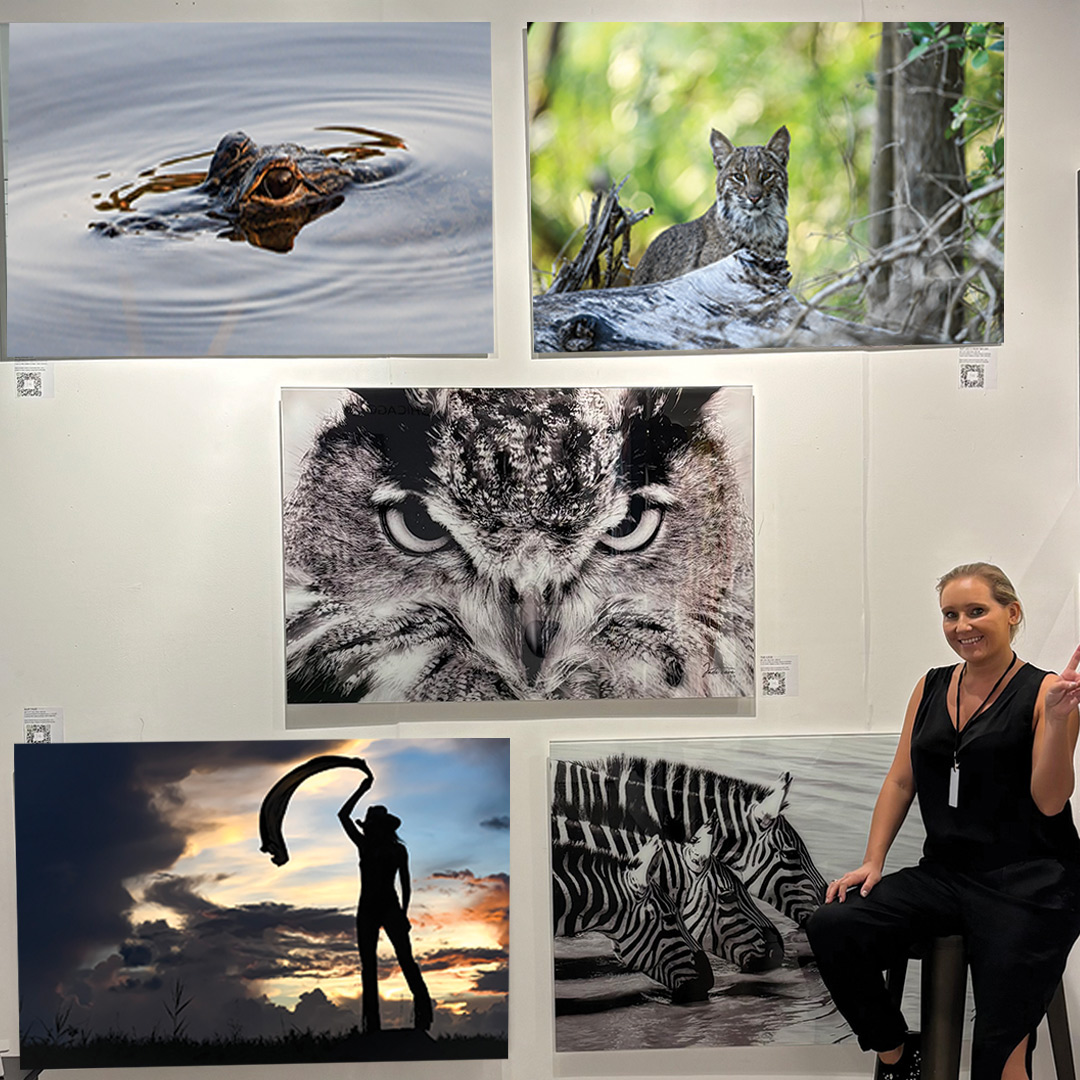
Born in the seaside town of Southend-on-Sea in Essex, in the United Kingdom, artist, designer, and wildlife photographer Jade Cave, 34, now calls Parkland home.

First moving from the U.K. to California when the COVID-19 pandemic struck, Cave and her husband, Mark, a businessman, hit the road. They traveled 3,000 miles coast-to-coast, stopping in Arizona at the Grand Canyon National Park, Kartchner Caverns State Park, and the city of Tombstone, and of course, they visited the London Bridge in Lake Havasu City.

Arriving in Miami, they rented a house in Hallandale Beach, but it was love at first sight once they discovered the city of Parkland. “I found where I want to be,” Cave says. “It’s so beautiful here; I love all the nature.”

Growing up, Cave’s family had a home in South Africa, and they traveled there often, taking in the wildlife on safari. “Being blessed to have a house in South Africa, to have a connection with nature and experience amazing landscapes, I’ve always had a passion for the outdoors,” Cave says. The climate and landscape of Florida and the Everglades ecosystem are reminiscent to her of Africa.

With her D850 Nikon camera, Cave frequents Everglades National Park, the Arthur R. Marshall Loxahatchee National Wildlife Refuge and the Green Cay Nature Center & Wetlands in Boynton Beach, and Wakodahatchee Wetlands in Delray Beach, where she captures birds, alligators, butterflies, and the flora and fauna.

“I love being outdoors in nature and being in the moment,” says Cave, who coincidentally was born on Earth Day.

Her photograph of Bunker, the Parkland burrowing owl who lived in her community on the 18th hole at the Parkland Golf and Country Club, is on display at the British Consulate in Miami. Another, a close-up of a long-neck white swan, titled “Reflections,” from her “Glades on Glass” collection, captures the bird with its long, S-shaped neck dipping into the water, its image reflected back.

One of her favorite images is a head-on close-up of “Fluffy,” an alligator who is anything but. To capture the image, Cave waited and watched patiently. After five hours, Fluffy jumped and the waters parted.  

Cave’s camera clicked, and she caught the shot of the day—the waters rippling around Fluffy’s giant head, his black eyes glistening in the water and his gaze staring intently at the viewer. “I love the way I captured the water moving around its face and the way the eyes stare at you,” she says.

Once she captures the shot, Cave feels elated. “When I look at my work, it takes me right back to the moment and I get an adrenaline rush,” she says. “It’s quite exciting and rewarding.”

She especially loves capturing close-ups and the emotions of the animals. She often shoots in black and white to create a stronger presence or to highlight the texture of the animal’s features.

Her photograph of a baby monkey asleep in its mother’s arms, titled “Nap Time,” from the “Spirit of Africa” collection, is an example of this black-and-white technique.  

Cave will use a zoom lens to capture an eye or to frame a face. “It enhances the details and affords a different perspective,” she says.

Self-taught, Cave honed her technique by watching YouTube videos. She rarely enhances her photographs or uses Photoshop and only edits them to crop or sharpen the image. “What you see is what you get,” she says.

Last November, Cave traveled to Tsavo West National Park in Kenya (“Africa is part of my spirit”), where she photographed monkeys, zebras, giraffes, and the African plains.  

These images, along with ones she took in the Everglades at Flamingo Campground, were on display at the Spectrum Miami Art Fair last December during Art Week in Miami. She donated 100% of her profits to the Alliance for Florida’s National Parks, where she volunteers her efforts to raise awareness about the national parks.

“Jade exudes such positive energy,” says Lulu Vilas, executive director of the Alliance. “She can light up a room with her exuberance.”

The Alliance for Florida’s National Parks, which includes Big Cypress National Preserve, Biscayne, the Dry Tortugas, and Everglades National Parks, raises funds and awareness to support the programs and activities of these national parks.

“Jade is never happier than when she is out in nature photographing wildlife and watching people enjoy the natural world,” Vilas says.  

“We’re fortunate to have her,” she says. “She is extremely talented and has a generous spirit.”

For Cave, being part of Art Week in Miami was a dream come true and a highlight of her career.

To celebrate becoming a U.S. citizen last August, Cave put her feelings into a creative photo shoot, hiring a model to dress as a cowgirl, representing the spirit of the U.S. The photograph, titled “Freedom,” depicts a model wearing a cowboy hat, her back to the camera, her left arm upraised swirling an American flag.

Shot in silhouette at the Arthur R. Marshall Loxahatchee National Wildlife Refuge, against a dramatic ombré sky of grays, blues, and oranges, the photograph speaks to themes of freedom and personal reinvention, reflecting Cave’s journey and her heartfelt connection to her subjects.

“It’s my homage to America and the freedom of America,” says Cave, who learned the Bill of Rights and the Constitution as part of her journey to becoming an American citizen.

She admires the work of Big Cypress National Preserve photographer Clyde Butcher and English wildlife photographer David Yarrow, and she had the opportunity to have dinner with Yarrow three years ago in Miami.

“He inspired me to keep pursuing what I love,” says Cave, noting that it was Yarrow who suggested she use a Nikon D850.

Now she encourages others to learn the craft as well as they can, to persevere and differentiate themselves by capturing their own vision. 

While in school in England, Cave studied fashion design and fashion photography. In 2009, she won the young retail designer competition.

She also studied Rogerian person-centered existential therapy and applies those principles to artwork she creates, finding expression and meaning to create word art, sketching an image using quotes, phrases, or inspirational speeches of iconic moments in history.

Her whimsical drawings of the Beatles’ “Abbey Road” album cover is a testament to her ability to merge visual and verbal expression. Depicting the four Beatles crossing the iconic walkway, the words from their lyrics—“Take a Sad Song and Make It Better,” “Baby, You Can Drive My Car,” and “Can’t Buy Me Love”—define the images.

Dyslexic as a child, Cave felt ashamed not to read or write well, and she says, “Language was my enemy.” Now, she embraces words, and they have become her medium for transformation and self-expression.

Cave is happy that people like both her photographs and her word art enough to hang on their walls.

This fall, she will exhibit her work at Silver Spring State Park in Silver Spring, Fla., and has her sights set on future gallery shows.

“There is always something new to learn and the art is forever evolving,” she says. “This adds to the excitement of being a photographer.”

Cave is excited to see where photography takes her. “My work comes from my heart,” she says. “I take something in life and transform it into art as a way to project how I see things. I give others a different view of creation.

“That, to me, is what I call art,” says Cave.

Visit Jade Cave on Instagram or at jadecaveart.com.

Music is on the menu with the band Vocal Menu

When somebody loves you
It’s no good unless he loves you
All the way

So begin the lyrics to Frank Sinatra’s classic song “All the Way,” on the 1961 album of the same name, and which he performed virtually with Celine Dion live in 1999 at the Millennium Concert in Montréal, Québec.

A classic love song, spotlighting both singers’ musical styles, it is a favorite to perform for local singers Catalina Prado, 29, and Carlos Iturrieta, 35, both classically trained vocalists and now members of the band Vocal Menu. Other members of the band include Jesús Herrera on guitar, Sandro Montoya on bass, and Oscar Bravo on drums.

“The song is so beautiful—I’m obsessed with it,” says Prado, the lead female vocalist, who admires both Celine Dion and Sandra Brightman.

Prado, a soprano, and Iturrieta, a bass-baritone, met in their native Chile during an audition backstage at the historic and iconic Teatro Municipal de Santiago, where they were asked to perform a duet from Mozart’s comic opera, “The Marriage of Figaro.” Both nervous for the audition, Prado sang the lead female role of Susanna while Iturrieta sang the lead male role of Figaro, two servants who fall in love and eventually marry, despite the obstacles in their way.

Luckily for Prado and Iturrieta, nerves gave way to something more. As Prado remembers, the couple, like their characters, fell in love during that audition, in a case of life imitating art.

And while they are not yet married, since that fateful day in November 2018, the couple has been singing together and two years ago relocated to Boca Raton from Chile, to be near family in Parkland.

Iturrieta studied at the Institute of Musical Arts in Concepción, Chile, under the tutelage of Chilean baritone Pablo Castillo and alongside renowned Chilean pianist Verónica Torres. A four-time scholarship winner, he studied under Chilean opera singers Rodrigo Navarrete, Oscar Quezada, and Christian Senn, as well as Italian baritone Alessandro Corbelli and Chilean soprano Pilar Aguilera.

In 2018, Iturrieta was a semi-finalist in two international competitions—in San Pedro de la Paz, Chile, and in Trujillo, Peru. The following year, he made his opera debut in Puccini’s “Madama Butterfly,” at Chile’s Biobío Regional Theater, in the role of the Imperial Commissioner, conducted by Italian maestro Lorenzo Tazzieri. And In May 2019, he was selected as a semifinalist in Plácido Domingo’s “Centre de Perfeccionament,” in Valencia, Spain.

And while Iturrieta studied opera formally for six years in IDAM, he, like Prado, realized he didn’t want to limit himself to one genre of music and felt that instead of people coming to him to hear him perform, he could bring his music to the people.

One of Iturrieta’s long-term goals is to found a performing arts center where people can come hear him perform. In addition to opera, he enjoys singing ballads, especially American music from the 1950s and ’60s, such as Frank Sinatra, Elvis Presley, Dean Martin, Andy Williams, and Nat King Cole. “The crooners,” he says.

Other musical influences include American opera singer Samuel Ramey and Russian opera singer Dimitri Hvorostovsky, who passed away in 2017.

Prado has an equally impressive background, beginning her musical journey in 2013 at the Symphonic Choir of the University of Chile, under the baton of conductor Juan Pablo Villarroel, where, at 17, she was the youngest student admitted to the program.

She studied under Chilean soprano Claudia Pereira, later graduating from the Conservatory of Music of the Universidad Mayor, in 2022. In 2018, Prado won the prestigious Amigos del Teatro Municipal de Santiago scholarship, and she performed in many of Chile’s top theaters.

Growing up, Prado attended a Waldorf School where music and the arts were an integral part of the school curriculum. She knew at a young age that she loved to sing, and to sing with others as part of a group. Finding success at an early age, she credits her mother’s prayers as having “something to do with it.”

Not one to leave fate to chance, Prado had a backup plan if her singing career didn’t take off: to become a doctor. “I always have a Plan B,” she says.

With a “strong passion” to heal people, Prado says both physicians and musicians are healing in their own way.

With a far-reaching repertoire, including arias, operettas, chamber music, popular music, and musical theater, Prado is not content to remain in one genre, and she’s looking to find her sound. “I want to explore my own sound without limitations,” she says, noting that to sing opera, one needs to conform to strict vocal techniques and requirements.

“I want more freedom,” she says, finding that freedom in musical theater and contemporary music, especially cross-over music.

“Cross-over music bridges different genres and worlds and is a way to bring people together,” Prado says. “Music is for everyone.”

Her dream, she says, is to be able to create unforgettable musical moments for everyone.

Prado cares for her voice with a healthy lifestyle that includes taking precautions against becoming sick; not eating spicy foods late at night, which can cause reflux and harm the vocal cords; and staying hydrated. She trains her vocal cords with warm-ups and scales every day.

Her dream is to play the role of protagonist Christine Daaé in “The Phantom of the Opera,” live on stage.

While the couple perform numbers from the musical, such as “The Music of the Night,” and others, Prado likes to imagine herself performing on stage in front of a large, enthusiastic audience.

“That would be unbelievable,” she says. She hopes to make professional connections here in South Florida to realize that dream.

The two also hope to make a name for themselves and the Vocal Menu band. Last year, they participated in the city of Parkland’s 60th Anniversary celebration, opened for the band Sugar Ray, performed for Veterans Day celebrations, and performed twice at the Parkland Farmers’ Market at the Equestrian Center, once as a duo and the second last February with the full band.

As recently arrived members of the community, they hope these performances are only the beginning.

“We love what we do,” says Prado. “We get to share special and emotional moments with each other and our audience.

“It’s a unique and beautiful moment,” she says. “Isn’t that what makes us human?”

To learn more, visit vocalmenu.com or go to Vocalmenu on Instagram


https://theparklander.com/2025/03/27/music-is-on-the-menu-with-the-band-vocal-menu/

From Ironman to Centenarian – A Bodybuilder’s Legacy

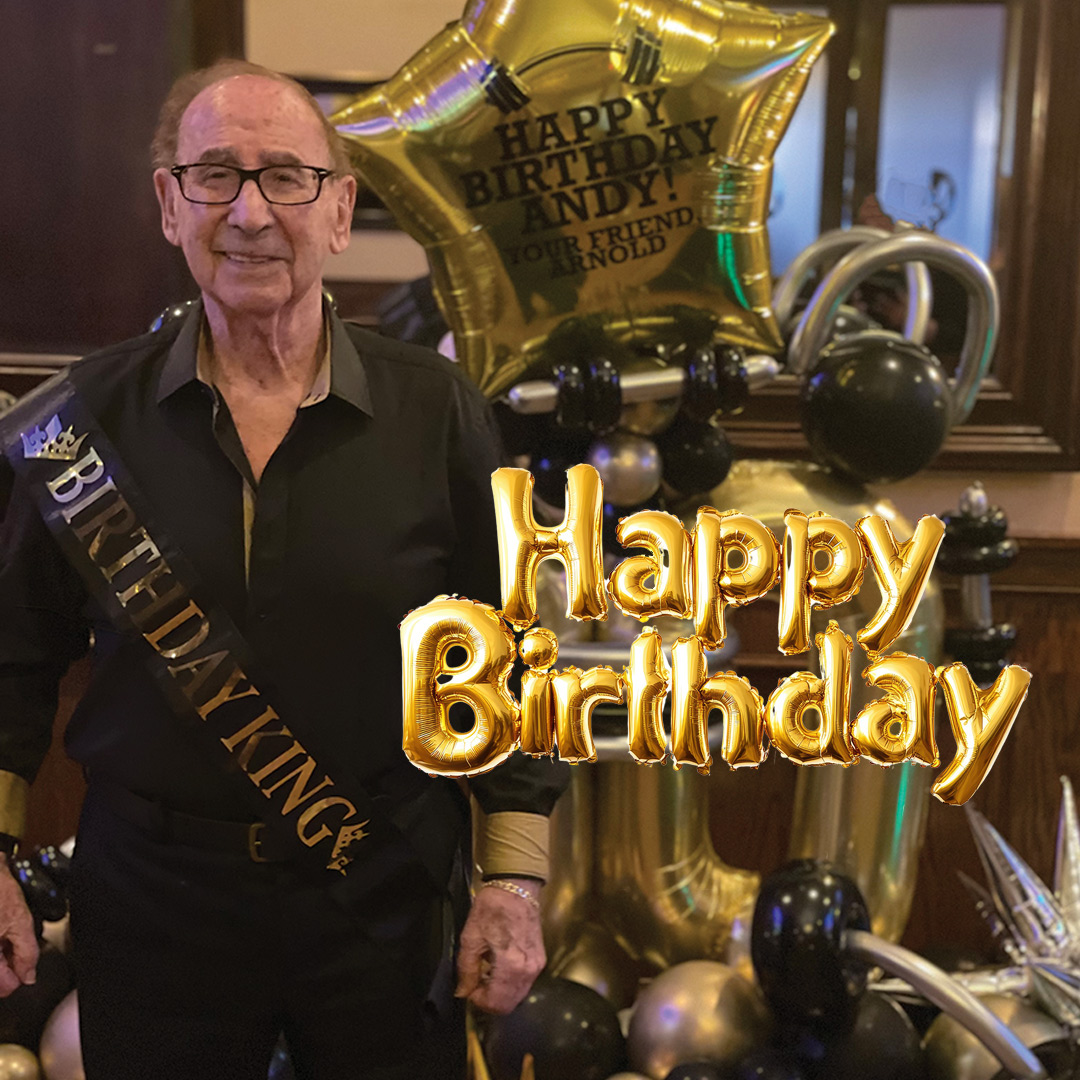
A lifetime commitment to physical fitness, healthy and drug-free living and a passion for bodybuilding has paid off for Parkland resident and WWII veteran, Andrew Bostinto, as he celebrated his 100th birthday on Jan. 11 by – what else – doing what he loves – working out at the gym.

His long and fulfilled life is defined by two passions – his three years spent in the army in the 101st Regiment, 26th Infantry – and his years devoted to bodybuilding.

In 1979 he founded the National Gym Association (NGA) a not-profit organization that supports the philosophy of natural strength training and bodybuilding with a mission to encourage drug-free athletes and is still active today.

He was the first in the industry to develop a personal trainer’s fitness certification program and in 2006 co-authored, “Become Your Own Personal Mental Fitness Trainer.”

He was friends with other well-known body-builders (or, as they called them at the time, muscle-men) Arnold Schwarzenegger, Lou Ferrigno and Jack LaLanne and in 1977, won the title of Senior Mr. America, at Madison Square Garden.

In 1963, Bostinto opened his own gym, the Olympia Gym and Health Club, in Queens, N.Y.

He lectured at Queens College on exercise and nutrition and personally trained many well-known celebrities, including Cyndi Lauper, Regis Philbin, Al Pacino during filming of the 1993 film, “Carlito’s Way,” and his favorite, Patrick Stewart from “Star Trek:  The Next Generation.”

He officiated at numerous national and international events, such as Mr. Olympia 1970-1971, and was a guest on many local New York television shows discussing physical fitness and bodybuilding.

In May 2025, he plans to earn the title of the “World’s Oldest Bodybuilder” for the Guinness Book of World Records in a competition in Deltona, Florida.

“Andy is still in great shape,” says his wife of 34 years, Francine Bostinto, 67, who is the current president of the NGA.  The couple, who met at Jacob Riis Park beach in Brooklyn, has been together 44 years and have one son, Dillon, 27, together.  Andrew Bostinto has a son (now deceased) and daughter from a previous marriage.

Aside from some knee and balance issues, Francine Bostinto jokes, “I take full credit for his longevity; this is what happens when you marry a much younger woman.”

Looking more like 75, than 100, Bostinto says when her husband wears his hat and medals, people mistake him for a Vietnam-era veteran, not a WW II veteran.  With smooth skin and no wrinkles (his mother lived to 99), Bostinto says her husband is a “good talker,” likes to watch TV, go grocery shopping and likes to cook eggs, pasta and burgers.

For Francine, he cooks her favorite pasta dish, pasta with green peas.

He doesn’t follow a special diet but his wife says he has a good metabolism and eats mostly anything.

In Joe Bonomo’s 1943 book, “Body Power,” Bostinto was called “one of 20 of the world’s most perfect super-strongmen,” and in 1972 at the age of 46 was featured in the magazine, “Muscle Training Illustrated,” where he talked about his diet and training regimen of leg presses, bench presses, parallel dips, sit-ups, shoulder, triceps and lat reps.

In December, the couple returned from a trip to Belgium, Luxembourg and Germany on the 80th anniversary of the Battle of the Bulge, (“the greatest American battle of the war”), Hitler’s last major offensive against the Western front, which paved the way for a Allies’ victory.

“This was the most meaningful event of my life,” says Bostinto about the experience, where he and other returning veterans, Louis Brown, Ed Cottrell, Jack Moran and Lester Schrenk, all of whom are between 99 and 102 years old, were treated like royalty and returning heroes.

“Going with Andy on this trip is the best decision I ever made,” says Francine Bostinto.  “These countries laid out their red carpet for these American veterans.”

Organized by Boston police officer and Iraq and Afghanistan War veteran, Andrew Biggio, author of “The Rifle,” Biggio is the founder of Boston’s Wounded Vet Run, New England’s largest motorcycle ride dedicated to severely wounded veterans.

Inspired by nostalgia and to honor an uncle and namesake who lost his life fighting in WWII, Biggio bought a 1945 M1 Garand Rifle, the most common rifle used in WWII, and had a neighbor, a WWII veteran, sign it.

This launched him on a mission to find the remaining WWII veterans and have them sign his rifle and tell their stories in his book.

Funded in part by a GoFundMe campaign which raised $32,814, Biggio, organized the trip to bring the American veterans back to the site of the battle in Bastogne, Belgium.

He told the Boston Herald in December, “What was important about this is that there isn’t going to be a 90th anniversary for these guys, same thing for D-Day. This was the last big anniversary for a big number of them.”

According to statistics from the Department of Veterans Affairs, fewer than 1 percent, or roughly 66,000, of the 16.4 million Americans who served during WWII are still with us today.

“We’re both so grateful to have had this opportunity,” says Francine Bostinto, where in a whirlwind week, they met the king and queen of Belgium, the duchess of Luxembourg, Senator Bob Graham of Florida, the mayor of Bastogne and other dignitaries, Helen Patton, the granddaughter of General George Patton, actors from the film, “Band of Brothers,” took part in a parade, visited a castle and the Bastogne War Museum and met with many locals, who Francine Bostinto says were “profusely grateful” to the Americans.

“It was “overwhelming” Andrew Bostinto says.  “There was so much gratitude.”

He was particularly moved by the fervor of little kids who waited in long lines and turned out to shake his hand and buy an autographed copy of “The Rifle,” which he and the other veterans signed for more than five hours.

In a post from Facebook on Dec. 15, reflecting on that day, Francine Bostinto writes, “Wherever we go, people applaud and bring gifts.”

They also visited Wereth, Belgium and a memorial to 11 American Black soldiers from the African American artillery battalion, a segregated unit, who were tortured and massacred by German SS troops on Dec. 17, 1944, in an event known as the “Werenth 11 Massacre.”

They appeared on the front page of many local publications, including the German newspaper, “Bild,” (“Der Terminator und der U.S. Veteran (99)” with the sub-heading, “Arnie Owes his Career to this Friendship.”

“I think the Belgian people remember tremendously,” Biggio says in a video post. “They crowd the streets, they crowd the museums so that we can’t even walk because they just want to get a glimpse of an actual WWII veteran who liberated them.”

“They’re taught at a very young age that these guys are superheroes,” he says.  “Most of them want autographs to keep and to wear on their jackets.”

Being a hero was not on Bostinto’s mind, but being focused and methodical was.

Training since the age of 13, Bostinto still works out on the treadmill and does weight training, including his favorite lat pull-down, five days a week at the Planet Fitness in Coconut Creek.

The self-described, “very analytical, very organized and very disciplined” bodybuilder and veteran who was born on the Lower East Side of Manhattan and grew up poor in Brooklyn, shares the wisdom he’s garnered over a productive and meaningful century of life.

“Know yourself,” he says.  “Know your priorities and your values and who you are innately.”

Nolan McMurry, 25, the manager at Planet Fitness and a self-described “WWII fanatic” says, “As a WWII veteran, Andy is a piece of living history.  I’m honored to know him and always enjoy hearing his stories about his time serving overseas.”

McMurry says the gym plans to mark Bostinto’s birthday with cake and a celebration.

“Andy had an amazing career as a professional bodybuilder and with founding the NGA and he’s still dedicated to helping people, working out and staying fit,” he says.  “He always has interesting stories to share and I always learn a lot from him.”

“He’s one of a kind and truly a living legend.”

Third annual music for a cause Musicians raise money to fight Parkinson’s disease

Singer Jade Ciel T of the band Sippin Fire, singer-songwriter Cheryl Arena of the Good Bread band, and guitarist Roderick Kohn are just a few of the musicians volunteering their time and joining forces to raise funds for the 3rd Annual DOB Parkinson’s Charity event on Dec. 8 at Sharkey’s Bar and Grille.

The local nonprofit was founded in 2012 by musician and Oakland Park resident Dan O’Brien, 70, along with his friend Wayne Belfer, 67, a retired senior executive of an auto insurance company who’s now living in Boca Raton.

The charity receives 100% of the proceeds and provides support and resources to individuals and families affected by Parkinson’s disease.

“It’s a big honor to be part of this fundraiser and to help find a cure for Parkinson’s disease,” says Arena, lead singer for the high-energy rock and blues band.

Arena, whose brother John also suffers from Parkinson’s, is grateful to O’Brien, who helped start her career in South Florida. “It’s personal,” says Arena, who is performing for the second year at the event.

“It hits home,” she says. “We’re thankful to all these musicians who come out on their own time and own dime and give of themselves to support this cause.

“Dan is a great guy and great musician, and we all want to do what we can,” says Arena.

The ’70s-themed night features a lineup of six duo acts, including blues and soul singer Dottie Kelly and Darrell Raines, Shannon Battle and Tom Piano, Dean Summers and Liz Sharp, Jade Ciel T and Giaco Pop Rock, and Cheryl Arena and Roderick Kohn, and five solo acts, including blues legend J. P. Soars, Ericson Holt, Billy Livesay, Sara Ann, and Jose Almonte from Havoc 305.

“Moving here from New Jersey, where we had similar charities, I noticed there wasn’t anything like it down here,” says Belfer. “Dan and I decided to put something together, and he was all for it as long as I could do most of the work.”

The two hope to eventually grow and expand the charity to help many people who need it and to create a worldwide network of communities, so that no one has to face the challenge of Parkinson’s disease alone.

O’Brien, a married father of two grown sons, was diagnosed with Parkinson’s in August 2012. “This disease is horrible,” he says. “It really sucks.”

Signs of Parkinson’s disease include motor symptoms such as slowness of movement (bradykinesia), stiffness (rigidity), and resting tremors.

According to the Michael J. Fox Foundation for Parkinson’s Research, approximately 1 million people in the U.S. and more than 6 million people worldwide are affected by the disease.

To mitigate symptoms, experts suggest eating a healthy diet, exercising, educating yourself about the disease, finding a movement disorder specialist and determining the right treatment plan, building a support system, staying socially active, and getting involved in the Parkinson’s community.

Many patients are treated with the medications carbidopa and levodopa, a combination medicine used to treat the stiffness or tremors associated with the disease.

O’Brien had an “amazing career” in music. He knows and played with many big-name musicians—including the Lovin’ Spoonful, Peter Noone of Herman’s Hermits, and locally with the band Shakey T and with recently deceased bass player Chuck Fiori, who played with John Denver.

He now has a stringent exercise routine: He walks, goes on the bike, has a gym in his home, does balance and strength training, and goes to physical therapy twice a week.

He still works in his home studio and continues to play guitar and write songs. “I’m hoping to be a 70-year overnight success,” he jokes.

Suffering from a “tremor-dominant” form of Parkinson’s, in 2020, O’Brien underwent a surgical procedure known as deep brain stimulation to mitigate the movement disorders associated with the disease.

He had great success with the procedure and says for him, it is a “game-changer.” He went from taking 12 pills a day to taking none and is now able to brush his teeth, shave, button his shirts, and play his guitar (to prove his point, he performed a short riff on the guitar).

“Parkinson’s disease is not a death sentence,” O’Brien says. “You don’t die from the disease; you die with it.”

Keeping a positive attitude is key.

“You have two choices: adapt or give up,” O’Brien says. “And I’ve got way too many things to do, including working to find a cure for the disease.”

The 3rd Annual DOB Parkinson’s Charity event will be held Sunday, Dec. 8, from 5:15 to 9:15 p.m., at Sharkey’s Bar & Grill, 10365 Royal Palm Blvd., Coral Springs. Advance tickets are recommended and can be purchased for $35 at dobparkinsonscharity.com. For more information, visit sharkeysfl.com or call (954) 341-9990. To learn more about the charity, visit it on Facebook or at dobparkinsonscharity.com.