Casinos are a major center for local entertainment in South Florida. We are home to several casinos, the most prominent is Seminole Hard Rock with its newly finished hotel shaped like a guitar.
Locally, Seminole Casino at Coconut Creek has been an entertainment center off 441 and Sample Road. When I heard it was reopening, I felt it was worth checking out what the New Normal of the South Florida casino looks like.
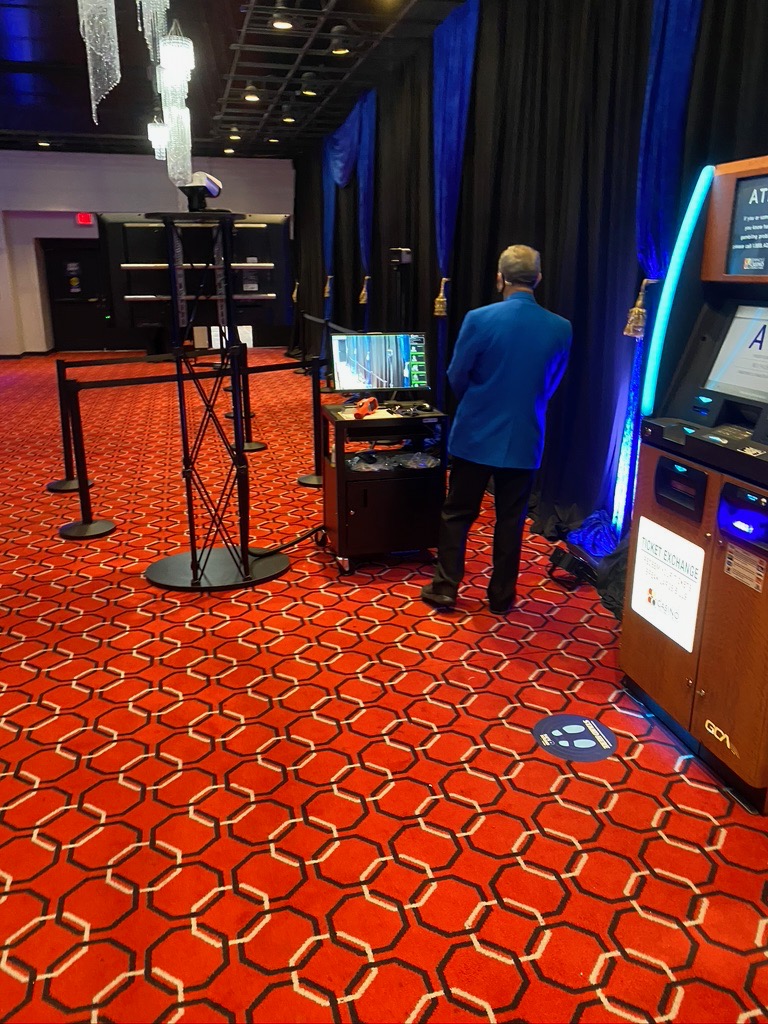
As you can see, the new entrance routes you to a thermal scanner, where your temperature is monitored.
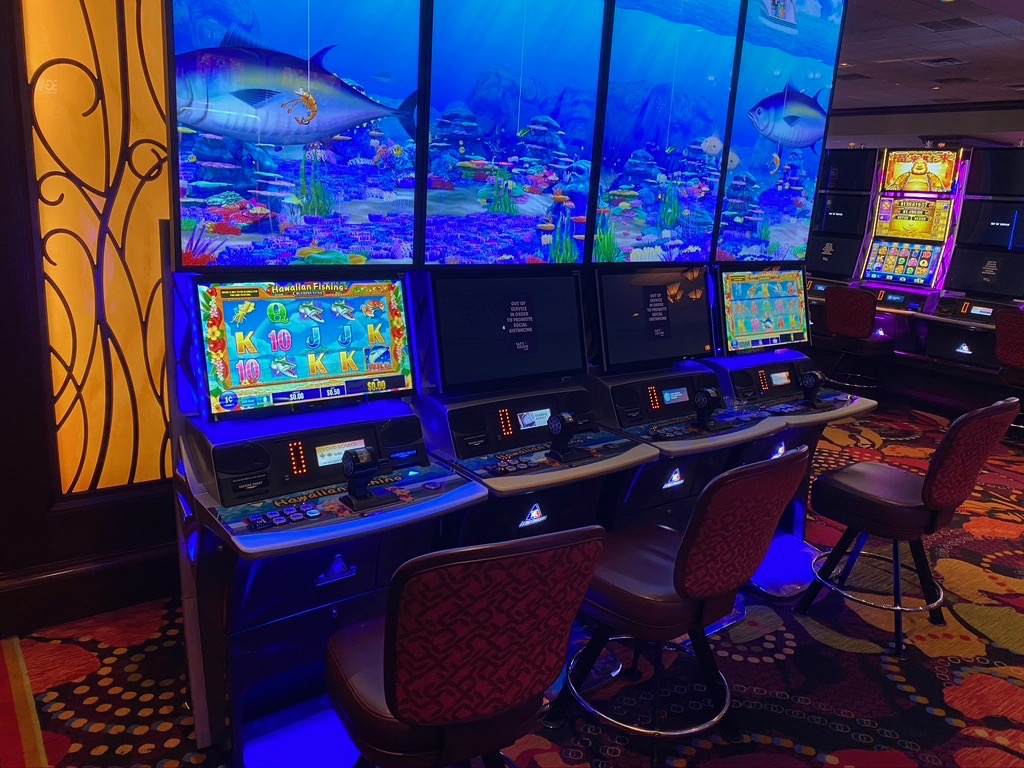
For slot machine players, you will find every other seat disabled to maintain the social distance while a crew of cleaning staff regularly cleans the area.
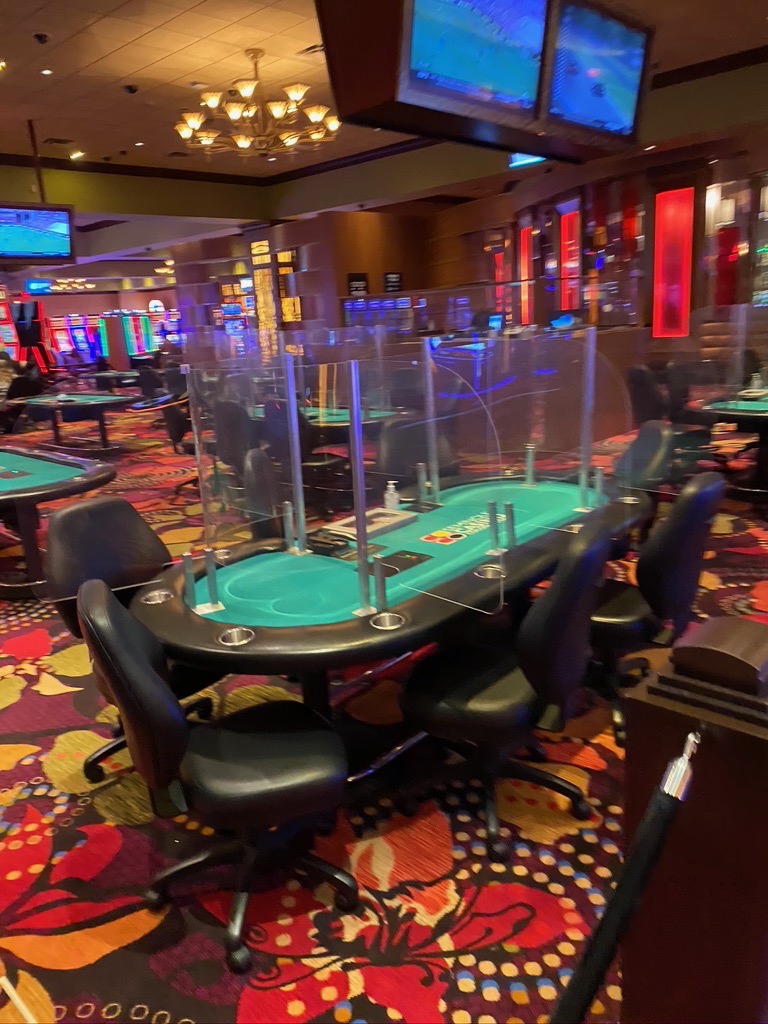
If you are looking to play a table game, the dealer will welcome you to a private plexiglass booth with a squirt of hand sanitizer. Then when you leave, a staff member will be immediately wiping down your former play area.
According to the hotel/casino, the air is constantly purified and disinfected via their Atmos™ bipolar ionization system. Combined with 50% capacity, it appears the Seminole Casino is trying their best to minimize all risk for customers.
Masks are mandatory and will be provided by staff if you don’t have one. Dealers will remind you if you are not covering your face during play.
For elderly customers, one challenge you should prepare for is more walking. Staff will be directing you through a predefined path through the building, and to the cashier. So expect to walk more in an attempt to maintain social distance.
The atmosphere is no different than pre-pandemic with the noises from brand new slot machines drawing you to their giant displays. Yet, every time you sit down at a table in your own private booth, you are reminded, this is the New Normal for the next while.
It feels strange… After months of cocooning in my home, I ventured out to an event with strong apprehensions. What is the expectation, what is the new norm, when you meet strangers?
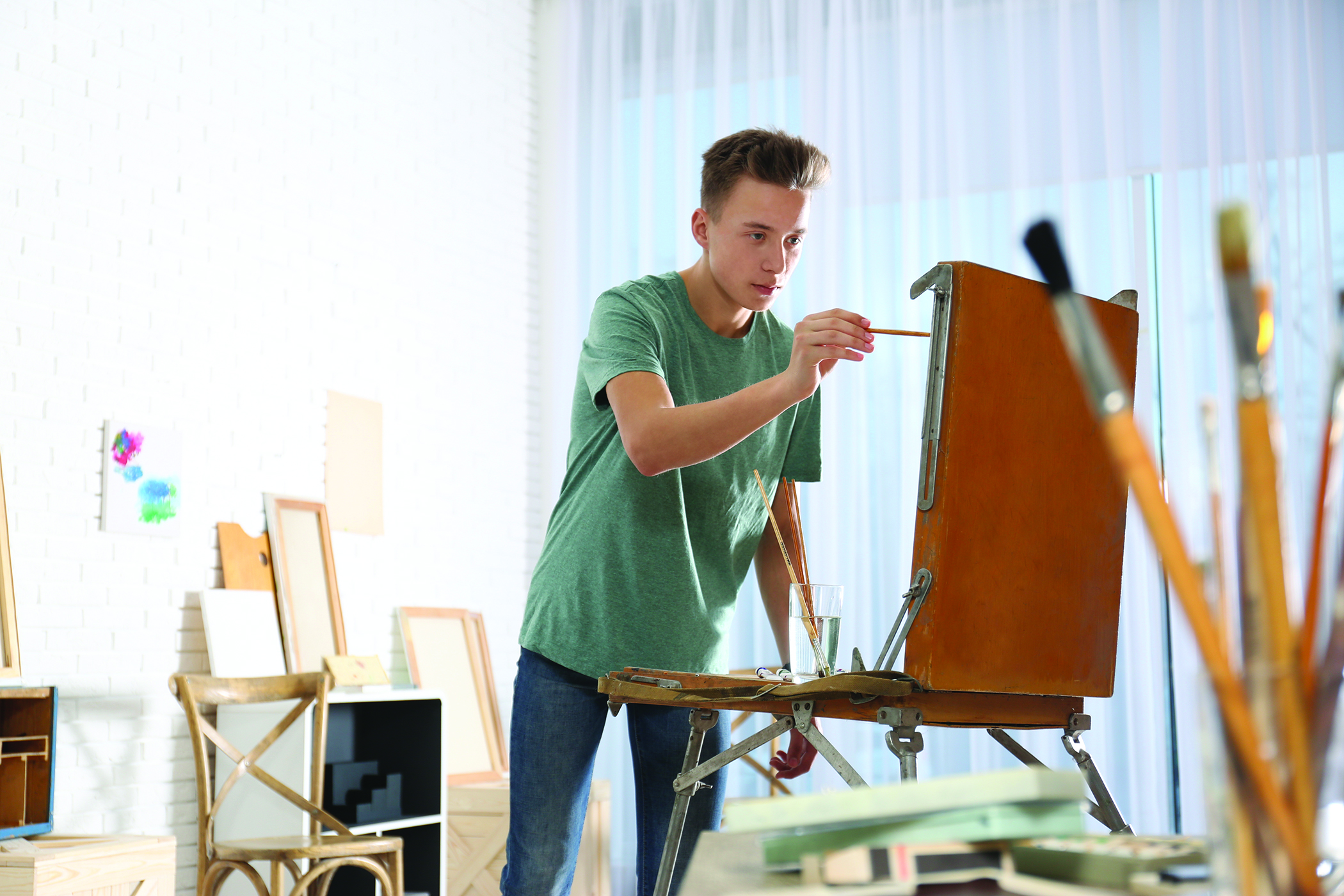
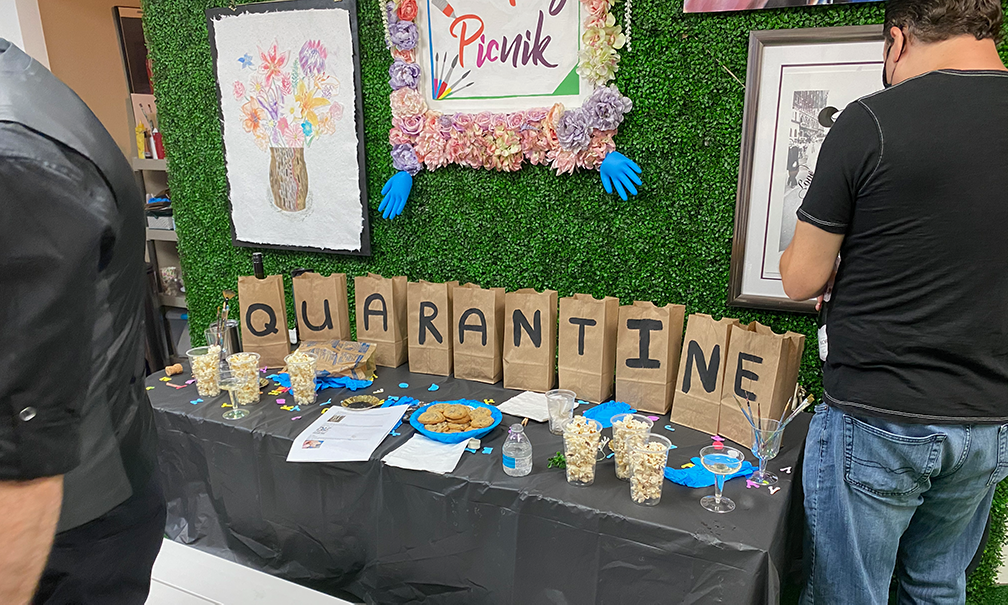
Art was an early casualty of the pandemic response. Not often associated with an essential activity, these exhibitions effectively fully shut down. With the reopening of south Florida, a local event in Fort Lauderdale, is showing works by local artists revolving around the quarantine theme. Desiring to see what the New Normal will look like for the artist community, I took my mask, and embarked on my longest journey since the COVID-19 pandemic started.
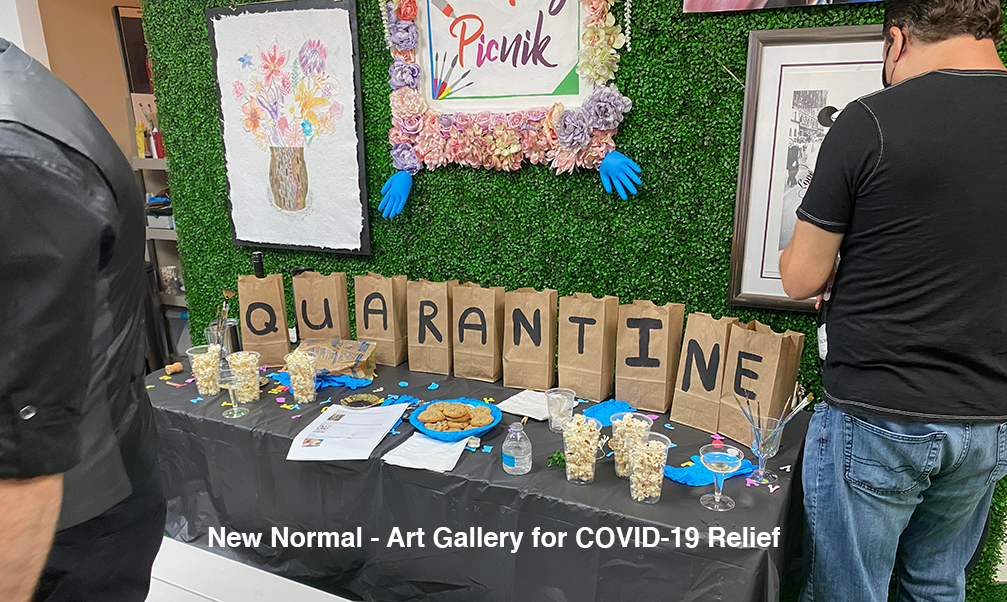
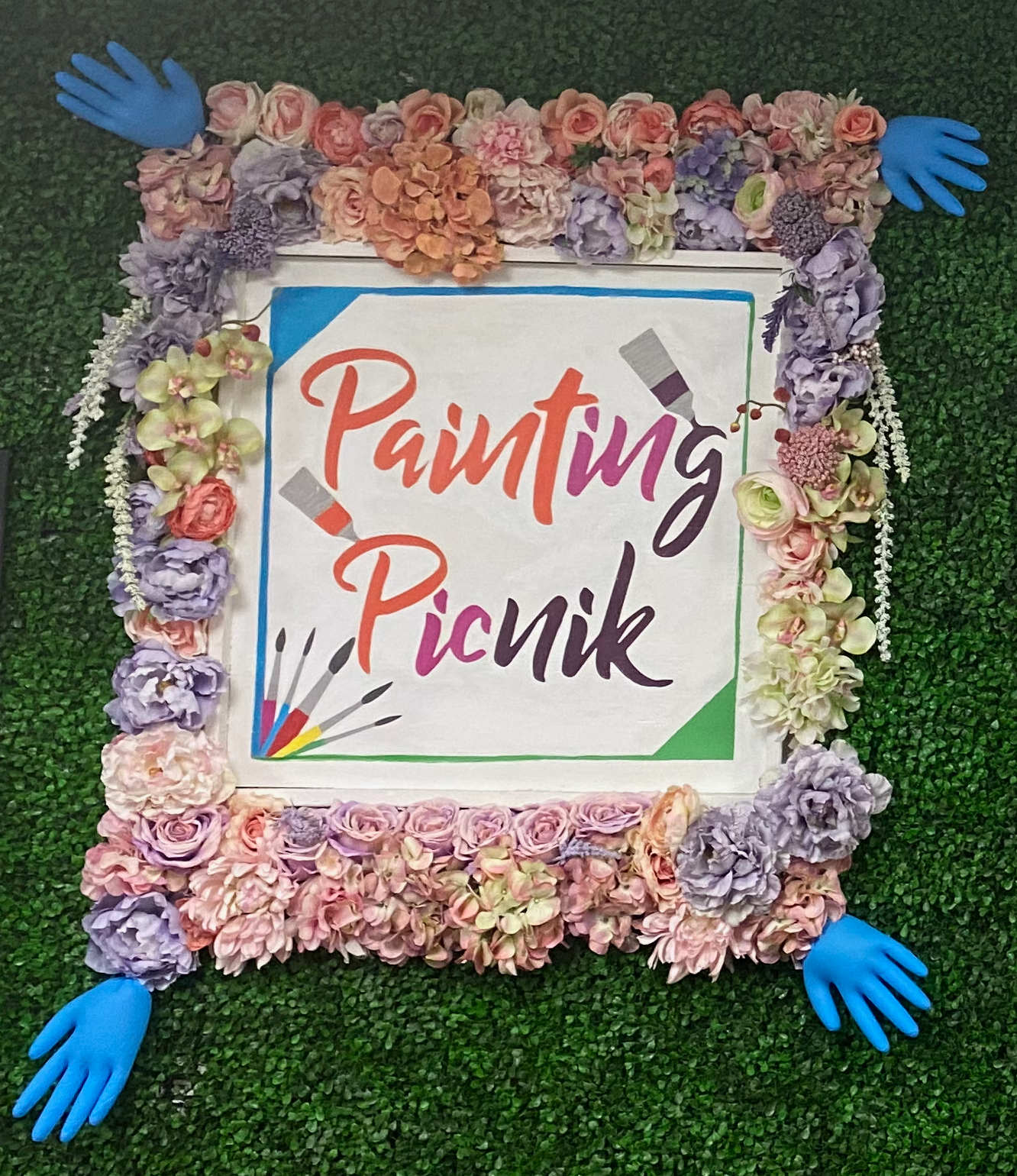
Artists picked a character from the word quarantine, to create art capturing the mix of emotions associated with the lockdown. The organizer, Chen H. Bitton of Painting Picnik, wanted to give the artists who have been in isolation for the past several months a venue to show the work they have been creating. Proceeds from sales will go to help fund COVID-19 relief.
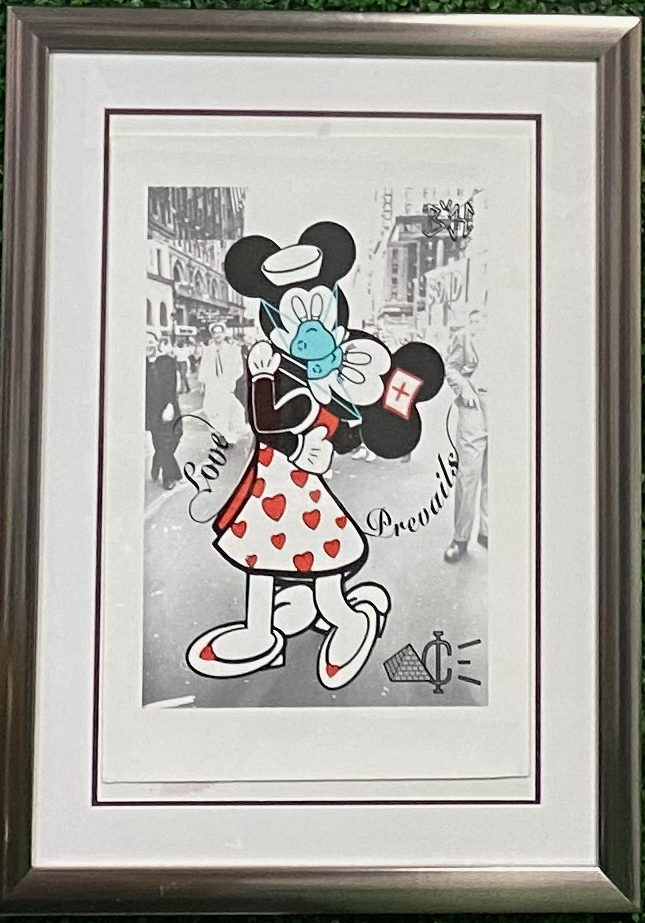
Caption: LOVE PREVAILS By Chen H. Bitton and Joey Ace
The exhibit, showing between June 13 to 17th at the Painting Picnik in Fort Lauderdale, is one of the first in the area. The public is invited to appreciate the works and discuss with the artists about their recent experiences.
Everyone at the first night of the exhibit was cautious, even though many know each other well. People overcame the uneasiness quickly by discussing the works in the exhibit. Everyone enjoyed being able to chat with each other about the works of art around us and share recent experiences.
For Painting Picnik, the gallery and studio has been open to clients by appointment. Clinics are still being held, for individuals or families. More events are starting to get planned, so please check in with Chen for details if you are interested in taking a class.
The COVID-19 pandemic is having a drastic impact on the art world. Social distancing has separated the artists and eliminated opportunities to gather and share. Patrons are also often staying home. I hope with this initial kick off, more patrons and artists will start defining the new norm for the art community.
Like all things new, we will feel strange for a while. Art will thrive, the stress of 2020 will surely be explored by artists. I believe many masterpieces have or will be produced, and I look forward to appreciating them… And reflecting.
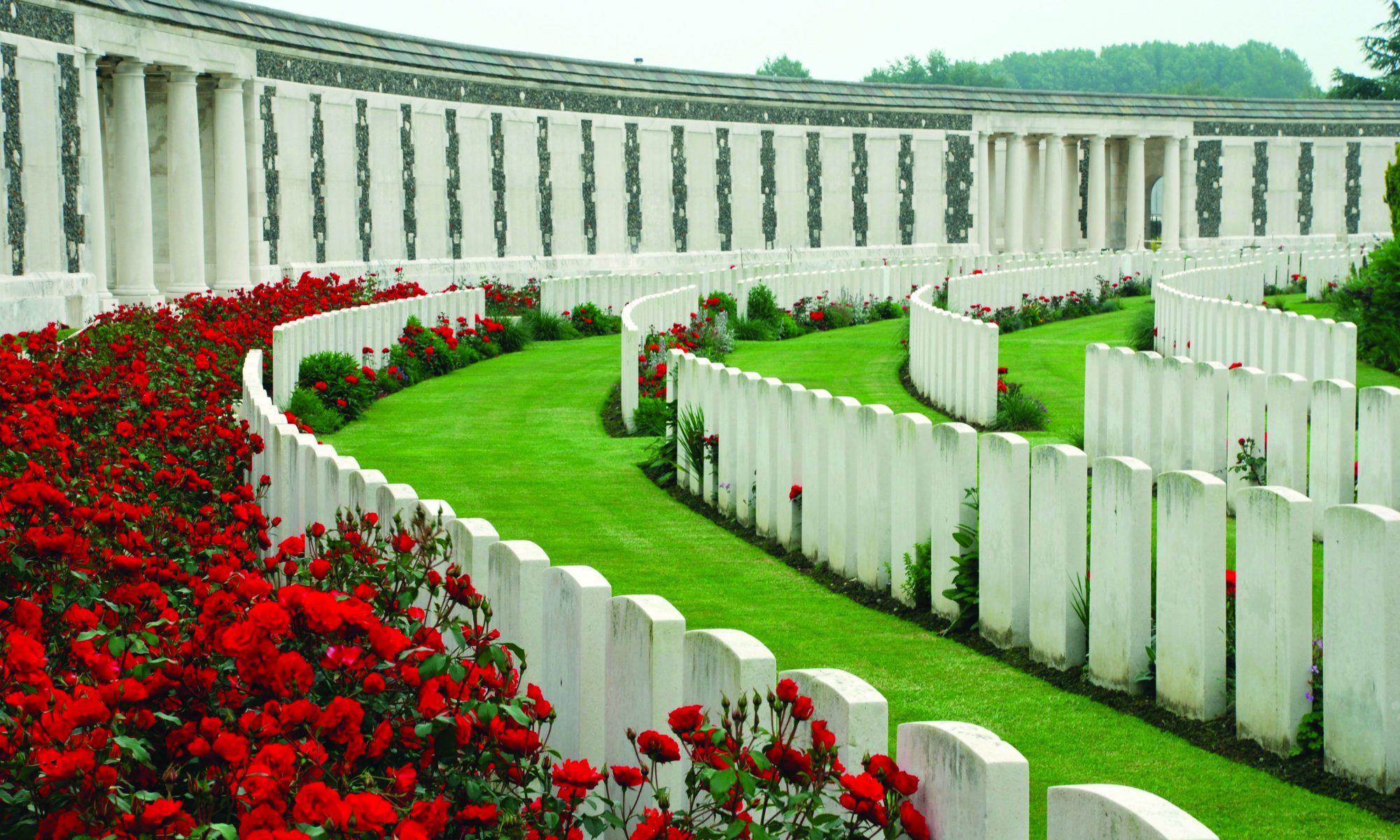
In Flanders Fields the poppies blow Between the crosses, row on row, That mark our place; and in the sky The larks, still bravely singing, fly Scarce heard amid the guns below. We are the Dead. Short days ago We lived, felt dawn, saw sunset glow, Loved and were loved, and now we lie, In Flanders fields. Take up our quarrel with the foe: To you from failing hands we throw The torch; be yours to hold it high, If ye break faith with us who die We shall not sleep, though poppies grow In Flanders fields.
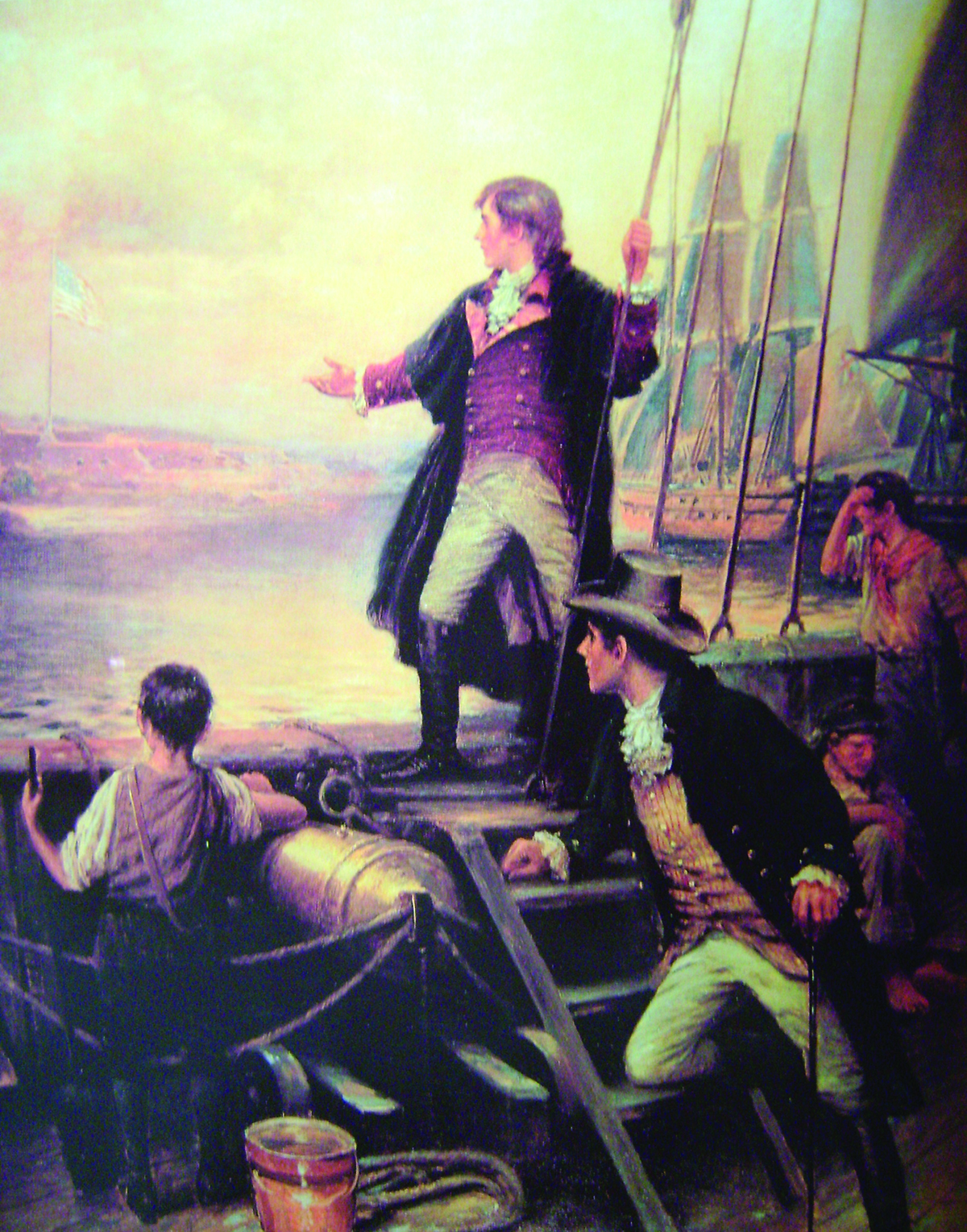
“In the spring of 1915 bright red flowers began poking through the battle ravaged land across northern France and Flanders (northern Belgium),” Barbara Maranzani wrote for history.com.
“Canadian Lieutenant-Colonel John McCrae, who served on an Allied artillery unit, spotted a cluster of the poppies shortly after serving as a brigade surgeon during the bloody Second Battle of Ypres.
“The sight of the bright red flowers against the dreary backdrop of the war,” she continued, “inspired McCrae to pen the poem, “In Flanders Fields,” in which he gives voice to the soldiers who had been killed in battle and lay buried beneath the poppy-covered grounds.”
The United States was not to enter the war for another two years, in April 1917. It was the month and year my father was born in Buffalo, N.Y. It was exactly one year before my wife’s father was born in St. Louis, MO. Archie and Bob.
Both served bravely in World War II: My wife’s father building hospitals for injured soldiers across Europe; my father at the controls of an M4 Sherman tank prowling Nazi-occupied Czechoslovakia. My wife’s mother, Pearl, born in Chicago in 1923, also served overseas in the U.S. Army during the war. That’s where Pearl met Bob.
Archie, Bob and Pearl were part of what Tom Brokaw called “The Greatest Generation.” They were among those who returned to their families.
This month we honor all the men and women who didn’t make it home, who gave up their lives in too many wars.
Earlier this year, before Covid-19 struck, Memorial Day events had been planned in communities throughout Broward and Palm Beach counties.
The “better part of valor,” however, as Shakespeare’s Falstaff reasoned in Henry IV, Part I, might still have us in stay-at-home mode at the end of the month.
One hundred years ago the country was still trembling from the devastation of the Spanish Flu. It killed an estimated 675,000 Americans between 1918 and 1920, more than were killed during the Civil War.
It was that same Civil War that sparked Union General John Logan to establish “Decoration Day” on May 30, 1868 to honor the estimated 620,000 who died in the four-year struggle. The name was later changed to Memorial Day and set for the last Monday in May.
One hundred years ago there were Memorial Day celebrations throughout Florida — in Tampa, Miami, Orlando — but at least one nearby city chose a different path.
“No Plans For Observance of Memorial Day,” read a headline on the front page of the Palm Beach Post, May 18, 1920.
“No preparations are under way for observance of Memorial Day,” the story read. “There is no post of the G.A.R and no organization of the Confederate Veterans or Spanish War Veterans” planning events for the day.
The G.A.R. was the The Grand Army of the Republic, the fraternal organization composed of veterans of the Union Army, Navy, Marines and the U.S. Revenue Cutter Service who served in the American Civil War.
After World War I Memorial Day was expanded to honor Americans killed in all wars. It became an official federal holiday in 1971.
This year, this month, again for “the better part of valor,” the Indianapolis 500, traditionally held on Memorial Day, has been postponed to August 23.
Still in its infancy a century ago, the race was held as scheduled on Monday, May 31. It was the race’s eighth running at The Brickyard.
Gaston Chevrolet, brother of the man who started the Chevrolet car company, won the race, posting an average speed of 88.6 miles per hour. The average speed at the 2019 race was 175.8 miles per hour.
Whatever Memorial Day events are allowed this difficult year and whomever you’re with, the Parklander joins all of you in honoring those brave men and women who made the ultimate sacrifice for their country.
We are all in agreement that COVID-19 has made a drastic impact on our daily lives. From schools to businesses, all the way to future vacations and concerts, everything has been put on hold. What does this mean for upcoming weddings?
April to June is typically a popular period of time where couples choose to get married. It can take anywhere from six months to a year or more to plan a wedding. This time in the couple’s life can be stressful, tiring but also exciting, as they prepare for their special day.
All this stress is not without reward. You get to plan the best day for you and your future spouse’s life. In a normal situation, a wedding is the culmination of months of planning, resulting in a celebration of the union between two people. This union is highlighted by beautiful bouquets, gorgeous dresses, and cake – stunning and delicious.
As the maid of honor for my older sister’s wedding, I was disappointed to find out that the venue for her wedding had to close because of the quarantine. My sister had to cancel her dream wedding.
Understandably, she became frustrated, worried, and stressed. Months of planning and money just disappeared. But despite all these setbacks, my sister and her fiancé realized they can still get married on their desired date.
With today’s technology she can livestream her ceremony. Even though her family and friends can’t make it to the wedding, she will be able to share it with everyone. They may not be there in person, but they will still be participating in the celebration.
Instead of postponing, couples are choosing to live stream their small ceremonies. By doing this, they are respecting the social distancing rule.
A bonus about having a virtual wedding is being able to invite everyone without feeling stressed or guilty about not inviting them originally. Weddings are very costly when it comes to the number of guests attending. Being able to save money, while not feeling guilty about not inviting someone, is definitely a plus.
Couples are doing whatever they can for this moment to still be as special as possible. The coming together of two people in marriage is a beautiful moment, regardless of the current situation.
Before the start of the first millennium, the Roman poet Virgil wrote “love conquers all things.” And now, in the 21st century, clever couples are proving that includes quarantines too.
Born, raised, and currently living in Parkland, Racquel Goldy has the much-coveted job as the on-air personality during the afternoon drivetime on Revolution 93.5 FM in Miami, South Florida’s home for EDM (electronic dance music).
By her own admission, the popular TV and radio host, interviewer and content producer is a workaholic and isn’t afraid to say it. She loves what she does. “I’m always working. I go to work, I come home, I prep my show or I’m researching djs or whoever’s coming in for interviews. I live and breathe the music/entertainment industry but that’s why I’ve gotten as far as I have and I don’t take it for granted.”
A 2011 graduate of Marjory Stoneman Douglas, Racquel largely credits her confidence to pursue a multimedia journalism major and a minor in theater at FAU – the earliest foundation of her subsequent success – with a class she took in high school.
Knowing that she wanted to major in broadcasting once she got to college, she thought the high school’s peer counseling class would give her some much-needed skills. “Peer counseling helped me with public speaking because you wouldn’t know it now, but I was really shy. I was a competitive dancer growing up, and obviously you don’t talk in dance,” she said.
It was during senior year when the teacher encouraged her to go to school for broadcasting and told her, “You’ve come so far, I’m very proud of you, you can do this,” that she truly believed her goal of a career in entertainment was attainable. “That was my moment,” Racquel said. “I knew my dream was working out the way I wanted it to.”
While at FAU, Raquel found herself hungry to immediately get hands-on experience so she started her own YouTube channel Off The Racq, where she interviewed musicians and athletes as well as interned at Y100 Miami, iHeart radio Miami.
After her college graduation, Racquel started working for an online digital music website, Stage Right Secrets. She found herself as their country music correspondent covering award shows, music festivals and events, traveling back and forth to Nashville often, while still living in Parkland.
Her biggest break came in 2017 when she got a job with the Florida Panthers as their in-arena host as well as the host of the BB&T Center’s digital event productions.
After 2 ½ years with the Florida Panthers and perfecting her craft as an on-air personality, Racquel found herself at a crossroads in her career. She would not be going back for another season with the NHL team and was unsure about what turn her career path was about to take. “I applied to maybe 50 jobs a week. Seriously, I’m not joking, and would hear back from maybe two if I was lucky and that was with someone putting my resume in the right person’s hands.
“For me, it was never about quitting because I know this is what I’m supposed to do with my life, but it was definitely scary.”
Racquel’s talent, experience and perseverance finally paid off. “I got the job at the radio station after going in and auditioning a couple of times on their morning show. I waited a month and finally got the call that I was waiting for. I never thought I would have the afternoon drive show by myself, never having worked in radio fulltime before. For the station to believe in me, I’m beyond grateful for that,” she said.
What is Racquel’s advice for students aspiring to a career like hers and who are determined to succeed? “Work hard. Know that you definitely will go through trials and tribulations. Roll with the punches. Never quit or second guess yourself because new doors and possibilities open up, ones you never thought would happen.
“And last but not least, surround yourself with good friends and family because they are going to keep you going mentally and physically.”
South Florida divers always look forward to lobster
miniseason, which for them is the biggest unofficial holiday of the year.
Properly known as the two-day sport season, which is the
last consecutive Wednesday and Thursday in July, miniseason is the first chance
for recreational divers to catch lobsters since the regular season closed on
April 1. That usually means lobsters are abundant, as commercial traps have
been out of the water since that date, and the bugs, as they are known, haven’t
been netted or snared by divers.
In addition, the tasty crustaceans are less wary than usual,
which makes them easier to catch. Instead of retreating into a hole in a coral
reef or under a ledge, like they do during the regular season, which opens Aug.
6, bugs in late July tend to stand their ground when a diver approaches.
Another reason the miniseason attracts thousands of divers
to South Florida is the daily limit outside of the Florida Keys is 12 lobsters
per person, which is double the regular-season limit. (For regulation info,
visit MyFWC.com.)
To get their limit, a fair number of divers will be in the
water at 12:01 a.m. July 24, when the miniseason begins. Most boaters don’t
head offshore until five or six hours later. They’ll be back on July 25 to
hopefully get another limit of bugs and the makings of a lobster feast for them
and their families and their non-diving friends.
Divers prepare for the miniseason weeks before it arrives.
Dive gear such as regulators and BCs (buoyancy compensators) are taken to a
dive shop for service and air tanks are filled.
Doing some dives also is part of pre-miniseason prep, both to
locate areas with lobsters and to make sure all your equipment is working
properly. For lobster divers, few things are as disappointing as having the strap
on a mask or a fin break during miniseason. Unless you have a replacement
strap, you probably won’t be catching any lobsters.
Two years ago, I dove the Monday before miniseason with my
good friend Jim “Chiefy” Mathie of Deerfield Beach. We were on the bottom in
about 60 feet and my mask was taking on water. When I tried to clear it, the
lenses popped out into my hands.
Mathie escorted me back to the surface. As it turned out, the
mask’s frame had cracked. Fortunately, Mathie had another mask on his boat that
I used that day.
The author of the book Catching the BUG: The
Comprehensive Guide to Catching the Spiny Lobster, Mathie will have a free lobster-hunting
seminar on July 23 from 6-7 p.m. to begin Lauderdale-by-the-Sea’s eighth annual
BugFest, a celebration of miniseason and the town’s beach access to local
reefs.
Following the seminar is a free miniseason kickoff party —
both will be held at Plunge Beach Hotel — during which divers can register for
BugFest’s popular Great Florida Bug Hunt. For a $20 entry fee, divers receive a
goody bag and T-shirt and the opportunity to win cash and terrific prizes such
as regulators, dive computers, air tanks, dive boat trips, and hotel stays.
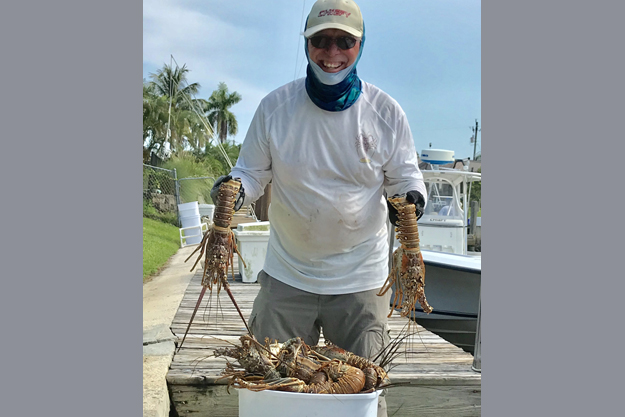
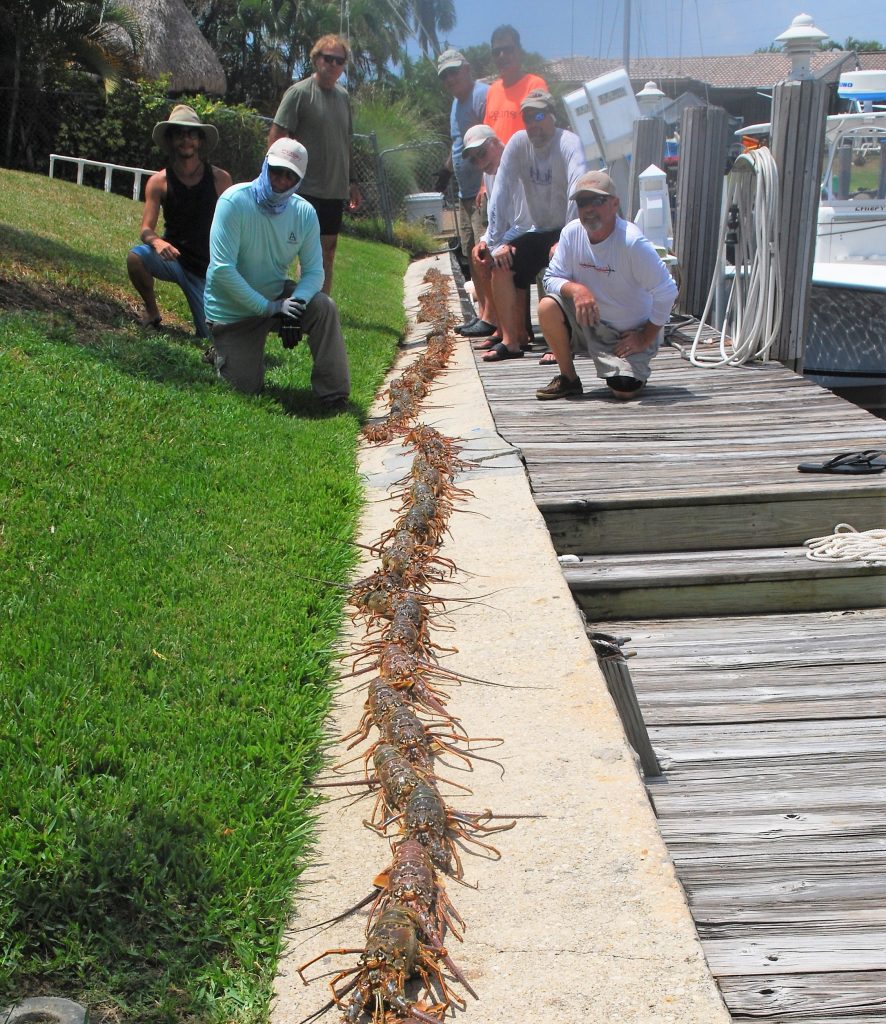
The Chiefy crew lined up its limit of lobsters caught during the first day of the 2018 miniseason. (Photo courtesy Steve Waters)
In the past, a $1,000 prize was awarded to the two-person team
catching the heaviest total weight of 12 bugs on Wednesday. This year, $500
goes to the team with the heaviest weight caught off Broward County and $500 to
the duo with the top weight caught off Miami-Dade or Palm Beach counties. Other
prizes include $400 for the biggest bug caught anywhere off a boat, $400 for
the biggest bug caught off the beach, and a Sherwood Oasis regulator valued at
$420 for the biggest bug caught on a midnight beach dive off
Lauderdale-by-the-Sea. There are also prizes for the biggest bugs caught
Wednesday on the 6 a.m. dives on the Aqua View and Black Pearl dive boats at
South Florida Diving Headquarters in Pompano Beach.
Divers don’t need to bag big bugs to win big. They receive a
raffle ticket for each lobster they weigh in on Wednesday and Thursday. Winning
tickets are drawn at 7:30 p.m. Thursday, following the lobster chef competition,
which starts at 6 at the Beach Pavilion at the end of Commercial Boulevard. So,
a diver who weighs 24 lobsters can win multiple prizes. Divers can register in
advance at Gold Coast Scuba in Lauderdale-by-the-Sea or South Florida Diving
Headquarters or online at DiscoverLBTS.com.
“It’s fun for the divers. It gives them more of an
incentive,” said Steve d’Oliveira, the town’s Public Information Officer. “The
town knows that BugFest is fun for divers and they get behind it, and everybody
has a good time.”
Other activities include a midnight beach dive on Tuesday, a fish
identification seminar on July 26, a free clean-up dive under and around
Anglin’s Pier at 8 a.m. July 27, and the third annual Diveheart Benefit Concert
from 6:30-10:30 that night.
Look — up in the sky — it’s a bird, it’s a plane! No — it’s
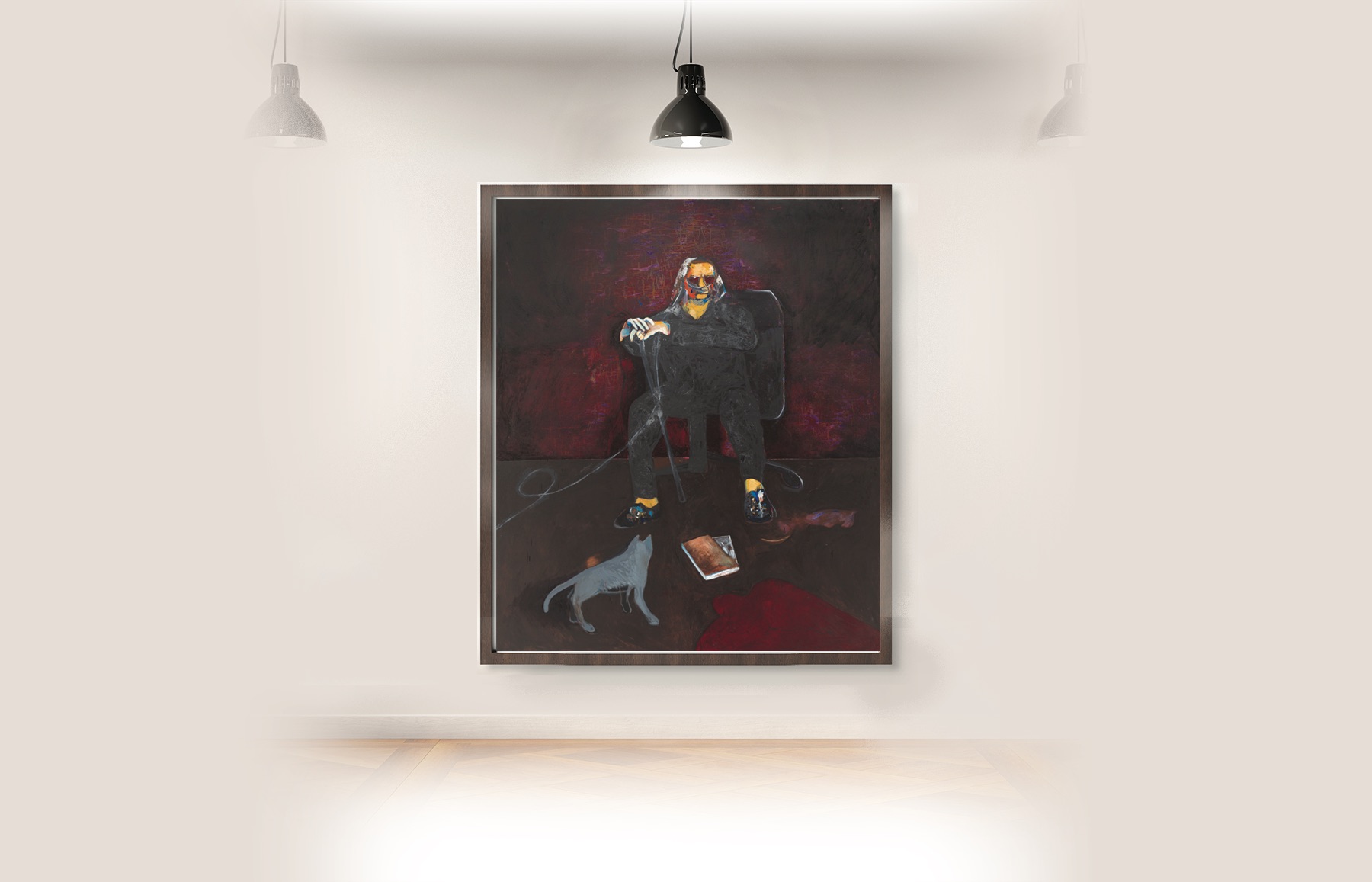
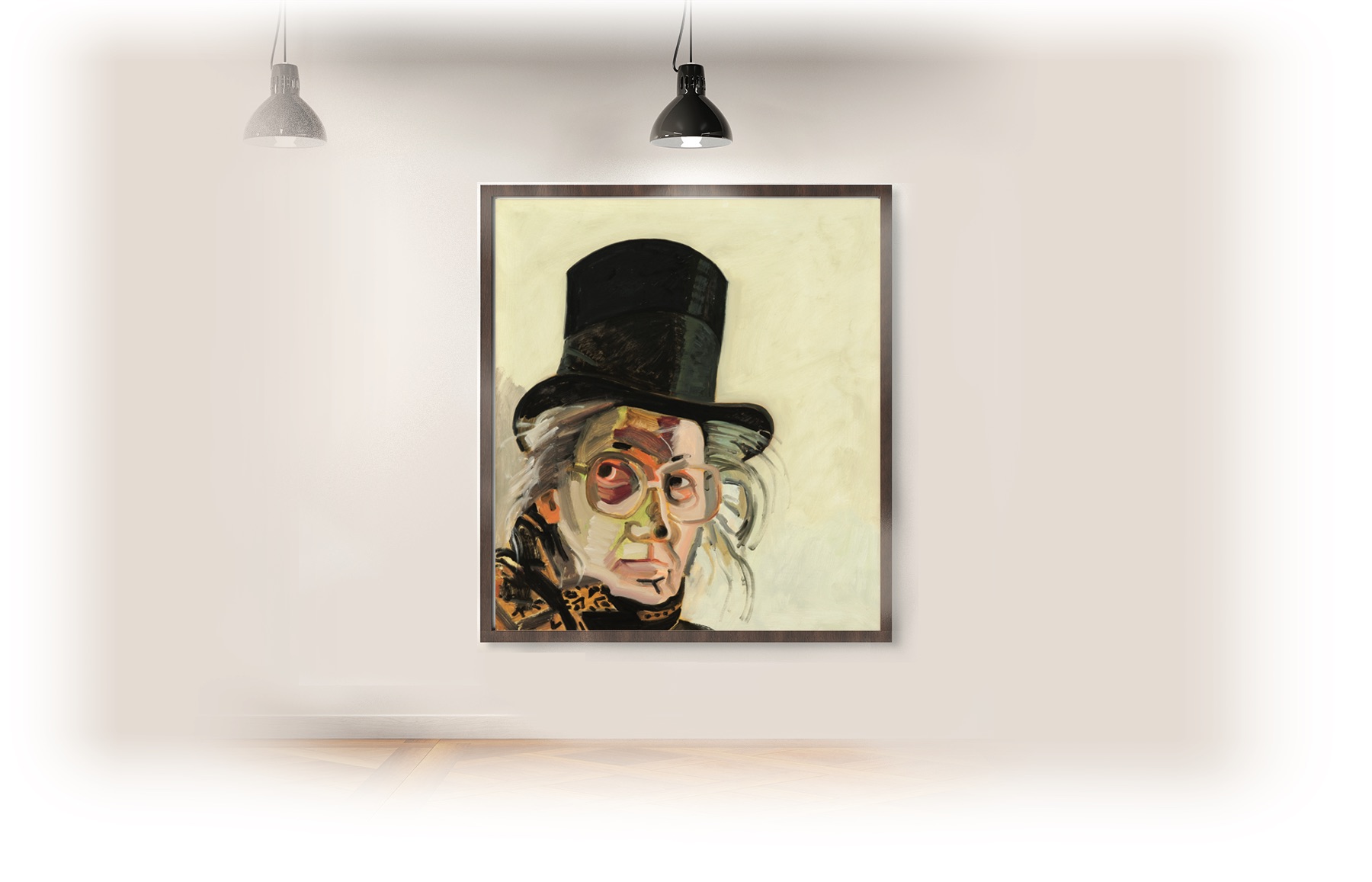
the Boca Raton Museum of Art’s new headliner, Beyond the Cape! Comics and Contemporary Art.
The exhibition offers a new look at the relationship between
contemporary artists and graphic novels and comic books.
Many of today’s most high-profile artists have been
influenced by this genre and the exhibit takes a deeper look at how graphic
novels and comics address societal issues of race, class, gender and politics.
“It’s exciting to see younger audiences express strong
interest in this exhibition,” Kathleen Goncharov, the museum’s senior curator,
said.
Goncharov — aided by Calvin Reid, senior news editor at Publishers Weekly and a comic book
expert — has selected an eclectic, playful, and sometimes wickedly burlesque
collection of video, photographs, sculpture, prints, and drawings in addition
to rare comics and contemporary and historic animation for display.
The installation features more than 80 works by 40 artists,
including Christian Marclay, Kerry James Marshall, Elizabeth Murray, Joyce
Pensato, Raymond Pettibon, Peter Saul, Kenny Scharf and Michael Zansky among
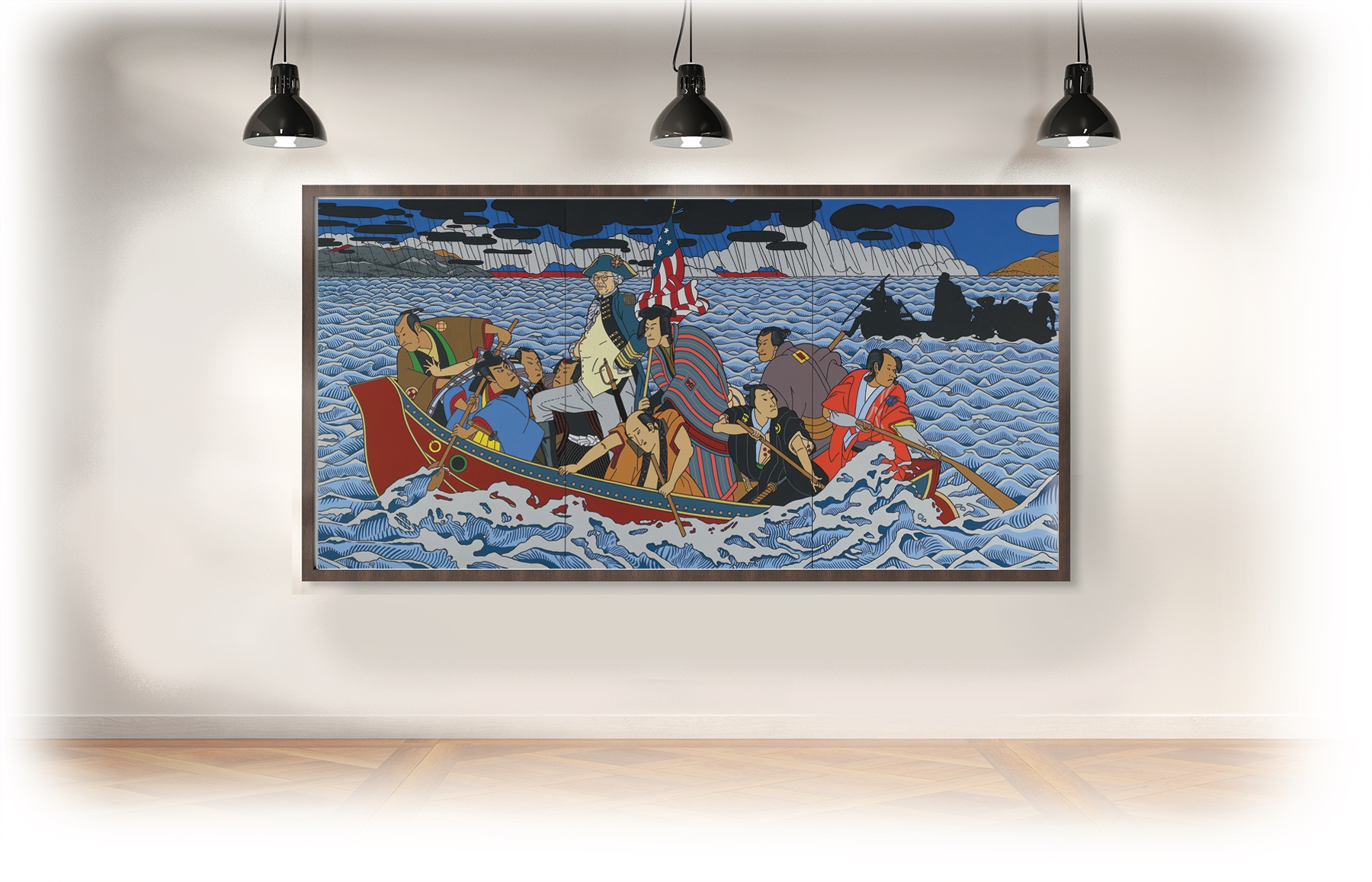
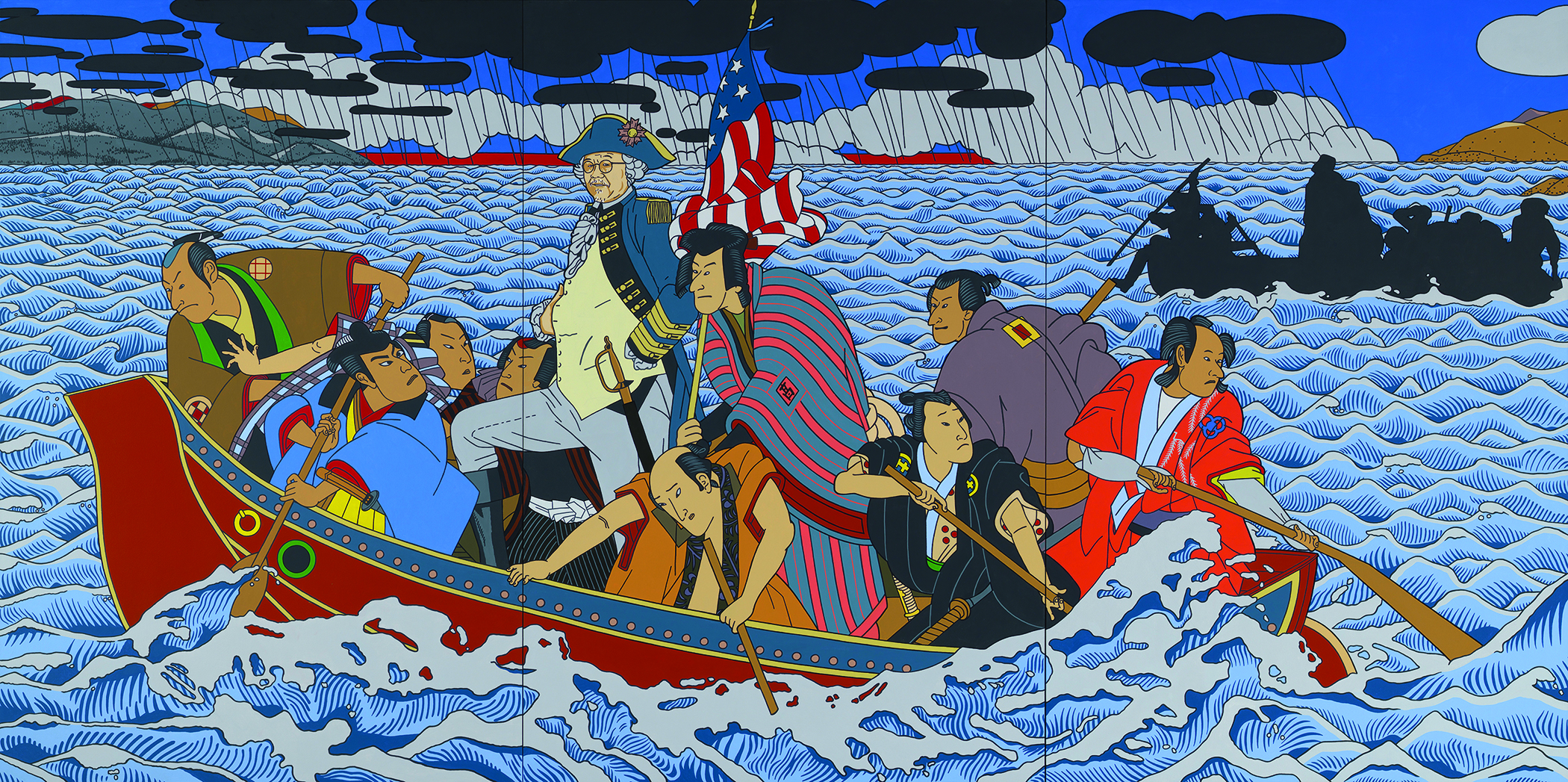
others. Works by Takashi Murakami and Yositomo Nara, who specialize in Japanese
comics, or manga, are also highlighted.
Work by Japanese manga artist Takashi Murakami.
“There is a long history here, in Europe and in Japan,
between comics and fine art,” Zansky, whose work is prominently displayed, said.
“Comics have a large influence in the culture and on contemporary artists. This exhibit showcases artists who are
attracted to (the) quirky visuals and subversive content of adult comics.”
Michael Zansky’s Saturn Series, standing 19 feet high, was created with carved, burnt, and painted plywood. (Photo by Jan Engoren)
Zansky comes to the world of comics naturally. His father
was Louis Zansky, who drew for the circa 1940s Classic Comics series of graphic adaptations of famous literary works.
Michael Zansky’s Walking Figure, a 16-foot-high
carved, burnt, and painted plywood panel of a giant foot on an octagonal
foundation, is based on the Colossus of
Constantine, a gargantuan marble statue of the Roman Emperor Constantine
the Great.
The work is displayed at the entry to the exhibit, next to and
juxtaposed with Manuscript, a giant
hennaed hand by Indian American artist Chitra Ganesh.
The show looks beyond the 1960s Pop Art movement, led by New
York-centric artists such as Andy Warhol and Ray Lichtenstein, and features the
“other” art movements from the ‘60s and ‘70s such as the Hairy Who and Bay Area
Funk Art. Hairy Who artists Gladys Nilsson, Jim Nutt, and Karl Wirsum,
along with works by underground comic book artists such as R. Crumb, Aline
Kominsky-Crumb, and Mimi Pond are also featured.
A highlight of the show is Chicago artist Kerry James
Marshall’s comic series Rhythm Mastr, which documents violence
in his hometown. Known for his flat, colorful paintings of contemporary black
America, Marshall’s work is in high demand.
Although comics and graphic novels are part of a genre
dominated by men, a number of women are highlighted in the show. New York
artist Jody Culkin, in particular, raises the feminist bona fides of the exhibit
with A Prophetic Drama. The 9-minute
animated comic is based loosely on a play about mummies coming to life in the
British Museum, written in 1875 by Harriet Hosmer, a celebrated 19th-century
sculptor who also enjoyed dabbling in science fiction writing.
Snapshot showing a scene from New York artist Jody Culkin’s animated comic A Prophetic Drama. (Photo by Jan Engoren)
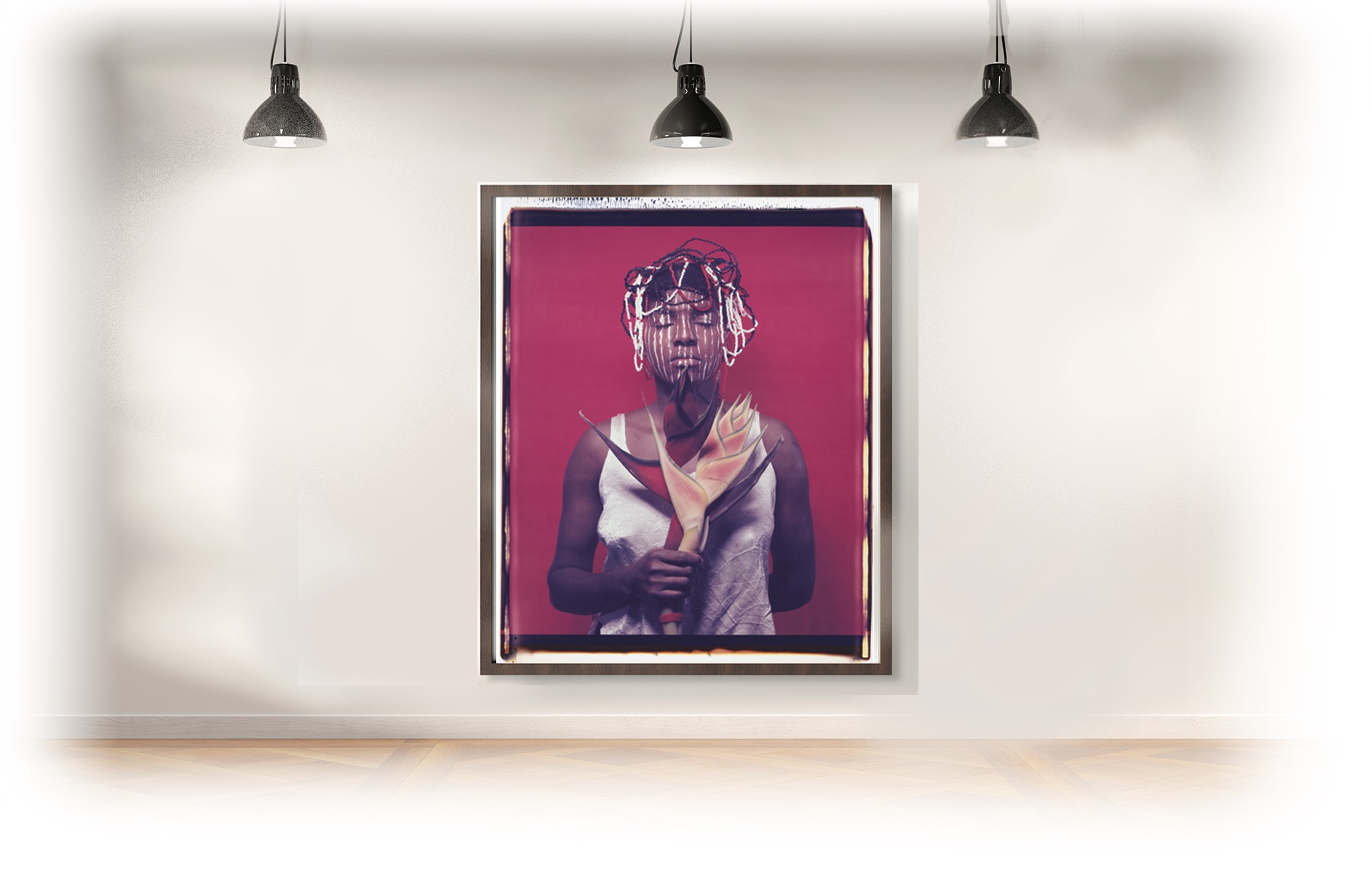
Also featured are Chitra Ganesh, figurative artist Elizabeth Murray and Jamaican feminist artist Renee Cox, known for upending sexist and racist stereotypes with her art. Beyond the Cape! runs through Oct. 6.
Back in the 1960s, vocalist Lou Christie sang a pop tune
called Two Faces Have I. In the ‘90s,
two famed puppet/mask designers took that concept to create masks for the live
stage version of Disney’s The Lion King.
The idea not only worked, it roared.
Since The Lion King
debuted on Broadway in 1997, more than 90 million people worldwide have
experienced its visual artistry and reveled in its award-winning score.
Based on the eponymous animated Disney film, the stage
adaptation features music by Elton John and lyrics by Tim Rice. Six indigenous
African languages are spoken throughout the show and extraordinary costumes often
exceed the expectations of show planners and audiences.
The Lion King has
just passed through South Florida. In mid-spring, the Serengeti was recreated
behind the footlights at the Kravis Center for the Performing Arts in West Palm
Beach. The production, with its array of performers and elegant scenery,
completed its run at the Adrienne Arsht Center in Miami on May 26.
The show that packed those two venues combined the talents
of Disney Theatrical Productions with the redoubtable capabilities of Julie
Taymor, the show’s director, costume designer, and —with Michael Curry — mask
co-designer.
Julie Taymor, director of The Lion King and co-creator of the masks used in the stage show. (Photo courtesy of Broadway World)
Taymor is the first woman to win a Tony Award for Direction
of a Musical. Curry is owner and operator of Michael Curry Design, which
creates live performance-oriented devices for Cirque du Soleil, Super Bowl
shows, the Olympics, and was the creative force behind New York City’s
millennium event in 2000.
With a nod to Christie’s song title, the masks for most lead
characters are attached to the top of the actors’ heads, meaning their faces as
well as their animal avatars can be identified. The masks drop to cover faces
when characters reveal their more animalistic sides.
Background performers are fitted with more stylized devices
or puppet-style gear, including bicycle-like equipment for herds of running
gazelles; stilts and neck extensions for giraffes, and a vast amount of rigging
and structuring for elephants. The stampede, critical to the plot, is artfully
crafted in a manner that defies explanation. But it appears so real and works
so well in the show.
Taymor said once she discovered she needed to show both the
human and animal traits of The Lion King characters,
she labored to convince Disney of her concept. That involved creating three
versions of the character Scar, three Zazus, and two Timons, and presenting all
to Disney’s then-CEO, Michael Eisner. He gave the thumbs-up.
The musical is a sweet love story between a father and son —
Mufasa, the lion king at the opening and his son and successor, Simba. Later
comes the sweetheart tale of the mature Simba getting to know his betrothed,
Nala.
Masks used in The Lion King, on display at the Kravis Center for the Performing Arts. (Photo by Dale King)
Taymor explained the imagery of the masks. “Obviously,
Mufasa is the sun. That’s why you have the circle [the song, Circle of Life]. He’s very much about
symmetry and radiation, the sun god. Simba and Nala are in that world of
Mufasa.”
Of her experience with The Lion King, Taymor said: “It’s the
most fun thing I’ve ever done in my life.”
If
you’re not up for braving the South Florida heat this summer, these local
venues offer family-friendly activities available during the quiet — and less
hot — afternoon and evening hours.
Gumbo
Limbo’s environmental complex in Boca Raton is an indoor / outdoor nature
center with several aquariums and exhibits. A variety of group programs,
including guided nature trail walks, sea turtle talks, and animal feedings, are
offered throughout the week. A popular activity that only takes place on summer
nights is the Turtle Walk and Hatchling Release, where participants have the
opportunity to learn about Florida’s native sea turtles, walk to the nearby
beach, and watch a nesting Loggerhead or see baby turtles race for the sea.
View
Gumbo Limbo’s calendar of events for information on how to register.
Where: 1801 N. Ocean Blvd, Boca Raton
When: Monday through Saturday, 9 a.m. to 4 p.m.; Sunday, noon to 4
p.m.
Cost: Free ($5 suggested donation); free parking
Details: GumboLimbo.org
Hugh Taylor Birch State Park
Hugh Taylor Birch State Park features a canoe-kayak launch in its long list of amenities. (Courtesy photo)
Favorite
activities at Birch State Park range from live animal presentations to guided
mangrove and trail walks, and all are excellent opportunities for families to
explore Florida’s natural ecosystems and wildlife, and learn about the history
behind this local state park. The two-mile loop surrounding the natural habitat
is bike- and rollerblade friendly, while the Intracoastal Waterway allows for
easy access to fishing and makes for a perfect sunset-viewing picnic spot.
Birch State Park offers paddleboard rentals for those looking to visit Fort
Lauderdale’s stretch of beaches along A1A. In addition, the park is home to
Camp Live Oak, an immersive nature program for children ages 5-13, as well as a
variety of scheduled tours, educational classes, and events.
Where: 3109 E. Sunrise Blvd, Fort Lauderdale
When: Every day, 8 a.m. to sunset
Cost: $6 per family/group vehicle
Details: FloridaStateParks.org/HughTaylorBirch
Bark Beach at Spanish River
Park
Release
the leash and let Fido roam free on the sands of Spanish River Park’s beach!
Bark Beach is sectioned off from the rest of the park to ensure dogs don’t run
too far and other park visitors remain unscathed by licks or wet paws. Summer
hours are conveniently scheduled in the early morning and late afternoon. Bark
Beach is open to all families of Boca Raton who have purchased a dog permit at
their nearest community center. A single weekend pass is also an option,
allowing unlimited access to Boca’s best dog-friendly beach from Friday through
Sunday.
Where: 3001 N. State Rd A1A, Boca Raton
When: Friday through Sunday, 7-9 a.m. and 5 p.m. to sunset
Cost: Bark Beach dog permit required; $11 weekend pass; parking
$17 weekdays, $19 weekends OR free with annual beach pass
Details: MyBoca.us
INDOOR DESTINATIONS
Children’s Science Explorium
Located
inside Boca’s Sugar Sand Park, the Children’s Science Explorium is a must-visit
attraction. Activities during the summer include a variety of interactive,
science-geared exhibits and exciting educational programs. The Grab ‘n’ Go Eco
Pack gives young children and their families the opportunity to embark on a
scavenger hunt throughout Sugar Sand’s nature trails and explore the park’s
plants, birds, and insects. Kids-only activities include the one-week Summer
Science Camp — open to youngsters in grades kindergarten through 5th — and the
after-hour Friday Nights @ the Museum, featuring a cool experiment and movie
night! Check the events calendar in early June for a list of summer exhibits
and more info on registering.
Where: 300 S. Military Trail, Boca Raton
When: Monday through Friday, 9 a.m. to 6 p.m.; Saturday and
Sunday, 10 a.m. to 5 p.m.
Cost: Free ($5 suggested donation); free parking
Details: ScienceExplorium.org
Young At Art Museum
Young At Art Museum’s ArtScapes features works that explore a child’s perspective on the world. (Photo courtesy Young At Art Museum)
What’s
one thing that makes the Young At Art Museum unique? Through its program YAA
for ALL: Access to Lifelong Learning, the museum has developed special programs
and events for children and adults with autism and other disabilities. In
addition to its pre-scheduled classes and exhibits, the YAA opens one hour
earlier every second Sunday of the month, giving exclusive access for families
with disabled children. Specialized activities include the Sensory Studio Art
Class, which creates a warm and friendly environment of hands-on art-making
alongside specially trained staff members.
Where: 751 SW 121st Ave, Davie
When: Monday through Thursday, 10 a.m. to 5 p.m.; Friday and
Saturday, 10 a.m. to 6 p.m.; Sunday, 11 a.m. to 6 p.m.
Cost: $14 for adults/children; $12 for seniors and Broward County
residents; $11 for military families. Membership and group rates available.
Details: YoungAtArtMuseum.org
Museum of Discovery and
Science
The Museum of Discovery and Science’s AutoNation IMAX and 3D Theater. (Courtesy photo)
In
addition to its array of science exhibits and children’s Discovery Camp, a
distinctive feature of the Museum of Discovery and Science is its in-house IMAX
3D theater, which presents a number of documentaries and Hollywood films. With
numerous showtimes throughout the day, as well as wheelchair-accessible and
sensory-friendly screenings, this theater is a great pick for families. This
summer, the Museum’s featured exhibit, Hall
of Heroes, immerses visitors in the superhero world of crime-catchers,
Batmobiles, spy gadgets, and more.
Where: 401 SW Second St, Fort Lauderdale
When: Monday through Saturday, 10 a.m. to 5 p.m.; Sunday, noon to
5 p.m.
Cost: $17 for adults; $16 for seniors; $14 for military families
and children ages 2-12; free for children ages 1 and under; parking $6-$10.
Museum membership rates available.
Details: MODS.org
(Note: The IMAX 3D Theater has its own hours and
admission fees. Please visit the MODS website for details.)
Neil Armstrong notched a
singular spot in history as the first man to walk on the moon.
But astronaut Scott Kelly has
made his own impressions on the space-time continuum. Not only are he and Mark
Edward Kelly the only identical twin astronauts ever to serve with NASA in the
U.S. space program, but Commander Kelly has also logged more time in the “final
frontier” than any other American spaceman.
Kelly is about to share with
the public dozens of digital photographs he took during his year aboard the
International Space Station (ISS). Space
Odyssey 2019, a display of images taken during that 12-month mission from
2015 to 2016, will open June 20 and run through Aug. 3 at the Palm Beach
Photographic Centre in West Palm Beach.
“One’s perspective shifts
when one lives for an entire year — as Commander Scott Kelly and no other
American astronaut in history has — in the isolating, grueling and utterly
unforgiving vacuum of space,” Fatima NeJame, the Centre’s president and CEO, said.
Kelly is a former military
fighter pilot and test pilot, an engineer, a now-retired astronaut, and retired
Navy captain. A veteran of four space flights, he commanded the ISS on three
expeditions. He is also the brother-in-law of former U.S. Rep. Gabby Giffords
(D-Ariz.), who survived a gunshot wound to the head after an attack at a
constituent event in 2011.
NeJame said the Space Odyssey 2019 exhibition will feature
between 40 and 60 frames, all reproduced using the center’s digital printer.
“We are making them large so visitors can see the detail.”
“Kelly mastered the rare art
of microgravity photography,” NeJame said.
Microgravity photography? “Using
a Nikon D4 with an 800-millimeter lens and a 1.4x magnifying zoom lens, he
panned the camera as the shutter released to compensate for the space station’s
velocity: 17,500 miles per hour relative to the earth.”
In the display, his photos
will be accompanied by personal commentary to put the images into their proper
contexts.
During the ISS mission, while
breaking records for time spent in outer space, Kelly spoke with President Barack
Obama about what he was seeing and the pictures he was taking. The President
encouraged him to share the photos with the world via Twitter and Instagram,
which he did. Kelly’s artistic eye helped make him a social media sensation.
Looking down at a frozen Himalayan lake from space.
Through his lens, Kelly captured sunsets, moonrises, the Aurora Borealis, and the luminous, hazy tapestry of the Milky Way. “There are hurricanes, wrinkled mountains, New York City shining like a galaxy,” NeJame said. “Glorious photographs that are, in themselves, a passionate argument for the preservation of our planet in the face of climate change and environmental destruction.” In one of the images taken over South Asia as the Expedition 46 crew orbited high above Earth, Kelly looked down on a vivid blue body of water shot through with white. “Cool frozen lake in #Himalayas! #YearInSpace” he tweeted on Jan. 6, 2016, to his more than 5.6 million followers.
Astronaut Scott Kelly shared the last sunrise of his yearlong mission on space on March 1, 2016, aboard ISS.
There must be at least
two considerations to label something as art. The first is … there must be the
recognition that something was made for an audience of some kind to receive,
discuss or enjoy. … The second point is simply the recognition of skill.”
Brannon
McConkey
At Stacey Mandell’s first solo
exhibition, Letters to Our Younger Self,
at the Miami Dade College Hialeah Campus Art Gallery, there could be no doubt
in a viewer’s mind the artist was sharing, successfully, the way she
experiences the world and that her work was an extension of her personality.
Her unique art form encompasses words, emotions, culture, but also activities
of daily life and current events.
“If Love is the Sun, Gratitude is the Moon”
Mandell uses shorthand words and
phrases — whether actual Gregg shorthand, cursive writing, even Braille — as an
abstract gestural form, in which the form’s meaning provides an abstract
narrative on the canvas.
“I believe we have much more in common
than we may think — love and gratitude, diversity and inclusion, identity and
culture, encourage and nurture. Saying ‘please’ and ‘thank you,’” Mandell said.
“These are expressions of the soul. We all share the same hopes, dreams, and
fears. We all have good days and bad days.
“My artwork is the physical manifestation of the expressions
of my soul,” she said. “My messages are the conversations contained in the
artwork.” xhibition curators Noor Blazekovic and Alejandro Mendoza, in a
joint statement, said they were fascinated how Mandell frames an idea and
communicates it to an audience. “What sets her creative work apart from other
human expression is that she is creating in the world of non-verbal
communication — she uses different tools: shorthand, words, visual images,
movement, ideas, and more — to create feelings, thoughts, images, and ideas in
the audience to communicate her particular message that as creator she wants to
share. The intent is to inform, move, and open the audience’s mind and
perspective to seeing the world in a different light than before.”
“This is not a blank steno pad” (48″ x 60″, Acrylic on Canvas. 2018)
One work that
shows that “different light” is This is not a blank Steno pad, a
5-foot-high acrylic-on-canvas image of the familiar off-green paper notebook.
We may know it’s called a steno pad, and many of us of a certain age understand
these notepads, with the spiral at the top for easy page-flipping, were
popularized in their use by actual stenographers — secretaries, court
reporters, close-caption writers in yesteryear’s TV industry, and the like.
Mandell has
more than a passing familiarity with proper penmanship. A devotee of
punctilious handwriting since her mother taught her cursive in grade school in
rural central Illinois, Mandell made her way in the world — in quite the
circuitous way, as it turned out — depending on Gregg Shorthand. After graduating
from college prepared to teach music and math, Mandell instead took a clerical
job where she had to learn shorthand.
“Learning
Gregg Shorthand was a turning point on my career path,” Mandell said. From
there, she became a legal secretary and, later, jumped to law school, employing
her shorthand skills at every point.
“Throughout
my 20-year legal career, I utilized shorthand to take notes and draft
documents,” Mandell said. During that span, she said, she became fixated on
using shorthand to communicate different ideas in a very different way — to
express herself as an artist.
Once she left
lawyering behind and relocated to South Florida when her husband retired,
Mandell decided to pursue that idea.
This
is not a blank steno pad was
her first work in her steno pad series. It’s as much a statement about her
present as it is about her view of our present culture: Much like the absence
of ink and scrawl on Mandell’s canvas, the very jobs it represents — or, at
least, the job titles — are now part of the past.
Mandell’s
steno pad is blank, she said, “because of technology; no one uses it for its
intended purpose anymore. It represents the dying art of a beautiful, phonetic
language.”
Mandell
said after she painted the pad of paper, she’d planned to add to it a number of
life lessons — in shorthand, of course. “But every time I thought about writing
on it, I stopped. I could not bring myself to write on this one,” she said. “I
finally realized this one meant more than anything I could express with
shorthand.”
For the Rev. Mark
Leondis, the icons of saints leading into the sanctuary at St. Mark Greek
Orthodox Church are family. And as you would with beloved family members, the
senior pastor at the golden-domed Boca Raton church pauses in conversation to
acknowledge them — a few whispered words of greeting to St. John and a
kissed-fingers tap for St. Mark.
Leondis only once
neglected such familial obligations. As a young deacon visiting a church in
Dallas, Texas, during Holy Week, Leondis was rushing through on some or other
important errand. A volunteer at the church stopped him short. “No matter how
much of a hurry you are in,” the man said, “always venerate the icon before
entering the Church.”
“We don’t worship
the icons themselves,” Leondis explained, gesturing to some of the 100-plus
paintings and mosaics adorning St. Mark’s, from the entryway to atrium to
sanctuary. “These are reminders of what these people achieved and what they represent.”
What the artworks
represent often depends on the believer, Leondis said. So, while one
parishioner has an affinity for Mary, another feels moved by St. John the
Baptist. Children love the stories the paintings depict, while elderly
churchgoers appreciate the traditions the art reinforces. For some, the
paintings inspire faith; for others, they serve as reminders of spiritual
journeys, struggles, and values.
Eastern Orthodoxy’s
icons, as much as the faith’s holy anointing oil, musical chanting, readings of
the Psalms, and the incense wafting from swaying gold censers during church
services, “incorporate all of the senses,” Leondis said. “They help lift us to
heaven and continually inspire us to treat each other as we treat the icons
themselves.”
Opened in 1997, the
sanctuary at St. Mark’s was consecrated in 2014, after a significant portion of
the church’s current iconography — painted over a span of 10 years by New
Jersey-based artist Laurence Manos — was completed. Leondis, St. Mark’s pastor
since 2011, said the overall brilliance of the artwork is itself a constant
source of revelation for him.
St. Mark’s is one of
the rare Greek Orthodox churches brightened by the sun streaming in the
chapel’s expansive windows. South Florida’s bright sunlight pours in from east
and west, seeming to set aflame the generous halos of gold leaf and the rich
reds and blues that suffuse Eastern Orthodox iconography.
Leondis
said work on the final stage of paintings for St. Mark’s, estimated to cost
more than $1 million, is set to begin in June.