Dolphin Put Color in Summer Fishing

Most offshore anglers in South Florida are focused on catching dolphin in the month of June. The colorful fish — not the mammal — are popular because they fight hard and jump a lot, they can be caught on a variety of baits and lures, and people love to eat them.

Although dolphin are caught year-round locally, this is the time of year when they are plentiful. The bag limit is 10 fish, a minimum of 20-inches long— per person per day or 60 fish per boat, whichever is less. Many anglers keep only enough dolphin for a few meals — the fish are terrific fried, blackened or in tacos — and safely release everything else back into the water.

Late spring and summer are when dolphin are often found in schools ranging from half a dozen to dozens of fish. Locating those schools is usually a matter of locating birds, weedlines, or floating debris.

Weedlines, patches of grass and debris such as tree trunks and wooden pallets, attract baitfish, which attract dolphin. Birds often hover over dolphin, hoping they’ll chase bait to the surface. Like serious bird-watchers hoping to spot a species they’ve never seen before, dolphin fishermen are always on the lookout for frigate birds.

Also known as a man-o’-war bird, a frigate bird has a forked tail and a wide wingspan that allows it to soar over the ocean, then suddenly swoop down to catch a fish with its long, hooked bill. The bird does not dive into the water. Instead, it waits for dolphin to send flying fish and other small fish fleeing to the surface. When a baitfish goes airborne, the frigate zips in and snags it. (A frigate also scores easy meals by harassing other seabirds so that they drop their catch, which the frigate grabs before it hits the water.)

When running offshore, some captains will stop every five minutes or so to scan the horizon with binoculars in the hopes of spotting birds or debris. Others will designate crew members to keep an eye on the sky.

If frigate birds are swooping, that’s a good sign. If birds are sky-high, they’re looking for dolphin, so it might not be worthwhile to race over to them.

“High birds, if they’re way up there, they’re taking advantage of their eyesight to look for something to play with,” said Capt. Bouncer Smith, a legendary charter fishing captain in Miami Beach. “If they’re 200 feet high, they’re probably into something. When they start to dive, then they’re really in the game.”

Smith added that anglers must pay attention to the direction a frigate bird is flying.

“If birds are working to the north, they’re over smaller dolphin or tunas,” Smith said. “If a bird is on good-sized fish, he’s going to be going south, because good-sized fish go against the current. The big dolphin are swimming just fast enough to hold their position in the current — the Gulf Stream is moving north at 3-4 mph — and eat what comes by.”

Smith, who runs charters out of Miami Beach Marina on Bouncer’s Dusky 33 (CaptBouncer.com), said anglers need to get ahead of a frigate flying south to have a shot at catching the dolphin the bird is following. If they stay to the north of a south-flying bird, the fish have already passed their boat.

“A lot of times when you’re on frigate birds, you’ve got to wind the lines in and get ahead of the frigate and let the dolphin catch up to you,” Smith said.

Once his boat is in position, Smith rigs two spinning outfits with live baits — pilchards, goggle-eyes, small blue runners, or cigar minnows — hooked through the nose. He has his anglers cast the baits 50-100 feet behind the boat. They leave the reel bails open and control the lines with their index fingers while Smith idles ahead of the bird.

“When a fish eats, give him a short drop-back, close the bail and wind,” said Smith.

Once you’re hooked up, it’s not unusual for the rest of the school to appear behind the boat. That’s when fishing can get frantic, with multiple anglers fighting fish and trying to not tangle their lines. Like a choreographer, Smith often has to tell anglers to go over or under another angler’s line.

To keep dolphin around the boat, many anglers leave one or more hooked fish in the water, which attracts other dolphin. When the next fish is hooked, the first one can be boated, and so on. If, after you’ve boated several dolphin, the school disappears, try splashing the water with a gaff to get the fish to return because it sounds like a feeding frenzy that they’re missing out on.

When the schoolies are solid behind the boat, you can catch them on dead bait, jigs, topwater plugs, and even flies. Smith recommends buying a 1-pound box of squid and casting the 3- to 4-inch baits to the fish. A one-ounce kingfish jig retrieved as fast as possible also entices strikes from dolphin. But Smith’s favorite way to catch schoolies is on a fly rod. “Better too small a fly than too big a fly,” said Smith, adding that yellow is an effective color. It also helps to toss out a few glass minnows every once in a while, to keep the fish turned on.
Diving in as Grouper, Hogfish Seasons Open

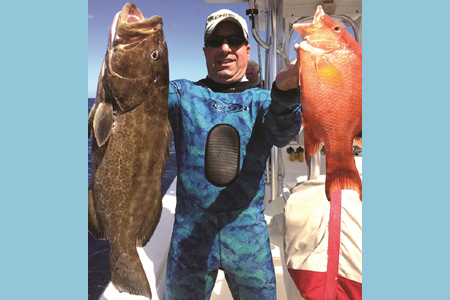
South Florida anglers and divers look forward to the month of May because the grouper and hogfish seasons open May 1.

“Opening day is a Wednesday,” spearfishing expert Jim “Chiefy” Mathie said. “If you’re a diver or underwater hunter, you may want to take that day off from work to get out there and get an early jump on grouper and hogfish.”

The grouper season in Atlantic waters has been closed since Jan. 1 and hogfish season closed on Nov. 1 in local waters. Scuba divers like Mathie could only look and stare at black, gag and red groupers and hogfish as they hunted for other fish and lobsters. When the seasons open, they’ll be targeting what many people consider to be the tastiest fish in the ocean.

The same goes for offshore anglers, especially those who fish on local drift boats like Capt. Skip Dana’s Fish City Pride at Hillsboro Inlet Marina in Pompano Beach. Dana will run trips focused on grouper fishing the first few days of the season. Until then, anglers on his boat and others have had to release every grouper and hogfish they’ve caught.

“We’ve been catching quite a few groupers,” Dana said. “We’ve also caught quite a few hogfish this past winter using dead sardines or squid.”

In addition to closed seasons, grouper and hogfish have restrictive bag limits. Black and gag groupers must measure at least 24 inches and reds must be 20 inches. Anglers and divers can keep a total of three grouper per day, but only one can be a black or a gag. The other two, or all three, can be red grouper.

The limit on hogfish is one per person per day, a minimum of 16 inches long. Previously, the season was open all year, the daily bag limit was five fish and the size limit was 12 inches. Mathie, of Deerfield Beach, has seen an improvement in the hogfish population from Pompano to Boca Raton since the regulations were instituted in 2017.

“We definitely are seeing a lot of big males,” Mathie said, explaining that male hogfish that are big enough to shoot have a long snoot with a dark stripe down the forehead. “Every dive, we’ve seen at least one big male, and in all depths — shallow, medium, deep. Their typical behavior, in particular the big males, is they’ll have a harem of females.”

Mathie is the author of Catching the Spear-it! The ABC’s of Spearfishing, which is sold by most area dive shops as well at Chiefy.net and other online retailers. Among the many tips in the book is to always keep in mind the 3 R’s — recognition, regulation, and range. In other words, be able to identify the fish, know the size limit and be close enough to shoot it with your speargun.

Spearfishers must check off the 3 R’s relatively quickly with black and gag grouper. Unlike hogfish and red grouper, which often try to hide behind a sea fan when a diver approaches, blacks and gags don’t usually stick around.

“You land a black grouper, you’ve done well, because they’re always on the move,” Mathie said.

A member of the South Florida Spearfishing Club (Spearfishing.org), Mathie and his dive buddies start the season hunting the west-facing side of the third reef. The top of the reef is about 50 feet below the surface and the bottom is 60-65 feet.

“The structure holds a lot of fish, and that’s where you see the bigger fish,” said Mathie, who also hunts for grouper and hogfish around wrecks at 65 feet. “Last year we did those areas for almost the whole month of May because we were finding big fish. We didn’t always get them, but we saw a lot of fish. After that, we went to the deeper wrecks in 110, 120 feet.”

Dana fishes wrecks from 75-240 feet for grouper. (GPS coordinates for Florida’s artificial reefs are available on the Florida Fish and Wildlife Commission website, MyFWC.com.) Dana said wrecks in 75-120 feet are good for gag grouper. Blacks are on the same wrecks and deeper ones. Reds can be as shallow at 30-40 feet around rockpiles, ledges, and grass patches, as well as on wrecks.

He added that heavy tackle is needed to quickly get hooked grouper away from wrecks. If the fish get into the ruins, odds are good your line will break.

“I’d use at least 50- or 60-pound monofilament or braided line with an 80- to 100-pound leader and a 7/0 or 8/0 circle hook,” said Dana, adding that anglers might use sinkers ranging from 2 to 16 ounces, depending on the strength of the current, to get their baits to the bottom. “I really like live pinfish for bait for grouper, but you can use two or three dead sardines on a hook, a goggle-eye head or a fillet of bonito. “Let the line spool out and feel for the bite. If you’re fishing a wreck, you want to be up current and upwind of the wreck so the bait will drop on the wreck. When you get the bite, there really is no drop-back or feeding the grouper. Just lock up the reel and pull hard to get the fish off the bottom and away from the wreck.”

Parkland Buddy Sports Golf Classic

Parkland Buddy Sports will host its seventh annual golf tournament on Sat., May 11, at Boca Lago Country Club in Boca Raton.

“Our Parkland Buddy Sports family has been providing fun, safe programming for our special needs children, their families, and our community since our inception in 2002,” Parkland Buddy Sports president Andy Zaukas said. “This tournament is our primary source of fundraising, with the hope that our fee-free sports programming will continue to grow and succeed.”

The mission of Parkland Buddy Sports, a 501 C (3) non-profit organization, is to provide quality sports programming for children and young adults with special needs in an inclusive, empowering, challenging, and caring environment where the emphasis is on having fun, making friends, and realizing their potential. The structure of a shared experience allows participants and volunteers to create a no-limits environment void physical, social, and cultural barriers.

The sports programs consist of weekly activities and/or games. Each player is paired for the entire season with their own “Buddy,” who in most instances is a student volunteer. Through the shared encouragement of all the program’s Buddies, the players with special needs and their families are able to experience the joys of their athletic endeavors.

The 1:30pm shotgun-start golf tournament will consist of up to 144 players in teams of four. The cost per player is $125, which includes golf, tournament prizes, a gift bag, and buffet dinner in Boca Lago’s VIP dining room. Specialty holes will be available, including a hole-in-one par 3, where golfers will be shooting for prizes courtesy of Infiniti of Coconut Creek. Other specialty holes will be available. Mulligan cards will be on hand for players to purchase.

Sponsorship opportunities may be obtained at several monetary levels, ranging from $500 to $5,000. T-Sign hole sponsorships are also available for $100 per hole. The Parklander is the official magazine sponsor. Other corporate sponsors include Connect Credit Union, The Eppy Group, Holman Enterprises, and Pepsi. Trophies and prizes will be awarded to the top teams. There will be a silent auction and raffle; prizes include hotel stays, signed sports memorabilia, attraction tickets, restaurant gift certificates, and more. If you are interested in assisting the charity or golf tournament committee with your time and/or donations, call Linda Brown at 954-288-7201. For more information on Parkland Buddy Sports, visit ParklandBuddySports.org or search Facebook for Parkland Buddy Sports Inc.

If Wishes Were Horses…One Woman’s Dream of Riding

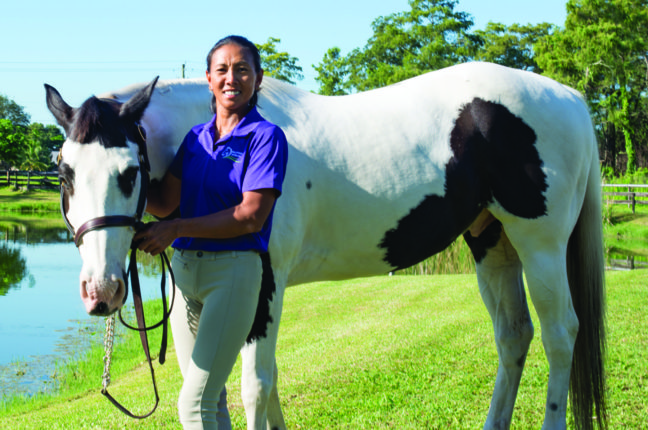
Twenty-seven years old is late for someone to become a jockey. But Patra Jean didn’t think it was too old to live her dream, which she did. Despite the late start, she finished her apprenticeship quickly and was in full gear. “You could say I was self-accomplished,” she said.

patrajean


For a couple of years beginning in 2000, the 5’1” 100 pound jockey donned her silks to compete in more than 500 races, and bring home 54 winners.


Most of Patra’s racing was at Calder Race Course in Miami Gardens, but she also rode at Gulfstream Park in Hallandale Beach, Hialeah Park in Hialeah, and in a track event in Jamaica. She rode for different owners and trainers, sometimes getting as many as five mounts a day.

Big-time horse racing has its dangers, and Patra knew them well. She was trampled in a race when her horse’s hoof clipped the heels of the horse in front of her. She went down, and was run over by the horse that was racing behind her. Patra was rushed to the hospital where she learned, fortunately, that she had no serious injuries beyond a collection of bruises. Patra learned something from her experience that day: “If I got hurt, it wouldn’t keep from racing,” she said.

As a child in Hialeah, Patra’s first experience with horses was in preschool when a babysitter’s husband took her for pony rides at Hialeah Park. She was hooked immediately and knew horses would be part of her life, not just riding them but caring for them.

Today, Patra and her husband, Rich Fitzgerald, own and operate Millpond Stables on Vinkemulder Road in Coconut Creek. They have five horses of their own, and board a number of others. She also provides riding lessons on a regular basis.

There are several long days in a business that requires never-ending work. Some days find her mucking out stalls, filling them with hay, tending to the horses’ water, feed, and making sure they get medical care when needed. Her horses need attention all day, every day, early mornings, and late nights.

“It’s not a job,” Petra said, “You have to love it. The horses don’t have a voice. They can’t speak for themselves. You have to have an eye to know when they’re hurting, or need care. That’s why I’m here. That’s what it means to have horses in your blood.”