Tales of a South Florida horse vet
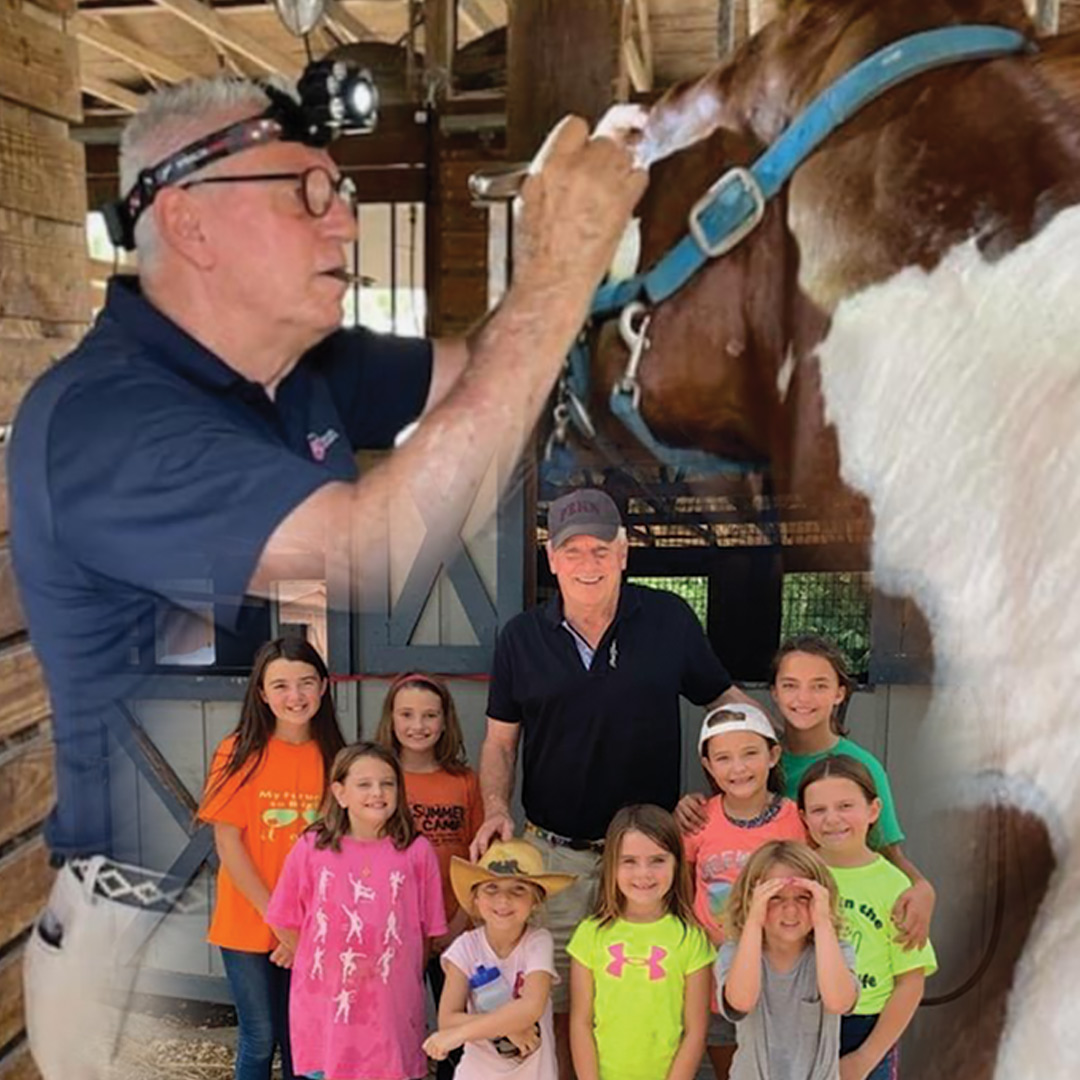
Since the 1980s, Glenn Gillard, VMD, has been a trusted name in equine veterinary care across Palm Beach and Broward counties. With more than four decades of experience treating everything from elite racing horses and show jumpers to backyard companions, his days have been filled with stories that are equal parts heartwarming, humorous, and humbling.
At just 13 years old, while working as a hot walker at a New Orleans racetrack, he knew he wanted to be a veterinarian. “I noticed veterinarians would show up to the barn, and they were like celebrities,” recalls Dr. Gillard. “Back in those days, they would have a jumpsuit and a tie. They looked like superheroes to me. And I said that’s what I want to do. I didn’t realize there were a few academic hurdles that I would have to overcome, but I did. I fell in love with it at that point. And I think spiritually, someone was looking out for me.”
After graduating from the University of Pennsylvania School of Veterinary Medicine, Dr. Gillard was offered a job at the Pompano Beach Racetrack and relocated to South Florida, where he worked with Dr. John Mitchell, who had a profound impact on his career. “I could have easily fallen into the trap of working for someone unethical in the race industry,” says Dr. Gillard. “But John Mitchell was the ultimate in ethics and integrity, and he represented the veterinary profession the way it should be done.”
After three years of working together, Dr. Gillard purchased half of the practice from Dr. Mitchell, opened up shop, and has been a fixture in South Florida ever since.
“I love my clients,” says Dr. Gillard with a bright smile. “I have clients where I’m in the third generation. I’m taking care of their grandchildren’s horses, so they’re almost more like family than they are clients.”
Throughout his career, he has been like a superhero to his clients, tackling difficult cases, creating innovative solutions—or, as he likes to say, “winging it”—and demonstrating compassion in situations where owners couldn’t afford veterinary care.
Recently, Dr. Gillard was involved in a case where a flesh-eating fungus, Pythium insidiosum, attacked a 5-year-old stallion. “This flesh-eating fungus grows by the hour,” he says. “I’ve had three other cases. The first two started in the leg and grew so fast those horses had to be euthanized. The third was a racehorse that had it on the ankle. I thought I had nothing to lose, so I sprayed the lesion with liquid nitrogen for three minutes, which was unheard of. I froze it down to the cannon bone. Then I froze the bone. That horse survived.”
So when they called Dr. Gillard out to this 5-year-old stallion, he was prepared, until he learned the location of the fungus. It was on the horse’s penis. He immediately wanted to do debridement surgery. After surgery, the horse did well for 12 days, but the fungus returned. At that point, Dr. Gillard gave the client two options: euthanize the horse, or go back for surgery round two.
At the same time, Dr. Gillard attended a meeting in Palm Beach and wound up meeting a veterinarian from a wildcat preserve. They had a jaguar with this same organism on its leg and had successfully treated it with Levamisole, a drug normally used for parasite control.
“We put the horse on the Levamisole, and we’re out two months now, and he’s cured,” enthuses Dr. Gillard. Cases like these are the reason he remains active in his career. “People ask when I’m going to retire, but it’s exciting. We just did something other people haven’t been able to do. This was a dead horse, and we saved it. I get a charge out of it.”
That’s not the only time Dr. Gillard’s innovation has saved a life. “Once, a little girl brought her kitten to me after a horse had stepped on its leg,” he recalls. “The leg was like a bag of marbles. It was more than one fracture.” He sedated the kitten and created a makeshift splint out of a syringe casing.
“I cut it, lined it with elastikon tape, put it on the cat’s leg, and smooshed the leg into the splint. Then I told the father we’re trying it for three weeks, and if something happens or you smell something, tell me and I’ll come out and put the cat to sleep.” Three weeks later, Dr. Gillard went to check on the kitten, and it came running around the barn. He cut the brace off, and the kitten was healed. He swears it was divine intervention.
Another time, Dr. Gillard was called to look at an Appaloosa horse by a 13-year-old girl. “I get there, he’s got a corneal ulcer, skin disease, and raging diarrhea,” he recalls. “We put him on the cross ties, and while I was treating the horse, the girl was mucking stalls in this little family barn.” The bill came out to just over $400.
“Normally, what happens with those things is a mother will call in a credit card. So I asked if her mother called in a credit card. But the girl takes out a little purse and says she’s taking care of it today. I look in the purse and see a bunch of singles and a couple of quarters. She’s got a smudge of manure on her cheek. When she asked how much the bill was, I looked at the manure smudge on her cheek and said, ‘$4.50.’ So she gives me three singles and six quarters.” His accountant thought he was crazy. “You gotta have fun with it,” emphasizes Dr. Gillard. “I make enough through the season that I can do that.”
Dr. Gillard’s career has been marked by both purpose and a sense of fun—from dissecting the volleyball-sized heart of a 36-year-old Polo horse with biology students at Spanish River High School, to guiding future veterinarians through their first bovine rectal exam as an adjunct professor at Florida Atlantic University. “Most of the kids were from Boca and wanted to work with dogs and cats. But you still have to have exposure to cows. So I would sit there, and they’d have their $400 designer sunglasses on, and as their wrist dropped into the cow’s rectum, I’d take pictures of their facial expressions,” laughs Dr. Gillard. “I have a whole album of kids that were doing their first rectal.”
Even situations that weren’t fun at the time can now be looked back on with a sense of levity, like the time a professional horse trainer called Dr. Gillard out at 11 p.m. on a Saturday, because she thought her horse was in trouble. “She told me he’s doing a silent agonal scream,” recalls Dr. Gillard, who drove there at about 90 miles an hour, pondering what could be wrong with the animal.
“I get there and there’s a semi-circle of about six cars, all with their headlights focused on this horse in its stall.” Heart racing, Dr. Gillard observed the horse carefully as it yawned. “I had to walk back to my car and count to 50. I told the lady that the horse is tired, sleepy, and yawning. No silent agonal scream. I can laugh now, but at the time my heart was going 100 miles an hour.”
While his heart rate may have come down, even at 76 years old, Dr. Gillard has no intention of slowing down. “I can see myself always keeping a toe in the water—otherwise, I don’t know what I’d do. I’d probably be climbing the walls,” he says with a smile.
To learn more or to get in touch with Dr. Glenn Gillard, call (561) 738-4601.