
The dolphin fishing had been slow. So when a school of dolphin weighing 3–5 pounds showed up about eight miles off Deerfield Beach on a hot and humid Saturday, boats swarmed to the area.
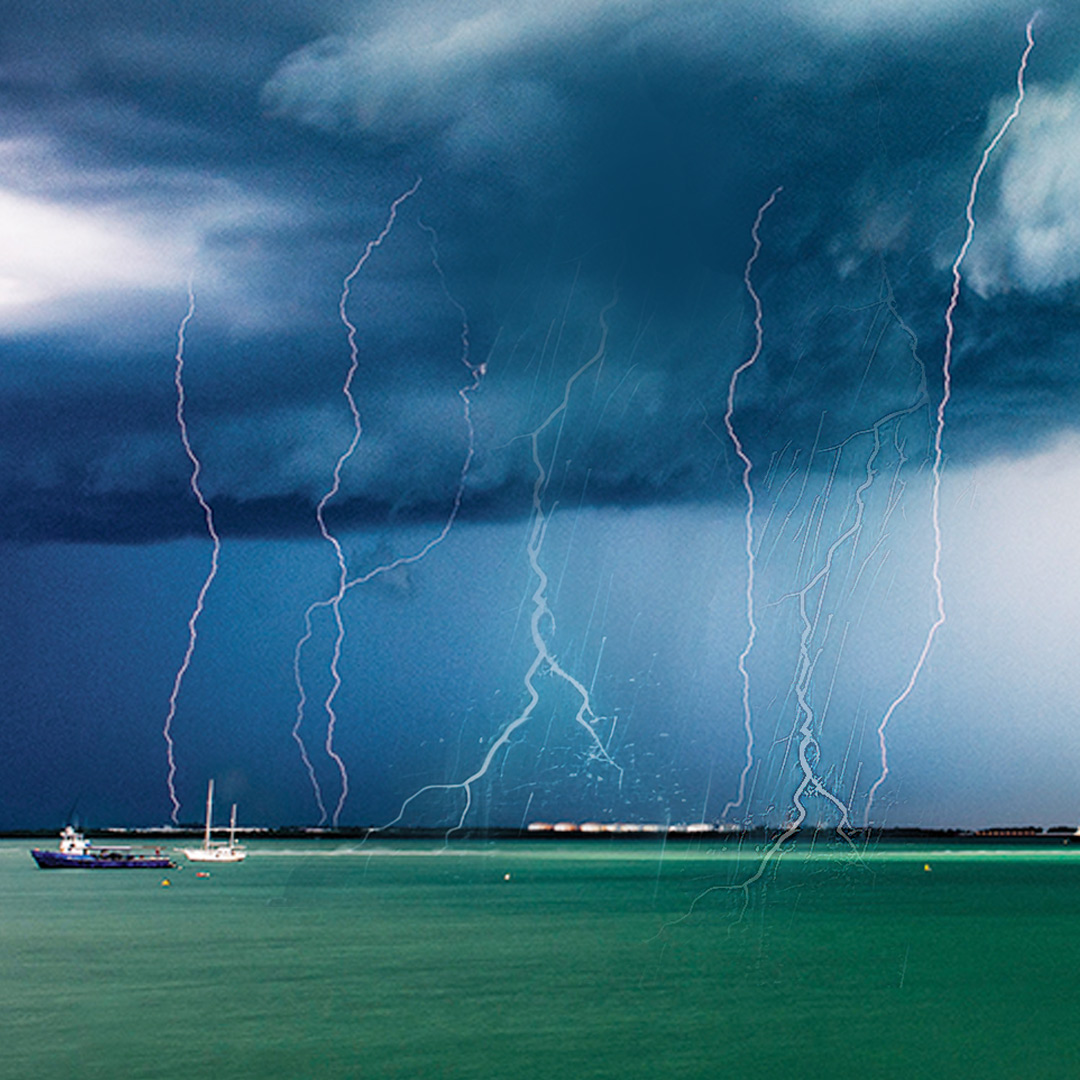
As anglers picked at the small schoolies, a cool breeze began blowing and black clouds moved overhead. Within minutes rain started falling and thunder crackled in the distance, a common occurrence this time of year in South Florida.
Judging by the cluster of boats, the fishing must’ve really been tough that morning, because none of them was leaving the schoolies. We didn’t have time to compare notes with the other anglers because we were on our way back to Boca Inlet.
My companions had asked whether I wanted to stay and fish or head home. My response was that I’d rather come back another day than push our luck.
We got to the inlet in the nick of time. Although the rain and lightning were well to the south of us, the wind had increased dramatically and turned the seas in front of the inlet into a sloppy hodgepodge of steep waves. Those who had stayed offshore were going to pay a wet, bumpy price for those schoolies.
It wasn’t until I read the book “Lightning Strikes” by meteorologist Jeff Renner that I learned that I’d employed two of what Renner calls the “four A’s” of thunderstorm safety: Assess and Act.
The four A’s are the crux of Renner’s strategy for safe, enjoyable outdoor experiences. They are Anticipate, which includes checking weather reports on TV, radio, and online before you head outdoors; Assess, which is the constant evaluation of weather conditions, such as cloud formations, while you’re outdoors; Act, which is doing something to avoid getting hit by lightning or tossed by big waves; and Aid, which is how to help those who have been injured in a storm.
Renner’s book goes into detail about the different weather systems that cause lightning. For example, sea breezes lead to many storms in South Florida. As the land heats during the day, the warm air rises and cooler ocean air flows inland—the sea breeze—during the late morning and early afternoon. When the cool air meets the warm air, a thunderstorm usually results. But if a weather system that produces strong winds is present, sea breezes might not develop, which is something you can anticipate.
Having miscalculated the proximity of violent thunderstorms and been forced to wait them out under concrete bridges, thanks to Renner I now know what to do as a thunderstorm approaches.
During a lobster bully netting trip at night in Biscayne Bay, a friend and I could see dark clouds off Miami Beach and hear the rumble of thunder, but it looked like the storm was moving north, away from our flats boat.
An hour later, tied up under a concrete bridge while 30 mph winds pelted us with rain as bolts of lightning boomed around us, we were kicking ourselves for not heading back to the boat ramp when we had the chance.
As Renner explains, if you can see lightning or hear thunder, it’s time to seek shelter. Thunder can be heard six to 10 miles away. Lightning bolts are visible within 15 miles, and the distance between successive strikes can be three to five miles or more. So if you see a bolt five miles away, the next one can hit you.
Lots of anglers I know use the “flash-to-bang” principle for estimating a storm’s distance, and most of them do it incorrectly. Renner says to start timing when you see a flash of lightning. Stop timing when you hear the thunder. Divide the number by 5. A count of 15 means the lightning is three miles away, not 15 miles.
Here’s the science behind the principle: Lightning moves almost at the speed of light. Sound moves at about 1,129 feet per second. In five seconds, the sound of thunder travels 5,645 feet, or a little over a mile.
If you get stuck on the water in a storm, the Florida Fish and Wildlife Conservation Commission offers these suggestions:
Most boats are grounded, so if they get hit by lightning, the charge flows to a grounding plate, which is typically on the underside of the hull, and goes into the water.
If the boat doesn’t have a cabin, boaters caught in a storm should crouch as low as they can, staying below the highest point of the vessel. Don’t stretch out flat, and don’t touch the water. If the boat gets hit, you’ll probably feel kind of tingly or you might get a slight zap, but you’ll be OK.
Take down antennas and turn off your electronics. Do not touch objects that can conduct an electrical charge, such as the handset of a VHF radio, a graphite fishing rod, or a T-top.
If lightning strikes an ungrounded radio antenna, the charge will be carried to the radio. If you’re touching the radio and your feet are on a wet deck, your body could be the best conductor for the charge.
Likewise, if you’re holding a graphite fishing rod and the lightning strikes the rod, the electrical charge will pass through you to the boat and then to the water.
If you’re fishing inshore, take cover under a bridge, most of which are grounded.