Strategies for coping with social isolation

What are you going to do? Your favorite restaurants and night spots are closed, the movie theatres have gone dark, and so have the theatres that offer live shows. All the sporting events have been cancelled, and it isn’t even safe to invite friends over anymore. 

Depending on your work status (employed, self-employed, retired, in search of employment), and the type of work you do, you may find yourself suddenly at loose ends during the daytime, as well. So, really, what are you going to do with yourself?

Believe it or not, I have two sets of suggestions. One set falls into the category of social interactions; the other falls into the category of keeping yourself happily and productively occupied “for the duration.” Ready?

Social interactions

The internet is your new best friend, your fallback for getting together with friends old and new. If you’re not already on Facebook, now would be a good time to join. And if you’re already on Facebook, start spending more time there.

The internet can also provide you with opportunities to get together with friends and family face to face, even though not in person. You may miss talking with your friends over a couple of glasses of wine or beer. You may have had to cancel a visit to your grandkids. But all is not lost.

Chances are you have FaceTime on your smartphone and/or your computer. My friend Deb, who lives in California, FaceTimes regularly with her grandkids in New Jersey and has been doing so since long before we’d ever heard of the coronavirus. She has cancelled her next planned trip to see the kids, but she continues FaceTiming with them. 

But you don’t have to have grandkids (or siblings or other relatives) to take advantage of FaceTime. Use it to keep in touch with your friend around the corner, now that she and you are skittish about getting together for coffee. And since it’s a visual medium as well as a voice medium, you can show her the new outfit you ordered from Amazon and see how she likes it on you.

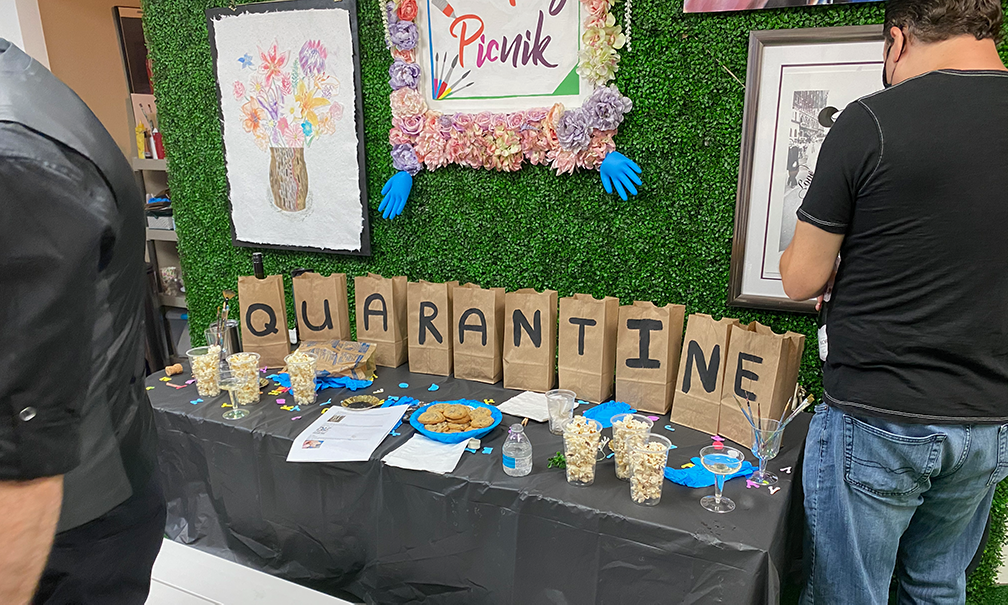
Facebook’s Messenger app offers another means of getting together visually as well as vocally (or just by text if you prefer). If you and the friend you want to “visit” are both on Facebook, use the Messenger app the same way you would use FaceTime. And then there’s Skype, which again offers visual and voice get-togethers. Most uses of Skype are free. (Calling a landline from Skype incurs a charge—but why would you want to do that anyway?) Instagram also has a video chat function for up to 6 people. And speaking of parties DJ D’Nice hosts “Homeschool at Club Quarantine” on his instagram channel @dnice, where on March 22nd of this year over 160,000 people danced while he DJ’d! Discord and WhatsApp are other free chat services that include voice, and text chatting.

Finally, you can have a party and invite a bunch of friends to join you — remotely. Zoom is an application primarily used for remote business meetings with which any number of people can get hooked in to a “conference.” If you limit your get-together to half an hour, it’s free. Or take some of the money you’re saving by not going out to your fave restaurant or other entertainment, and go for the Zoom plan that will let you stay in the conference for as long as you want. Invite your friends to pour a beverage (“adult” or soft), sit in front of the computer, and have a party or just a conversation.

Keep yourself productively busy

There are plenty of projects around the house and on your computer that aren’t “busy work” but are genuinely useful and really need to be done. What better time than now to do them?

Let’s start with a subject that’s dear to my own heart: writing. How many of you reading this have had an idea for a book, whether it’s the next Great American Novel, a self-help book, or a children’s story, but have put off sitting down and writing it for lack of time? You said maybe you’d write it some day when you retired. Well, now’s your opportunity. Go for it!

And speaking of writing, how about writing your memoirs, or your family history? I don’t mean for you to write this for publication. No, you’re writing for your children, your grandchildren, your great-grands, and beyond, and perhaps for your nieces, nephews, and cousins, as well. 

Now, while you’re at your computer, when’s the last time you went through it deleting old files you don’t need anymore? “Housecleaning” is a term that applies to your computer as well as to your kitchen. You go through your spice rack periodically, getting rid of old spices that have lost their pungency. You go through your fridge periodically, getting rid of old foods that should no longer be eaten even if they haven’t yet turned into “science experiments.” 

You go through your closets periodically, getting rid of clothes that no longer fit you or suit you. Do the same with your computer. Delete files you are sure you have no further need for. You’ll make room on your hard drive for new files and may well find your computer executing saves and other functions faster.

Now, moving on from your computer and getting back to your closets, when’s the last time you went through them all to see what’s in them — clothing and otherwise — that you and your family no longer want or need? Fill giant-sized bags with all the things you want to give away. When it’s once again safe to do so, you can venture out and drop the bags off at your favorite thrift store or other charity. And now that your closets are emptier, reorganize them.

Until then go online and check out organizations like Vietnam Veterans of American at scheduleapickup.com or American Veterans at amvets.org. 

What else in your house needs reorganizing? Your kitchen cabinets? Your bookshelves? Your kids’ toys? Maybe this is even a good time to reorganize the furniture in your living room, family room, or kids’ rooms. 

Some day — in the not-too-distant future, I hope — the need for social isolation will be over. But until then, you have ways to “visit” with your friends and plenty of projects to keep you occupied between visits.

Your neighbor, the black bear

As creeping urbanization slowly takes over nature’s wild habitats, denizens of the wild increasingly find themselves living in close quarters with us human folks — and foraging our garbage for food. Case in point: The black bear. Once you had to go camping to risk an encounter with creatures of the ursine kind, a.k.a. bear. Now you can step out into your backyard and surprise a black bear attracted by the smell of the steaks on your grill.

While finding a bear in your backyard (or while walking your dog in the neighborhood, or when you’re on a camping trip) can be startling, to say the least, and may make your pulse pound, black bears are not dangerous unless they’ve been confronted, according to Ray Simonsen, Sr., known as “Ray the Trapper.” 

Ray is a licensed nuisance wildlife trapper but says you don’t need to call a trapper if you encounter a black bear. “They’re very docile,” he says. 

You can chase it away yourself, but don’t turn tail and run, he advises. Instead, put your hands in the air. Clap your hands, and yell at the bear — something like, “Hey bear, get out of here, bear.” 

Back up. Don’t turn your back to the bear. You can get a small airhorn at a sporting goods store. One blast will scare the bear back into woods. The bears are more afraid of us than we are of them. There is also bear spray, available at local stores like Dick’s and Bass Pro Shops.

Although bears are normally docile creatures, if one is confronted or feels threatened by a human or a pet, it could react. As long as a bear has the means of a way out, it will retreat unless it has cubs in the area. But if cornered by people or pets, it could become aggressive. 

Bears have been known to tree themselves when scared. If you do encounter a bear and see it climb a tree, leave it alone. It’s not stuck in the tree. It will come down on its own. Just let any neighbors know that there is a treed bear, so they don’t approach the tree and bother the bear. If left to its own means of escape, it will be fine and not bother anyone.

While there’s no way to ensure you won’t have a bear encounter, especially if you’re camping, you can minimize the chances of finding one in your backyard: Keep your garbage cans covered and secured. Thoroughly clean out any backyard grill, fryer, or smoker, and don’t leave food droppings on the adjacent ground. Clean up promptly after a barbeque or picnic; no matter how tired you are, don’t leave the clean-up till morning. Bears can smell food from two miles away.

If you do find a bear in your yard, chances are he is just passing through — unless you’ve left something appetizing out. If the bear can get into your garbage or finds something else of interest, then, just like Arnold Schwarzenegger, he’ll be back.

You are more likely to see a bear in the spring at dusk and dawn. Like most other wildlife, they conserve their energy in the heat of the day. 

What you should not do in case of a bear encounter is shoot the creature. Bears are a protected species. They are losing more and more of their habitat to construction, but the good news (for the bears, if not for those humans who fear them) is that the Florida black bear is making a comeback. There are some estimated 1400 black bears in the state now, up from the low 100s in the 1970s. 

Their worst enemies are humans and cars. Despite laws, poachers still kill bears for their meat and/or their hides. And now there’s a new dark motive for bear poaching: extracting the bears’ gall bladders. It seems that the bile this organ produces is erroneously believed to have medicinal properties. 

The legal consequences for killing bears are less severe than those for killing turkey and deer out of season. But recent proposals would set the minimum fine for killing bears at $750 instead of the maximum $500 under current law. Also, hunting licenses could be suspended for three years, rather than the current yearlong maximum. There is now an effort on the federal level to stop the poaching of black bears. 

While a bear in your backyard that refuses to leave is unlikely, you are breaking the law if you shoot it. In such an event, call the Florida Fish & Wildlife Conservation Commission at 888-404-3922.

June 2020 Magazine

Jan 2020 Magazine

Feb 2020 Magazine

March 2020 Magazine

April 2020 Magazine

May 2020 Magazine

Travel Back in Time to Yesteryear Village

An obviously happy youngster, who couldn’t be more than 5 or 6 years old, beckoned her equally enthused friends into a building that you might not expect to pique the interest of small girls – a jail house. Nevertheless, the girl’s friends followed her to the old structure.

Inside, they found a statue of a prisoner in a striped uniform. Perhaps the girls’ experience unleashed their curiosity just a bit about their state’s past. The jail building stands amid other attractions at Palm Beach County’s Yesteryear Village. It is a living history park where the volunteers and staff’s aim is “opening people’s eyes to Florida’s history,” said Steve Barnard, a volunteer since 1998.

He is one of many volunteers who donate their time, among other things, portraying people from the state’s past. In Barnard’s case, he plays a fictional character, Lt. Ambrose Hall, a man inspired by Barnard’s family history. Ambrose was an “old family name,” he added. Barnard can speak with authority about one attraction in particular, a village fire department housing old-fashioned fire trucks. Barnard, a West Palm Beach resident, is a retired fireman who joined the city’s department when he was 40.  He recalled that when he joined the department, it was a time of horses and buggies.

Recently, he showed a visitor several fire trucks at Yesteryear dating back to the 1920s.  Up until then, the trucks were horse-drawn, he said.  Barnard, a man with grey hair and mustache, sporting work overalls on a recent day, speaks with a scratchy voice and states, “I love South Florida, it has some real cool history that most people don’t know about.”

The village comprises 9 acres on the South Florida Fairgrounds. ”If it wasn’t for the fairgrounds, the village wouldn’t be here,” said Paige Poole, Yesteryear’s Education and Community Relations Manager. The village displays buildings and artifacts from 1895 to 1945. Through audio on telephones, visitors can browse and learn about the original and replicated buildings including an old school, a farm, a blacksmith shop, a general store, a jailhouse and other places. In addition, Yesteryear features “the only big band museum in the United States, the Sally Bennett Big Band Hall of Fame Museum.”

Poole recommends that visitors allot at least two hours to tour the entire village. She says, “Past visitors love it, they absolutely love it, adding they’ve come from afar as Germany, Italy, Spain and Russia. There are a lot of unique exhibits here that people really enjoy.” For instance, if you wish to learn about a major crop in Palm Beach County, you can visit the sugar-processing exhibit.

Yesteryear Village also showcases a Southern Bell Telephone Exhibit dedicated to the history of the telephone. That term might sound like one from the past – especially in this day of cell phones and other technological advances.

“Speaking of technology, the village affords visitors and others a chance to unplug and go back in time,” said volunteer Marie St. John. On a recent day, St. John, in character, was showing youngsters how pioneers churned milk to make butter and make the liquid safe to drink. Back in her character’s day, everyone helped prepare a meal. “Everyone’s prepared some food for a feast,” she said.

 Visitors can learn about history at Yesteryear Village, one of Palm Beach County’s most unique cultural attractions. Yesteryear Village, located at 9067 Southern Blvd. in West Palm Beach.  Hours of operation are 10 a.m. to 4 p.m. Thursday, Friday and Saturday. https://www.southfloridafair.com/p/yesteryearvillage