Beat the heat Where to stay cool this summer in Broward, Palm Beach counties

Florida summers can be relentless, but there’s no reason to stay cooped up waiting for sunset. Across Broward and Palm Beach counties, there are plenty of ways to enjoy the season while staying cool—whether that means lacing up skates at the ice rink or spending an afternoon at a trampoline park. Here are some of the best spots to keep your family active, entertained, and out of the heat this summer.

Bowl and Cool Off

Bowling is always a reliable go-to when it’s too hot to be outside. Sawgrass Lanes in Tamarac is great for families, with plenty of lanes, arcade games, and food. Strikes in Boca Raton offers a vibrant, modern atmosphere with neon lights and an on-site sports bar—perfect for a group hangout or something low-key on a hot afternoon

Chill Out with Indoor Ice Skating

For a full-on escape from the heat, head to Panther IceDen in Coral Springs. The rink offers public skating throughout the week and is a fun, low-stress way to stay active indoors. It’s great for families, beginners, or anyone in the mood for a cool new activity.

Trampoline Parks for High-Energy Indoor Fun

Too hot for the playground? Sky Zone in Pompano Beach delivers wall-to-wall trampolines, foam pits, and dodgeball courts. Urban Air Adventure Park in Coral Springs ups the ante with climbing walls, obstacle courses, and even a virtual reality zone. Both are air-conditioned and perfect for burning off extra energy.

Indoor Adventure Parks with Something for Everyone

Xtreme Action Park in Fort Lauderdale is one of the biggest indoor fun zones in South Florida, with go-karts, roller skating, escape rooms, bowling, and more. For the younger crowd, Flippo’s Indoor Playground & Café nearby is ideal, with climbing structures, soft play zones, and interactive games in a cool, safe space.

Splash Parks and Pools

Nothing beats the heat like a day spent splashing around. Waters Edge Park in Tamarac has a splash pad with sprayers and shaded seating—great for younger kids. In Boca Raton, Coconut Cove Waterpark brings the full package with a lazy river, slides, and a big splash playground.

A Peaceful, Shaded Escape at Butterfly World

For something quieter, Butterfly World in Coconut Creek offers a calm, scenic outing. With covered walkways, lush greenery, and misting fans, it’s surprisingly comfortable, even on steamy days. It’s a great pick for relaxed family time or out-of-town guests.

Beach Clubs for a Breezy Daycation

Looking for a cool coastal escape without committing to a resort stay? Apps like DayPass and ResortPass make it easy to book daily beach and pool access at select local hotels. You can enjoy perks like loungers, towel service, poolside dining, and beachfront views—all without being an overnight guest. Spots like Plunge Beach Resort in Lauderdale-by-the-Sea and other nearby hotels often offer passes starting around $30–$60 per day. It’s a relaxed, convenient way to enjoy a little luxury and stay cool by the water.

Vegetarian cookout ideas for summer

Summer brings the unofficial start of grilling season. For some vegetarians and vegans, however, this means making do at backyard picnics with the same old appetizers or soggy green salads. But barbecues do not have to be a washout for those who do not eat meat. Classic cookout foods can easily be transformed into delicious vegetarian or vegan fare.

Main Dishes

When hosting, be sure to offer some sort of plant-based protein, which can be as simple as a chilled bean salad! You will also find meat-free burgers and hot dogs in most grocery stores. Or, if you are feeling adventurous, create your own homemade burgers made from beans, rice grains, or tofu.

Side Dishes

From pasta salad and quinoa salad, to pickled veggies and pico de gallo, there are lots of plant-based options to serve at your cookout.

Grilled vegetables are satisfying no matter what your eating pattern! Marinated and grilled portobello mushroom caps are tasty and offer a savory flavor that can be appealing to vegetarians and non-vegetarians alike. Or skewer mushrooms, peppers, squash, and tomatoes, then grill them until slightly charred.

Deviled eggs, potato salad, and macaroni salads are possible food choices for lacto-ovo vegetarians, and they can be modified for vegans by altering some of these recipes, such as substituting certain ingredients with dairy- and egg-free products. Try a vinegar-based dressing for broccoli or green bean salad. Or make a simple chopped salad using canned chickpeas, tomatoes, cucumber, and bell peppers.

For a more nutritious chip option, offer guests homemade kale or collard chips. Another traditional favorite is grilled corn on the cob.

 Desserts

You cannot go wrong with fresh seasonal fruit such as watermelon slices and an assortment of berries. If you’re looking for something more indulgent, soy, almond, cashew, and coconut milk–based ice creams command more shelf space in today’s frozen food aisle, and for good reason—they taste absolutely delicious! And if you want to join in for some s’mores around the campfire, gelatin-free marshmallows guarantee your place. Grilling? Try peaches, mangoes, pineapples, bananas, and other fruit. The heat caramelizes their natural sweetness.

On the Road

New vegetarians and vegans often find it difficult to ask hosts about food—what will be served and how it will be prepared. Most hosts, however, want their guests to enjoy themselves, so let them know you follow a vegetarian or vegan diet. You may be pleasantly surprised by their response. Some hosts will even go so far as to prepare dishes that are vegetarian- or vegan-friendly or at least not mind if you bring your own food.

If most dishes include meat, dairy, eggs, or cheese, offer to bring food to share with the crowd so you will not go hungry. As a courtesy, let the host know, as there may already be a crowded refrigerator or limited oven space—in which case, you can bring your own cooler or decide on a different recipe.

You will also want to follow good food safety practices. Bacteria grow rapidly between 40 and 140 degrees Fahrenheit, and vegetarians and vegans are not immune to food poisoning. Keep perishable foods in the refrigerator until you are ready to leave, and then keep cold foods chilled in an ice-filled cooler or by packing with frozen gel packs. If you are bringing food that is already hot, transport in a thermal container to help retain its heat. These foods should be reheated to a minimum internal temperature of 165 degrees once you arrive. Enjoy!

Trooper’s Law and the importance of animal hurricane preparations

As hurricane season approaches, a new law is going into effect to further protect dogs. Trooper’s Law, effective Oct. 1, will make it a third-degree felony to abandon a restrained dog during a natural disaster. The measure was inspired by Trooper, the bull terrier who made national headlines last year when state troopers found him tied to a fence and left in belly-high water on Interstate 75 during Hurricane Milton evacuations.

Trooper was adopted by Parkland residents Frank and Carla Spina and was honored at Parkland City Hall in January. “The state troopers appeared and presented him with a ‘Junior Trooper’ Florida Highway Patrol badge, which he wears around his collar,” says Frank Spina.

After being rescued and adopted, Trooper went through an even greater ordeal, requiring surgery to remove cancerous tumors from his body, and then undergoing a four-hour endoscopy to remove more than 100 pieces of garbage from his stomach. Thankfully, the procedures went well, and Trooper is now thriving.

Trooper and the Spinas have been invited to witness Governor Ron DeSantis officially sign Trooper’s legislation into law. “The governor and his wife are very big proponents of Trooper,” says Spina. “They think the world of him.”

Trooper’s situation was not the first to force lawmakers to expand protections for animals during natural disasters. The Pets Evacuation and Transportation Standards Act of 2006, known as the PETS Act, was passed and codified into federal law following the aftermath of Hurricane Katrina in 2005, when an estimated 200,000 pets were stranded and close to 150,000 perished during the storm. The act requires states to include the needs of households with pets and service animals in emergency preparedness operational plans in order to receive federal funding for those plans.

Florida was one of the first states to revise disaster relief plans to include household pets and service animals, creating pet-friendly shelters and aiding in pet evacuation and transport. But where the law still falls short is in protecting farm animals, including horses. Because they are not considered household pets, the PETS Act does not require states to incorporate hoofed animals into their emergency plans, and Florida does not have specific legal protections for these animals during hurricanes, despite the need for it. During Hurricane Ian, one dairy farmer in Myakka City lost 250 dairy cows.

The Florida Department of Agriculture and Consumer Services offers guidelines on disaster preparedness for horses, livestock, and pets, which include what to consider when sheltering in place or evacuating. For horse and livestock owners, it’s important to maintain contact with private businesses and nonprofits as many of them often step up during a storm, offering aid and/or shelter. During Hurricane Ian, the World Equestrian Center in Ocala provided free shelter for 3,000 horses, and American Humane helped rescue farm animals stranded during the storm.

Many of these organizations also offer free online resources on making preparations for your animals in case of a hurricane. It’s never too soon to prepare.

Tomorrow’s Rainbow When tragedy creates new purpose

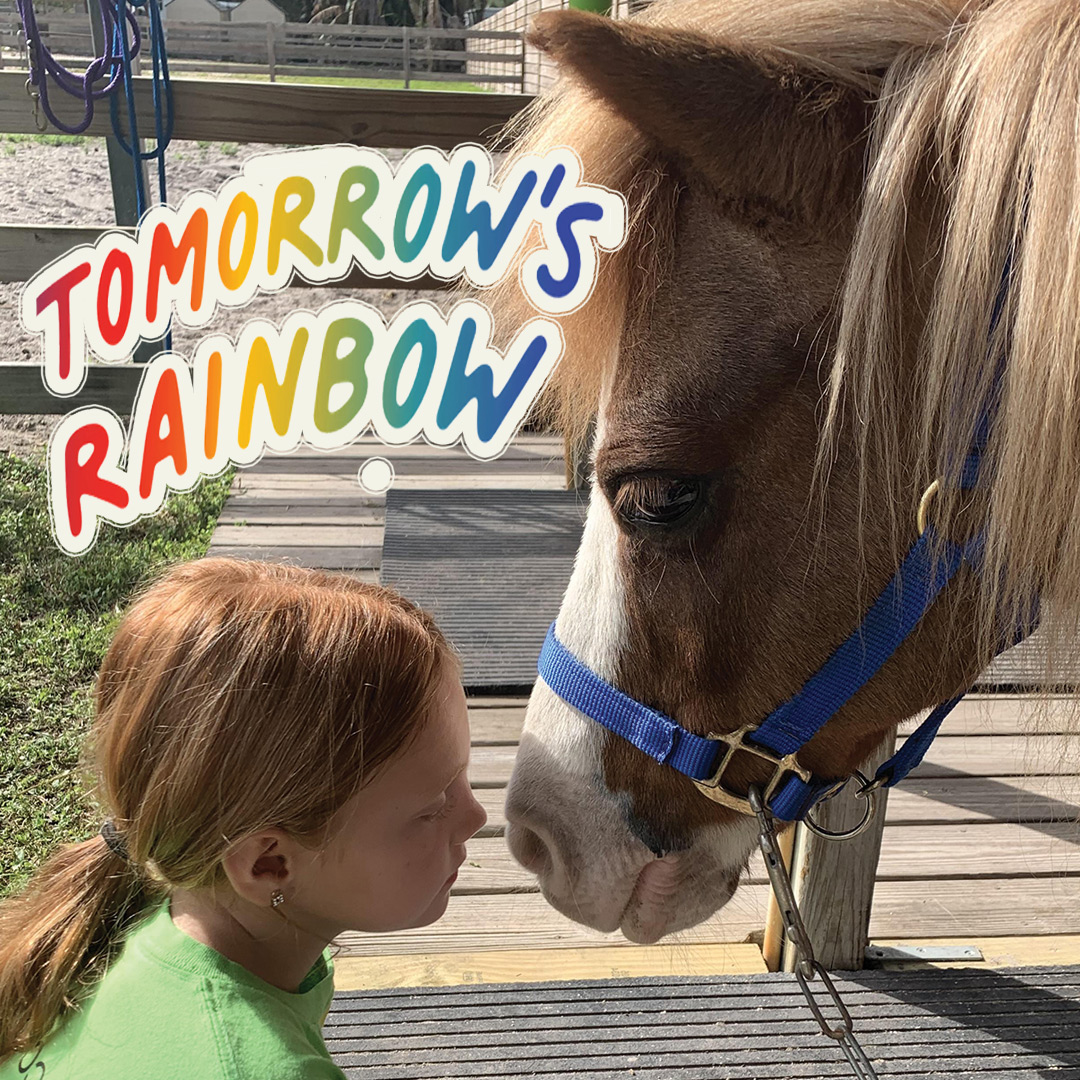
Abby Mosher turned a personal tragedy into purpose, creating one of the most magical places for children in Coconut Creek—Tomorrow’s Rainbow.

Tomorrow’s Rainbow is a 501(c)(3) nonprofit organization that provides free mental health support services for children ages 3 through 18, their caregivers, and adults healing from grief, loss, or trauma. What makes Tomorrow’s Rainbow special is that it incorporates animals—specifically, horses, goats, and mini donkeys—into its program, providing outdoor, experiential sessions where children explore their world through interactions with the animals.

This year, Tomorrow’s Rainbow will celebrate its 20th year of providing these life-saving services to children—services inspired by Mosher’s difficult loss. On a family vacation in Texas 25 years ago, a head-on collision took the life of Mosher’s husband, Paul. She and her 7-year-old son, Dustin, survived but were thrust into a world of grief and loss that didn’t have many resources available for children.

“When we came back to Florida, I thought, with Broward County being the sixth-largest school district in the nation, that there’d be tons of resources available,” says Mosher. “But I found that Broward County had no children’s grief center.”

Thankfully, Mosher had insurance, so her son was able to receive individual therapy. But that therapy had its limitations. “The social isolation for him was devastating,” explains Mosher. “He didn’t have a single friend he could relate to.”

That’s when Mosher decided she wanted to create a space where families could come together with other families who knew what it was like to have someone important in their life die. She also wanted to make it accessible for those who couldn’t afford individual therapy.

Mosher didn’t know at the time that her newfound dream would quickly align with her childhood dream of owning a horse. Through her work with the parent-teacher association, she knew Wally Hennessey, a Hall of Fame harness track racer. She and her son would go to the track to watch Hennessey race.

“After the race, Wally would take his goggles off, and he’d be covered in sand, and the horse’s nostrils would be flaring from winning the race, and Wally would be perfectly peaceful,” recalls Mosher, who wanted whatever that peacefulness was. When the Hennesseys introduced her to a woman with miniature horses, she knew the animals had to be part of her program.

Three years later, Mosher met her current husband, Shel, and shared with him her dream of supporting grieving children with horses, and he was on board. Together, they purchased a 2.5-acre mini-ranch adjacent to Tradewinds Park, and in 2005, Tomorrow’s Rainbow opened its doors.

It wasn’t until after opening and going through trainings with the Equine Assisted Growth and Learning Association that Mosher realized how powerful horses are in the healing process. “Horses are the only animal that can mirror our behavior,” explains Mosher. “The horse is the mirror for the child. So if the child doesn’t like what they see, if they adjust themselves, the horse will adjust as well.” Mosher likens it to a football player watching game tapes to get better. With horses, you watch their behavior to improve your own.

Tomorrow’s Rainbow offers bereavement group sessions and individual equine-assisted psychotherapy. When children first arrive, they undergo a screening process. Those who have suffered trauma in addition to grief are put into individual equine-assisted psychotherapy, where they work with a horse, an equine specialist, and a therapist. “We have to support the trauma before we can support the grief,” explains Mosher. “So we get them into our individual services and then when they’re ready, they can transfer to our bereavement group services.”

A bereavement session begins with introductions under a large tree, followed by an activity, horse grooming/interaction, and then play. “Kids can’t stay in their grief for a long time,” explains Mosher. “So we have to have opportunities for them to laugh and be kids.” During the bereavement session, adults are in a facilitated talk circle and given some psychoeducation on raising grieving children.

Children often tell their stories through the activities, acting out what happened at the puppet theater, or building something related to their loss at the LEGO table. Program facilitators are trained to honor the children’s stories and provide the space for them to express without judgment or shame. “We’re not teaching them how to grieve,” explains Mosher. “Children are experts in their own grief. We are supporting them. We’re not giving advice, we’re not problem-solving. It’s not a problem we can fix.”

At the end of a session, children are taken into a room filled with teddy bears where they can symbolically light a candle to remember their loved one. These charming, child-friendly touches run across the property, from the puppet theater to the teddy bear hospital to the wishing well. “We have dissolving paper so the children can write messages to their loved ones and put them in the wishing well, and the paper will dissolve, but the words will stay floating on top of the water until they’re ready to swirl it,” says Mosher.

To ensure that children of all economic backgrounds have access to these services, there is no cost for the bereavement groups. A combination of corporate and private donations, along with grants from organizations including Parkland Cares, Broward Behavioral Health Coalition, and the Jim Moran Foundation, helps offset the cost of individual psychotherapy sessions, which are normally $150 per hour. The organization runs on a tight budget, but for Mosher, the priority is the impact these services have on children.

“They come in with the weight of the world on their shoulders, and they leave joyful,” enthuses Mosher. “The energy completely changes when they realize they’re not alone and they don’t have all that stuff bottled up inside anymore, because they had a safe space for it to come out. And nobody made fun of them, nobody told them how to feel, and nobody tried to change them in any way, they just honored their journey.”

In addition to its on-site work, Tomorrow’s Rainbow has a “Grief on the Go” trailer to support underserved communities in Broward and Palm Beach counties through partnerships with nonprofits that work with at-risk children.

For Mosher, Tomorrow’s Rainbow has become her life’s mission. “I feel like I don’t work a day in my life,” she says. “To see the children and the impact this program has on their lives is a blessing. I knew we were going to help children heal. But what I didn’t know is that we would literally be saving lives, and that’s pretty powerful.”

For more information, visit TomorrowsRainbow.org.

The Politzer Saga – One Woman’s Journey from Secrets to Self-Discovery

“You are the sum of your ancestors,” says a Jewish proverb, expressing the sentiment that each individual is a living continuation of those who came before them.

In the wake of the Holocaust, it’s not unusual for people to unearth long-lost Jewish roots, and a lineage they may not have known about. Out of fear for their survival, many people concealed their Jewish identity.

Such is the case for Virginia resident Linda Ambrus Broenniman, 69, when an unexpected discovery after a 2011 fire in her parents’ home led her to uncover a treasure trove of a lost Jewish heritage and relatives going back eight generations to 18th-century Hungary.

Buried within 77 boxes in her parents’ attic were documents, photographs, heirlooms, letters, and other ephemera of lives lived and lost, and a long history of accomplished artists, doctors, business owners, freedom fighters, art collectors, and musicians—all of whom Broenniman was unaware.

Broenniman was the middle child of seven born to Julian Ambrus and Clara Bayer, Hungarian physicians who survived World War II and started their new life in Buffalo, New York, in 1949. She was raised Catholic in a family that went to church every Sunday. She had no idea that her father was Jewish and that her non-Jewish mother had actively hid Jews, including her father and his mother, during World War II and the Nazi occupation of Hungary.

The revelation was like opening a door to a lost part of herself, igniting an eight-year journey back in time, culminating with a book she researched and wrote, titled “The Politzer Saga,” which reconnected Broenniman with the people, traditions, and history that silently shaped her identity.

Broenniman was in South Florida in March to talk about her book and spoke at the Sinai Residences in Boca Raton and at Harbour’s Edge senior living in Delray Beach. “I didn’t intend to write a book,” says Broenniman, who has an MBA from Carnegie Mellon University and worked as an entrepreneur and in corporate America.

“I just wanted to understand my family’s history,” she says. As she learned about that history, she read many books about the era her relatives lived in and says the more she read, the more she realized she needed to capture it and make sense of it all, and she began writing it all down.

While as a child, Broenniman had a sense there were family secrets, it wasn’t until she was in business school in 1983 at the age of 27 that she learned of anything. Her older sister went to a medical convention in Montreal, Canada, and stayed with a relative. Her question, “What was our great-grandmother like?” elicited a surprising response. “Well, like most strong, Jewish women…,” the relative began, and “shocked her sister into silence.”

Busy in graduate school, Broenniman didn’t fully absorb the clue until a friend, Yona Eichenbaum, gave her Daniel Mendelsohn’s book, “The Lost: A Search for Six of Six Million,” one of the first books to come out searching for lost Jewish ancestry.

“I’m so proud of Linda and what she has accomplished,” says Eichenbaum, an essayist for The Forward and The Toronto Globe and Mail. The two met in graduate school and have remained friends.

In 2023, Eichenbaum and her husband accompanied Broenniman to Hungary where they attended Shabbat services in the Dohány Street Synagogue, the largest in Europe, and sat in the same seats as had Broenniman’s grandparents. “Linda is one of the smartest and most resourceful people I know,” Eichenbaum says. “I’m so proud of what she’s accomplished.”

As a child of Polish Holocaust survivors, Eichenbaum saw similarities in her family’s story of immigration to Canada with that of Broenniman’s family story immigrating to the U.S. “I was bowled over by Linda’s discoveries of her family history,” she says. “Bowled over, but not surprised.”

Eichenbaum encouraged Broenniman to write down everything she was uncovering and said, “If you don’t write it down, they [your relatives] will have died twice.”

Broenniman took her friend’s advice. In 2006, her mother had received a letter in the mail from Yad Vashem, Israel’s memorial museum dedicated to preserving the memory of those Jews murdered in the war, wanting to honor her with a designation, “Righteous Among the Nations,” an honor given to non-Jews who took great personal risks to save Jews during the Holocaust.

At just 19 years old, Broenniman’s mother, Clara Bayer, risked her life and endured nine months of terror, hunger, and cold to save Jews during the Holocaust.

In addition to her future husband and his mother, she hid her friend Éva Fisher Klein and her boyfriend, Rabbi Béla Eisenberg, as well as both their families. Ironically, in 2006, while her father gave the acceptance speech in New York (“inspirational,” says Broenniman), he never once mentioned that he was Jewish and that Bayer had saved his life by hiding him from the Nazis.

Despite having advanced Alzheimer’s disease at the time, when receiving the honor, Broenniman’s mother said, “I did what any decent human being would do,” something Broenniman is proud of to this day. It was the first time she learned of her mother’s heroic actions during the war.

To write “The Politzer Saga,” Broenniman enlisted the help of Hungarian researcher András Gyekiczki, and the two uncovered not only a long line of accomplished ancestors, but also tales of resilience and achievement.

“I was blown away by the incredible rich heritage that we found,” says Broenniman, whose own sense of identity and belonging has evolved as she pieced together the threads of her family’s past and discovered a newfound interest in Jewish history and culture. Many of her ancestors came from the town of Politz in then-Czechoslovakia and had the surname Politzer.

One of the most well known was Ádám Politzer, a famous otolaryngologist known as the “founder of clinical otology” (the study of the ear), who lived in Vienna (1835–1920) and treated the Emperor Franz Josef and Tsar Nicolas II.

To this day, the Politzer Society for Otologic Surgery and Science is an active society with annual meetings and awards. Politzer was known for his skills as a physician, researcher, teacher, historian, and artist. “Ask any ENT surgeon today, and they will know the name Ádám Politzer,” says Broenniman. “He was the most influential otologist of the 19th century.”

Learning about Politzer’s life and achievements had a special resonance for Broenniman, who came to realize that her father, an oncologist who loved his patients and students, almost certainly modeled himself and his career after Politzer’s. “To hide that knowledge and awareness must have been very tough for my father,” she says.

Other ancestors that Broenniman came to cherish and feel connected to include her great-grandmother Margit (Broenniman’s middle name is Margaret) and Rachel, a young woman at the time who chose Judaism when her parents converted to Christianity and moved to the U.S. After her older brother convinced the family to convert from Judaism and emigrate to the U.S., Rachel refused to be baptized and to leave home. She fled from her father’s home in the middle of the night, and the rest of her family left Zalaegerszeg in western Hungary for the U.S. without her. “Your descendants will be blessed forever,” she was told by the rabbi.

“My eyes welled up when I read this story,” Broenniman writes. “I was one of Rachel’s descendants, her great-great-great-great-great-granddaughter.

“I sighed, grateful that her courage and convictions were rewarded with such a blessing,” she writes. Hard to put into words, she was touched by the story and its meaning.

Broenniman also admires another relative, Ignácz Misner, an attorney who helped found the Hungarian bar and who was the father of her namesake, Margit. They were forced into the Jewish ghetto in 1944 under the Nazis and to wear the yellow Star of David, and the family home and all their possessions were confiscated. They were ordered to move into a “yellow star home” and forced to share the home with other families, one family to a room.

“Ignácz did not want to take off the yellow star; he wore his Judaism as a matter of pride,” Broenniman quotes a cousin in the book.

“I found remarkable relatives who believed in truth and justice and had unshakeable faith,” says Broenniman. She has reconnected with lost relatives, and she’s found Politzers in Hungary, England, and France.

In addition to the book, the results of Broenniman and Gyekiczki’s research turned into a permanent exhibition in the education and cultural center of the 1872 Rumbach Synagogue in Budapest, Hungary. Along with Zsuzsa Toronyi, director of the Hungarian Jewish Museum and Archives, Broenniman worked to create the exhibit, comprising 10 lyrical and artistically rendered seven-minute films about eight generations of Politzers, all based on the stories Broenniman uncovered.

“Zsuzsa shares a vision that my family’s stories can stimulate new awareness, especially among Hungarian Jews, about the power of ancestral legacies,” Broenniman writes in her book.

Broenniman herself has a newfound awareness of her Jewish background and says she was most surprised by her family’s “incredible, rich heritage.” She writes, “It wasn’t enough to find the family my father never spoke of, I needed to write their stories.”

She says, “It is a way to connect to their lives and to make them even more real. I honor my ancestors’ memories and experience the true meaning of the Jewish statement of condolence, ‘May their memory be for a blessing.’”

And while Broenniman hasn’t replaced going to Sunday services at church with Saturday services at synagogue, she does say she has found a new appreciation for Jewish culture and is more sensitive to the effects of anti-Semitism.

“I am more aware of Jewish holidays, ‘Jewish-isms,’ and keep abreast of Jewish issues,” she says. “My mother always raised us to treat everyone with respect, dignity, and compassion, and I live by that.”

To learn more, visit politzersaga.com.

 

Autism awareness Understanding the spectrum and the importance of accountability

Autism awareness has grown significantly over the years, but misconceptions persist—misconceptions that often do more harm than good. Many people mistakenly believe that behaviors such as aggression, elopement (running away), or inappropriate touching are inherent to autism. Others believe that children on the spectrum must be shielded from discomfort rather than taught how to handle real-world challenges.

These ideas are not just wrong—they can prevent children from developing the skills they need to succeed. Autism is a spectrum of traits, but it is not an excuse for inappropriate behavior, nor a reason to avoid necessary challenges. The focus should be on teaching, adapting, and reinforcing accountability, not on allowing harmful behaviors or reinforcing sensitivities through over-accommodation.

Misconception 1: Everyone is “somewhere on the spectrum”

Many believe that autism exists on a linear scale, with individuals falling somewhere between “mild” and “severe.” The reality is that autism is a collection of traits that everyone exhibits to varying degrees—but simply having some traits does not mean someone is autistic.

For example, some people—both autistic and neurotypical—may do the following:

  • Struggle with social cues and understanding personal space.
  • Prefer routine and predictability over change.
  • Have sensory sensitivities (e.g., loud noises, strong smells, certain textures).
  • Experience intense focus on specific interests.

The difference is that for individuals diagnosed with autism, these traits become so extreme that they interfere with daily functioning—affecting communication, independence, and relationships. Simply having traits that overlap with autism does not mean that a person is autistic.

This distinction is important because it shifts the focus from labeling individuals as “on” or “off” the spectrum to identifying specific challenges and providing appropriate support.

Misconception 2: Aggression, elopement, and inappropriate touching are part of autism

One of the most damaging myths about autism is that behaviors like aggression, running away (elopement), and inappropriate touching are symptoms of autism itself. This is false.

  • Autism does not cause aggression.
  • Autism does not cause a child to run away.
  • Autism does not cause inappropriate touching.

These behaviors occur because of a lack of boundaries, structure, or consequences, not because of autism. When neurotypical children hit, touch people inappropriately, or run away, they are corrected and disciplined. However, when an autistic child exhibits these behaviors, many parents and educators wrongly excuse it, saying such things as “He can’t help it—he’s autistic”; “She doesn’t understand—she’s on the spectrum”; or “There’s nothing we can do.”

This excuse-based mindset allows these behaviors to continue unchecked. Instead of reinforcing self-regulation, accountability, and appropriate alternatives, it sends the message that autistic children cannot control their actions—which is not true.

Misconception 3: Sensory sensitivities should be avoided, not overcome

Another damaging belief is that children on the spectrum should be shielded from any discomfort rather than taught how to handle real-world challenges. Over-accommodation reinforces sensitivities, rather than helping a child adapt.

Every baby is startled by loud noises and unexpected sounds. A child on the spectrum may have a more extreme reaction, but the brain is capable of desensitization through repeated exposure. The key is gradual, controlled desensitization—not avoidance.

Real-Life Example: Desensitization vs. Accommodation

One child struggled with the loud sounds of a car wash and public restroom toilets. Instead of avoiding those situations:

  • Her mother took her through the car wash repeatedly until she no longer cried.
  • Her father spent hours in public restrooms flushing toilets until she no longer reacted.

Some may view this as punitive, but it was actually a critical step toward her functioning in the real world. Had the parents avoided car washes and public restrooms, she would have continued to experience severe distress whenever faced with those unavoidable noises. Instead, through consistent exposure, her brain adapted.

Why Over-Accommodation Is Harmful


Many parents immediately remove the triggers (using noise-canceling headphones, avoiding public places, limiting activities). While this may seem helpful in the short term, it reinforces avoidance behavior and makes the world feel even more overwhelming as the child grows older.

  • If a child is never taught how to handle loud environments, they may struggle with shopping malls, airports, movie theaters, and concerts.
  • If a child is always given special accommodations instead of learning coping strategies, they may struggle with workplace expectations and social relationships in adulthood.

The goal of early intervention should be helping children adjust to the world, not reshaping the world to eliminate every challenge.

The Key to Success: Accountability and Exposure, Not Excuses

Autism affects each individual differently, and some children require extra instruction and reinforcement to develop social and emotional regulation. However, this does not mean they are incapable of following rules or learning to cope with discomfort.

  • Aggression should be addressed through emotional regulation strategies, communication alternatives, and immediate consequences.
  • Elopement should be handled with structured transitions, visual schedules, and direct instruction on safety awareness.
  • Inappropriate touching should be corrected with clear social skills training and reinforcement of personal boundaries.

If a child acts out, the behavior should not be excused—it should be corrected and replaced with an appropriate alternative

Final Thought: The Goal Is Independence, Not Excuses

True autism awareness isn’t about labeling behaviors as part of a diagnosis—it’s about recognizing that every child is capable of learning, growing, and improving when given the right tools.

By shifting the conversation away from excuses and avoidance and toward structured teaching, self-regulation, and accountability, children on the spectrum are given the best chance for success—not just in school, but in life.

Dr. Lance Fein is the executive director of AEF Schools. AEF helps students build the skills they need to thrive academically and in life. With a curriculum designed to enhance cognitive, social, and life skills, AEF goes beyond academics to ensure that each student gains the confidence and independence needed for long-term success. To learn more, visit www.aefschools.com

Understanding culinary lingo

Braise, broil, poach, simmer: What does it all mean? Following healthful recipes is easier if you understand cooking vocabulary. Whether you are new to the kitchen or just need a refresher, understanding the basics of common cooking techniques will help you navigate through recipes and get healthy meals on the table with ease. From slicing to steaming, here is how to talk the talk in the kitchen.

The Bs, Cs, and Ds of Cooking

  • Bake:type of dry-heat cooking—food is cooked using the hot air surrounding it, usually in an oven
  • Barbecue (grill):type of dry-heat cooking—to roast or broil food over a source of heat like charcoal or hardwood fire
  • Boil:type of moist-heat cooking—a liquid is brought to a boil, and food is cooked in it
  • Braise: to brown, then simmer slowly over low heat in a small amount of liquid in a covered pot, on the stove or in the oven
  • Broil: to cook using a direct heat source, usually under a heating element in the oven, but it also can be done over the flame of a grill
  • Chop:to cut food into smaller pieces of no particular size or shape
  • Deep-fry:type of dry-heat cooking—cooking food by submerging it in hot oil
  • Dice:to cut foods into uniform, square pieces
  • Dry-heat cooking: methods that use hot air, the heat from a pan or grill, or hot fat to cook foods

From G to Ps & Qs

  • Grate:to create small (fine or coarsely shredded) pieces by rubbing food against a serrated surface
  • Mince:to cut food into very small pieces
  • Moist-heat cooking:methods that use water or liquids such as broth to cook foods
  • Panbroil:to cook uncovered in a preheated skillet without added fat or water
  • Poach: type of moist-heat cooking—to cook gently in simmering liquid
  • Quadriller:to make a crisscross pattern on the outside of grilled or broiled food

R to Z

  • Roast:type of dry-heat cooking—to cook uncovered with dry heat in the oven or in a fire
  • Sauté:type of dry-heat cooking—to cook quickly in a small amount of fat
  • Simmer:type of moist-heat cooking—cooking food in a hot liquid that is bubbling but not boiling
  • Slice:to cut through or across into slices, generally of uniform size
  • Steam:type of moist-heat cooking—to cook a food over boiling water with the steam heat, or wrapped in foil or leaf (such as banana leaves) packets over boiling water or on a grill
  • Stew: to cook in a liquid, in a tightly covered pot over low heat
  • Stir-fry:to cook small pieces of food over high heat, stirring continuously—generally with only a small amount of oil
  • Zest:to scrape the outer rind of a piece of citrus fruit for flavoring

Be in the Know

Knowing these culinary techniques can help to bring out the flavor of foods without adding a lot of extra ingredients or calories. The healthiest cooking methods require only a little amount of fat:

  • Sautéing and stir-frying use a small amount of oil, compared with frying or deep-frying.
  • Steaming helps foods retain more nutrients, because they are not soaking in water, as is the case with boiling.
  • Grilling also can influence the flavor of foods, but it’s important to avoid charring them, which occurs when foods turn black.
  • Marinating meats and vegetables prior to grilling can help add flavor and keep them moist.

And remember, cooking all foods at the appropriate internal temperatures is important, regardless of how the food is prepared!


Local Easter brunch and Passover meals

Spring is in full swing, bringing with it festive celebrations and, of course, delicious food! Whether you’re searching for the perfect spot for Easter brunch or for a place that prepares traditional Passover meals, here are some wonderful local dining options to make your holiday celebrations extra special.

Easter Brunch

Tap 42

Known for its lively atmosphere and craft beer selection, Tap 42 serves up a delicious brunch menu featuring favorites like chicken and waffles and truffle-infused mac and cheese.

The Original Pancake House

A go-to spot for breakfast lovers, this classic eatery is famous for its fluffy pancakes and hearty morning staples—perfect for a relaxed Easter brunch.

First Watch

If you’re in the mood for a fresh and health-conscious brunch, First Watch offers a variety of options, from traditional favorites to innovative dishes made with wholesome ingredients.

Farmhouse Kitchen

This cozy farm-to-table eatery specializes in organic, locally sourced brunch dishes, from avocado toast to decadent French toast, making it a great Easter brunch choice. 

Passover Meals

Aroma Kosher

Aroma Kosher offers a delicious selection of Passover meals, featuring traditional favorites like matzo ball soup, tender beef brisket, and crispy potato pancakes. Whether you’re dining at home or hosting guests, their takeout options make celebrating Passover easy and enjoyable.

Ben’s Kosher Delicatessen—Boca Raton

A go-to spot for authentic Jewish cuisine, Ben’s Kosher Delicatessen offers Passover meal packages with all the traditional fixings, making it easy to enjoy the holiday without all the prep work.

Fooderie—Coral Springs

This local kosher grocery store provides a wide variety of Passover essentials. It’s a great option for those looking to prepare their own holiday dishes while ensuring that everything meets kosher-for-Passover standards.

Grove Kosher Market

Grove Kosher Market is a one-stop shop for all your Passover needs, offering a wide selection of kosher-for-Passover groceries, prepared meals, and specialty items. Whether you’re cooking from scratch or looking for ready-to-eat dishes, they provide high-quality options to enhance your holiday celebration.

No matter how you celebrate, there are plenty of great local spots to make your holiday meal feel special. Whether you’re enjoying a festive Easter brunch or a meaningful Passover dinner, you’ll find delicious food and a welcoming atmosphere to share with the people who matter most.

From Ironman to Centenarian – A Bodybuilder’s Legacy

A lifetime commitment to physical fitness, healthy and drug-free living and a passion for bodybuilding has paid off for Parkland resident and WWII veteran, Andrew Bostinto, as he celebrated his 100th birthday on Jan. 11 by – what else – doing what he loves – working out at the gym.

His long and fulfilled life is defined by two passions – his three years spent in the army in the 101st Regiment, 26th Infantry – and his years devoted to bodybuilding.

In 1979 he founded the National Gym Association (NGA) a not-profit organization that supports the philosophy of natural strength training and bodybuilding with a mission to encourage drug-free athletes and is still active today.

He was the first in the industry to develop a personal trainer’s fitness certification program and in 2006 co-authored, “Become Your Own Personal Mental Fitness Trainer.”

He was friends with other well-known body-builders (or, as they called them at the time, muscle-men) Arnold Schwarzenegger, Lou Ferrigno and Jack LaLanne and in 1977, won the title of Senior Mr. America, at Madison Square Garden.

In 1963, Bostinto opened his own gym, the Olympia Gym and Health Club, in Queens, N.Y.

He lectured at Queens College on exercise and nutrition and personally trained many well-known celebrities, including Cyndi Lauper, Regis Philbin, Al Pacino during filming of the 1993 film, “Carlito’s Way,” and his favorite, Patrick Stewart from “Star Trek:  The Next Generation.”

He officiated at numerous national and international events, such as Mr. Olympia 1970-1971, and was a guest on many local New York television shows discussing physical fitness and bodybuilding.

In May 2025, he plans to earn the title of the “World’s Oldest Bodybuilder” for the Guinness Book of World Records in a competition in Deltona, Florida.

“Andy is still in great shape,” says his wife of 34 years, Francine Bostinto, 67, who is the current president of the NGA.  The couple, who met at Jacob Riis Park beach in Brooklyn, has been together 44 years and have one son, Dillon, 27, together.  Andrew Bostinto has a son (now deceased) and daughter from a previous marriage.

Aside from some knee and balance issues, Francine Bostinto jokes, “I take full credit for his longevity; this is what happens when you marry a much younger woman.”

Looking more like 75, than 100, Bostinto says when her husband wears his hat and medals, people mistake him for a Vietnam-era veteran, not a WW II veteran.  With smooth skin and no wrinkles (his mother lived to 99), Bostinto says her husband is a “good talker,” likes to watch TV, go grocery shopping and likes to cook eggs, pasta and burgers.

For Francine, he cooks her favorite pasta dish, pasta with green peas.

He doesn’t follow a special diet but his wife says he has a good metabolism and eats mostly anything.

In Joe Bonomo’s 1943 book, “Body Power,” Bostinto was called “one of 20 of the world’s most perfect super-strongmen,” and in 1972 at the age of 46 was featured in the magazine, “Muscle Training Illustrated,” where he talked about his diet and training regimen of leg presses, bench presses, parallel dips, sit-ups, shoulder, triceps and lat reps.

In December, the couple returned from a trip to Belgium, Luxembourg and Germany on the 80th anniversary of the Battle of the Bulge, (“the greatest American battle of the war”), Hitler’s last major offensive against the Western front, which paved the way for a Allies’ victory.

“This was the most meaningful event of my life,” says Bostinto about the experience, where he and other returning veterans, Louis Brown, Ed Cottrell, Jack Moran and Lester Schrenk, all of whom are between 99 and 102 years old, were treated like royalty and returning heroes.

“Going with Andy on this trip is the best decision I ever made,” says Francine Bostinto.  “These countries laid out their red carpet for these American veterans.”

Organized by Boston police officer and Iraq and Afghanistan War veteran, Andrew Biggio, author of “The Rifle,” Biggio is the founder of Boston’s Wounded Vet Run, New England’s largest motorcycle ride dedicated to severely wounded veterans.

Inspired by nostalgia and to honor an uncle and namesake who lost his life fighting in WWII, Biggio bought a 1945 M1 Garand Rifle, the most common rifle used in WWII, and had a neighbor, a WWII veteran, sign it.

This launched him on a mission to find the remaining WWII veterans and have them sign his rifle and tell their stories in his book.

Funded in part by a GoFundMe campaign which raised $32,814, Biggio, organized the trip to bring the American veterans back to the site of the battle in Bastogne, Belgium.

He told the Boston Herald in December, “What was important about this is that there isn’t going to be a 90th anniversary for these guys, same thing for D-Day. This was the last big anniversary for a big number of them.”

According to statistics from the Department of Veterans Affairs, fewer than 1 percent, or roughly 66,000, of the 16.4 million Americans who served during WWII are still with us today.

“We’re both so grateful to have had this opportunity,” says Francine Bostinto, where in a whirlwind week, they met the king and queen of Belgium, the duchess of Luxembourg, Senator Bob Graham of Florida, the mayor of Bastogne and other dignitaries, Helen Patton, the granddaughter of General George Patton, actors from the film, “Band of Brothers,” took part in a parade, visited a castle and the Bastogne War Museum and met with many locals, who Francine Bostinto says were “profusely grateful” to the Americans.

“It was “overwhelming” Andrew Bostinto says.  “There was so much gratitude.”

He was particularly moved by the fervor of little kids who waited in long lines and turned out to shake his hand and buy an autographed copy of “The Rifle,” which he and the other veterans signed for more than five hours.

In a post from Facebook on Dec. 15, reflecting on that day, Francine Bostinto writes, “Wherever we go, people applaud and bring gifts.”

They also visited Wereth, Belgium and a memorial to 11 American Black soldiers from the African American artillery battalion, a segregated unit, who were tortured and massacred by German SS troops on Dec. 17, 1944, in an event known as the “Werenth 11 Massacre.”

They appeared on the front page of many local publications, including the German newspaper, “Bild,” (“Der Terminator und der U.S. Veteran (99)” with the sub-heading, “Arnie Owes his Career to this Friendship.”

“I think the Belgian people remember tremendously,” Biggio says in a video post. “They crowd the streets, they crowd the museums so that we can’t even walk because they just want to get a glimpse of an actual WWII veteran who liberated them.”

“They’re taught at a very young age that these guys are superheroes,” he says.  “Most of them want autographs to keep and to wear on their jackets.”

Being a hero was not on Bostinto’s mind, but being focused and methodical was.

Training since the age of 13, Bostinto still works out on the treadmill and does weight training, including his favorite lat pull-down, five days a week at the Planet Fitness in Coconut Creek.

The self-described, “very analytical, very organized and very disciplined” bodybuilder and veteran who was born on the Lower East Side of Manhattan and grew up poor in Brooklyn, shares the wisdom he’s garnered over a productive and meaningful century of life.

“Know yourself,” he says.  “Know your priorities and your values and who you are innately.”

Nolan McMurry, 25, the manager at Planet Fitness and a self-described “WWII fanatic” says, “As a WWII veteran, Andy is a piece of living history.  I’m honored to know him and always enjoy hearing his stories about his time serving overseas.”

McMurry says the gym plans to mark Bostinto’s birthday with cake and a celebration.

“Andy had an amazing career as a professional bodybuilder and with founding the NGA and he’s still dedicated to helping people, working out and staying fit,” he says.  “He always has interesting stories to share and I always learn a lot from him.”

“He’s one of a kind and truly a living legend.”

25 heart-healthy eating tips

February is American Heart Month, a time to pay special attention to understanding, preventing, and treating heart disease. Certain foods can lower your risk of heart disease or help to manage it, while other foods may increase your risk. Try these tips for preparing heart-healthy meals.

Choose Healthier Types of Fat and Cooking Methods

  • Use small amounts of oils, such as canola and olive, in recipes and for sautéing.
  • Make your own salad dressings with olive or flaxseed oil.
  • Blend mashed avocado into dips, or use small amounts to add flavor to dishes.
  • Try different ways of cooking foods, such as baking, broiling, grilling, steaming, and poaching, to add variety.

Eat Foods Containing Omega-3 Fatty Acids

  • Add walnuts to cereal, salads, or muffins. Try walnut oil in salad dressings too.
  • Eat two 4-ounce portions of fatty fish each week. Some options include salmon, lake trout, canned light tuna (in water), mackerel, and sardines.
  • Some chickens are given feed that is high in omega-3s, so their eggs will contain more as well. When buying eggs, check the package label.

Include Sources of Dietary Fiber Throughout the Day

  • Include plant-based foods as sources of protein, including tempeh, beans, lentils, seeds, and nuts.
  • Make half your plate fruits and vegetables at each meal.
  • Opt for whole fruits and vegetables instead of 100% fruit juices more often, and don’t discard edible peels. Removing the peels on produce, such as apples and potatoes, lowers their fiber content—just be sure to wash them before preparing or eating.
  • Choose whole grains instead of refined grains whenever possible.

 Limit Saturated Fat

  • If you eat meat, select lean cuts of beef and pork, especially cuts with “loin” or “round” in their name, and drain the fat off cooked, ground meat.
  • Cut back on processed meats high in saturated fat, such as hot dogs, salami, and bacon.
  • When you make a stew or soup, refrigerate leftovers and skim off the fat with a spoon before reheating and serving.
  • Replace higher-fat cheeses with lower-fat options, such as reduced-fat feta and part-skim mozzarella.
  • Thicken sauces with evaporated, fat-free milk instead of whole milk.
  • Move toward using lower-fat milk and yogurt. Start with 2% products, then move to 1%, and finally to fat-free to adjust to the new taste.
  • Choose skinless poultry, or remove the skin before eating chicken or turkey.
  • Check the Nutrition Facts Label on food packaging for saturated fat content and to see if trans fat or partially hydrogenated oils are listed. Food manufacturers have removed trans fats from their products, but some foods with longer shelf-life dates—such as cakes, cookies, crackers, pastries, pies, muffins, and doughnuts—may still contain them. These foods also are sources of added sugars and should be limited for that reason as well.

Reduce Salt (Sodium)

  • Prepare foods at home more often so you can control the amount of salt in your meals.
  • Use as little salt in cooking as possible. You can cut at least half the salt from most recipes.
  • Skip the table salt and be mindful when adding other higher-sodium condiments such as soy sauce, ketchup, pickles, and olives to your food at the table.
  • When choosing canned foods, select “reduced-sodium” or “no-salt-added” soups and vegetables.
  • Check the Nutrition Facts Label for sodium, and choose products with lower sodium content.
  • Season foods with herbs, spices, garlic, onions, peppers, and lemon or lime juice to add flavor.

Sweet spots Exploring the best local chocolate shops around town

As February settles in, love is in the air; and what better way to celebrate than with the indulgence of rich, decadent chocolate? Whether you’re treating a loved one, helping yourself to a treat, or sharing a sweet moment with friends, local chocolate shops have you covered with everything from truffles to ice cream. Here is a closer look at the best local chocolate spots that are adding a little extra sweetness to our February.

Kilwins Coral Springs

2758 N. University Drive, Coral Springs

Best known for chocolates, fudge, and ice cream, Kilwins makes many other delicious sweets, including barks, brittles, candies, clusters, taffy, truffles, and chocolate-covered pretzels, Oreos, and Rice Krispies. Whether you’re looking for an after-dinner frozen treat or a gift basket for someone special, Kilwins is a must-visit.

Signature treat: Signature Turtle Caramel Apple

Mindy’s Munchies

8182 Glades Road, Boca Raton

Discover Mindy’s chocolate-covered creations—from Marshmallow Mountains to its dark chocolate Coconut Bliss, Oreo delicacies, salty, chocolate-coated pretzels, and the most delectable hand-dipped creations. Mindy’s offers a complete menu of Munchies for every occasion: individually wrapped treats, holiday platters, gift baskets, corporate gifting, special events, party favors, and more.

Signature treat: Chocolate Raisin Clusters

Hoffman’s Chocolates

5250 Town Center Circle, #135, Boca Raton

Hand-crafting legendary chocolates for more than 40 years, Hoffman’s Chocolates is known for its gourmet truffles, milk and dark chocolate assortments, chocolate-covered pretzels, fudge, ice cream, milkshakes, gourmet caramel apples, and custom orders.

Signature treat: Milk & Dark Chocolate Covered Pretzels

Schakolad Chocolate Factory

1303-A SE 17th St., Fort Lauderdale

Pronounced shaq-oh-LAD (a combination of “schaked” and “chocolate”), Schakolad is a name associated with three generations of chocolate making. Schakolad Chocolate Factory uses only the finest ingredients, resulting in chocolates that are preservative-free and bursting with flavor. Schakolad makes its chocolates fresh, on premises.

Signature treat: Hand Dipped Chocolate Graham Crackers

Laderach Switzlerland

6000 Glades Road, Suite 1085, Boca Raton

Läderach is known for its high-quality and varied chocolate specialties. As one of only a few manufacturers, the family business produces the chocolate itself from the cocoa bean to the end product in Switzerland, guaranteeing exceptional freshness and quality.

Signature treat: “FrischSchogg” 

Facts About Chocolate

(Courtesy of the National Confectioners Association)

  • It takes 400 cocoa beans to make one pound of chocolate.


  • The average serving of milk chocolate has about the same amount of caffeine as a cup of decaf coffee.


  • Chocolate comes from a fruit tree; it’s made from a seed.


  • It takes two to four days to make a single-serving chocolate bar.


  • Chocolate can make dogs and cats ill—meaning, no tastings for your furry friend, and more for you.

Discovering the newest eateries in town

The local food scene is constantly evolving, and this year has been no exception. New places to enjoy are sprouting up around the area, each bringing a fresh twist on flavors and dining experiences. Whether you’re a fan of a warm, doughy bagel, want a healthy and nutritious meal, or just love exploring new eateries, these new dining spots are sure to satisfy your craving.

Just Salad

Cuisine: Healthy (options for vegan, keto, gluten-free, and paleo lifestyles)

Location: 4608 N. University Drive, Coral Springs

Give in to hunger without giving up on what really matters. From its reusable bowls to its plant-centric menu, Just Salad is a fast-casual concept specializing in customized salads, warm bowls, wraps, and  smoothies.

Must-try: Earth Bowl and Almond Berry Blast Smoothie

Ella Cafe

Cuisine: Breakfast/brunch and coffee

Location: 4691 N. University Drive, Coral Springs

Ella Cafe specializes in Italian-style coffee using its proprietary blend of beans, providing an extraordinary coffee experience coupled with freshly made pastries, sandwiches, and more. All items are prepared in-house, assuring you of tasty artisanal quality.

Must-try: Vanilla Latte and Nutella Coffee Cake

Schmear Bagel Co.

Cuisine: Bagel shop

 Location: 10645 Wiles Road, Coral Springs

Schmear Bagel Co. offers freshly baked bagels every day. Its breakfast and lunch menus include everything from delicious breakfast sandwiches to French toast, wraps, fresh salads, and much more.

Must-try: Nova or Lox Platter 

Tacocraft Taqueria & Tequila Bar

Cuisine: Mexican

Location: 3240 N. University Drive, Coral Springs

Known for its high-quality Mexican cuisine, perfect margaritas, and lively atmosphere, Tacocraft serves up delicious, hand-crafted dishes for brunch, lunch, and dinner. With its contemporary interpretations of traditional Mexican street food, all of which are made with ethically sourced, fresh ingredients, you can’t go wrong at this new hot-spot.

Must-try: Tuna Poke Tacos and Blood Orange Margarita

Julian’s Bagel Place 

Cuisine: Breakfast and brunch 

Location: 11570 Wiles Road, Suite 6, Coral Springs

This cozy little breakfast and lunch spot is a hidden gem, offering a perfect balance of flavor and comfort. Its menu options are equally delightful, with omelettes, wraps, sandwiches, and delicious salads. Though small, the warm atmosphere and friendly service make it a local favorite worth returning to.

Must-try: Cobb Salad