Jewels of July’s night sky

Fireworks aren’t the only reason to look skyward this month.

This month’s challenge for beginners: the Summer Triangle and the Northern Cross. The asterism called the Summer Triangle consists of three bright stars (Deneb, Vega, and Altair) from three different constellations, with Vega being the brightest and northernmost of the three. Deneb, which is in the tail of the constellation Cygnus the Swan, also forms the top of an asterism known as the Northern Cross. The long axis of the cross represents the body of the celestial bird and the shorter axis part of its wings.

This month’s astrophotography challenge: As mentioned above, Deneb forms the top of the Northern Cross. Anchoring the opposite end of the long axis of the cross is one of the most beautiful double stars in our sky — Albireo. The striking difference in color between the two stars will be readily apparent through a telescope.

For a more difficult photographic challenge, the Ring Nebula is found south of the star Vega (the brightest Summer Triangle star). It appears as a little smoke ring in smaller telescopes, but more advanced astrophotographers can tease out its beautiful color. The Ring is an example of a Planetary Nebula, an erroneous historical name for the shroud of dying, low-mass stars.

Sky highlights this month:

  • July 4. Earth at
    Aphelion

    Because the Earth’s orbit is slightly elliptical, its distance from the Sun varies through the year by an almost imperceptible 3%. This year, the farthest the Earth will be from the Sun falls on the Fourth of July.

  • July 6. First Quarter Moon. This is a great phase in which to photograph craters along the line between the light and dark halves of the Moon’s face — the so-called terminator line.
  • July 13. Full Moon. This so-called Super Moon will be the largest Full Moon of 2022 due to the proximity of the Moon on that date (the Moon’s orbit is elliptical). It was nicknamed the Buck Moon by some Native American tribes.
  • July 15/16. There will be a conjunction of the Moon and Saturn in the early morning hours.
  • July 21. The conjunction of the Moon and Mars should be a pretty sight in the early morning hours of the 21st.
  • July 28. New Moon. As always, this is the best time of the month to travel to a dark area and go hunting for some faint Deep Sky Objects.
  • July 28/29. Delta Aquarids Meteor Shower. This is just an average meteor shower, but falling on a New Moon means that it will be at its best (without moonlight to wash out the meteor streaks). It is best seen after midnight in dark skies.

I hope that everyone is enjoying their summer and finding some time for stargazing. If you happen to be traveling to less light-polluted areas, be sure to download a stargazing app (or bring a star map) and maybe take some binoculars along. (Don’t forget the bug spray!) You might be surprised at how many of the beautiful gems and jewels of our celestial neighborhood are awaiting your discovery…

Trolling the water with ballyhoo, bonito strips

Just about every offshore angler in South Florida prefers to fish with live bait for everything from sailfish and dolphin to kingfish and tuna, but there are times when using dead bait can be just as effective.

In fact, trolling rigged ballyhoo and bonito strips can sometimes be more effective than live bait. So just because you aren’t able to catch or buy several dozen live baits for a day of fishing doesn’t mean you can’t catch fish.

One advantage of using a dead bait is that it can be fished exactly where and how it needs to be fished, whereas a live bait can swim out of the target zone or get tangled with another line.

In addition, some predators prefer an easy meal as opposed to chasing a live baitfish that’s trying to get away.

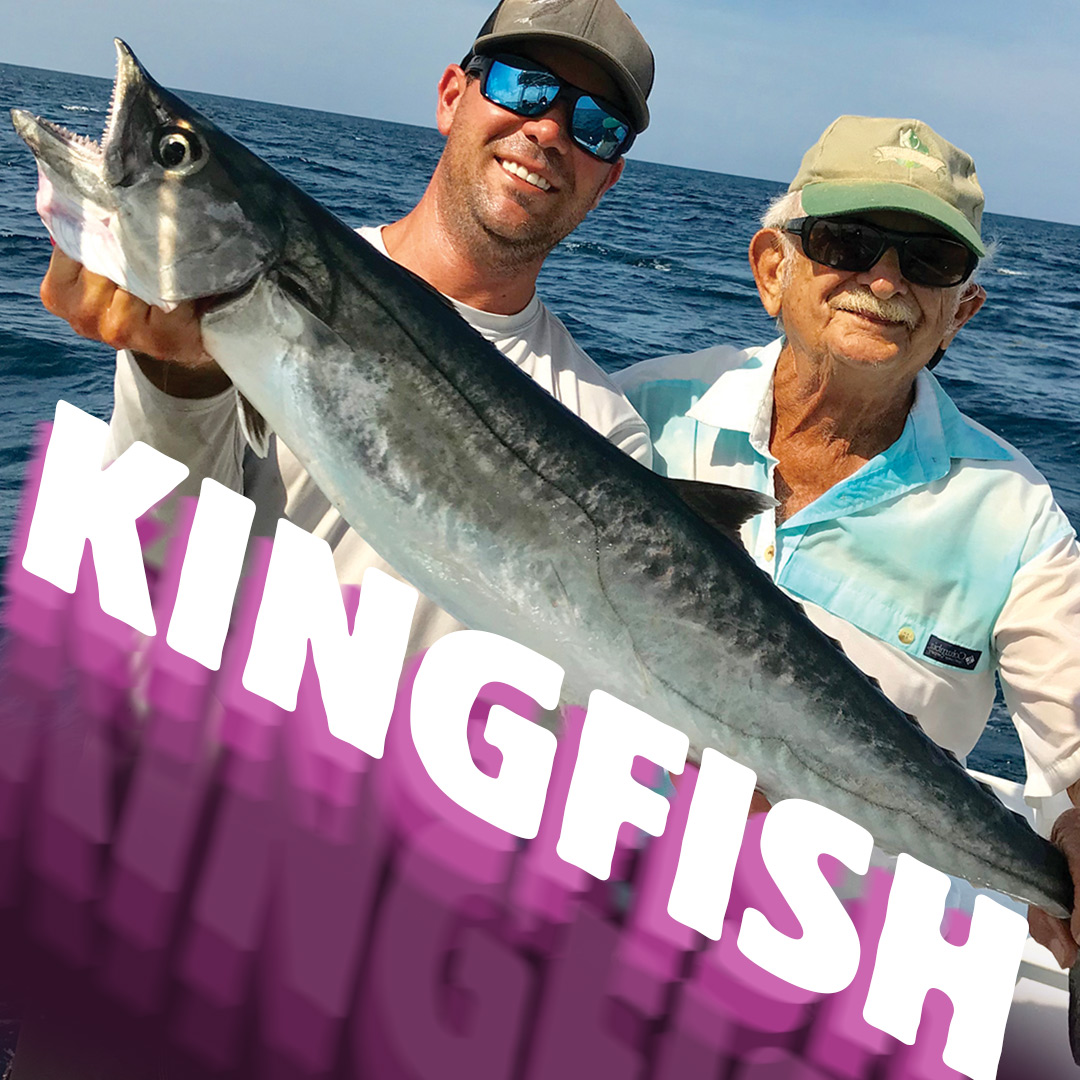
Capt. Abie Raymond of Go Hard Fishing (gohardfishing.com and @abie_raymond) trolls bonito strips for kingfish, sailfish, tuna, bonito, wahoo, and dolphin when fishing out of Bill Bird Marina in Miami Beach.

When his anglers catch a bonito, he fillets the fish and removes most of the meat from the skin with the blade of his knife until the fillet is an eighth of an inch thick, which allows a hook to penetrate a fish’s mouth more efficiently. Raymond then cuts the fillet with the blade angled to produce a beveled edge, which is hydrodynamic and yields a strip that resembles a thin baitfish.

He squares off one end of the strip and pokes a hole in that end with the knife. Then he sprinkles kosher salt over the strips to remove water from them and toughen them up, and he places them in a zip-closure plastic bag.

Raymond rigs a bonito strip on a 4- to 6-foot, 50-pound fluorocarbon leader with a perfection loop at one end that is attached to a snap swivel. The other end of the leader has a flashy, reverse-feather Mylar Sea Witch — his favorite colors are pink-and-blue and blue-and-white — above a 7/0 J hook tied to the leader with a six-turn improved clinch knot. Raymond puts a 4-inch piece of Monel wire through the hook eye, wraps it three times below the eye, and then places it back through the eye.

The Monel goes through the hole in the strip, with the meat side of the strip touching the shank of the hook. The wire is then wrapped below the tag end of the clinch knot to secure the strip, and the hook point is poked through the center of the strip. Raymond fishes bonito strips on a Penn International 16 conventional reel spooled with 20-pound line.

“I’ll put out two of those strip baits on my outriggers 80 to 120 feet behind the boat, along with a lure like a Billy Bait or Dolphin Jr. We stagger them, so a 20-foot lure, a 40-foot lure, an 80-foot strip, and a 100-foot strip would be my typical four-bait spread,” said Raymond, adding that anglers need to determine the most effective distances for their baits based on their type of boat and its engines. Strip baits might raise more fish closer to a boat with one brand of outboard motors than the same boat with a different brand of outboards.

Raymond favors bonito strips over rigged ballyhoo because strips last longer and can be cut to size to resemble a 4-, 6-, or 8-inch flying fish, with the wings imitated by the Sea Witch.

“Another huge advantage of a strip over a ballyhoo is if a sailfish grabs a ballyhoo and rips the tail off, you’re done,” Raymond said. “A bonito strip, he’ll just grab it and grab it. It might stretch and get longer and the meat might come off, but the skin’s still there swimming and looking beautiful.”

Capt. Chris Lemieux of Boynton Beach (lemieuxfishingcharters.com) also loves to troll bonito strips with Sea Witches, which is a great way to catch kingfish as well as dolphin, tuna, and bonito this time of year.

He fishes the strips behind planers on heavy, two-speed, conventional outfits spooled with 80-pound braided lines that are placed in rod-holders on each side of the stern of his 27-foot center console. A weighted, rectangular piece of metal, a planer dives to a range of depths depending on how much line is let out. One end of a planer is attached to the mainline and the other is attached to the leader. Lemieux uses 80 feet of 60-pound fluorocarbon leader, which he pulls in by hand after the planers are reeled to the rod tip.

“Some guys use a lighter leader, some guys use heavier, it just depends on your preference,” he said. “When the fish are biting good, I try to get a little heavier on them. When it’s a real slow, picky bite, you can go down to even 40-pound leader if you want to.”

Frozen ballyhoo, which are available at most tackle stores, also catch a variety of fish and are especially effective for dolphin. Raymond rigs skirted ballyhoo on a 7/0 J hook tied to a 15-foot, 50-pound, monofilament wind-on leader on a 20-pound spinning outfit.

“You fish it like a strip, 80 to 120 feet behind an outboard boat,” said Raymond, who trolls at 6 to 6½ knots.

Presented properly, dead ballyhoo and bonito strips look so real, even the most finicky fish can’t help but eat them.

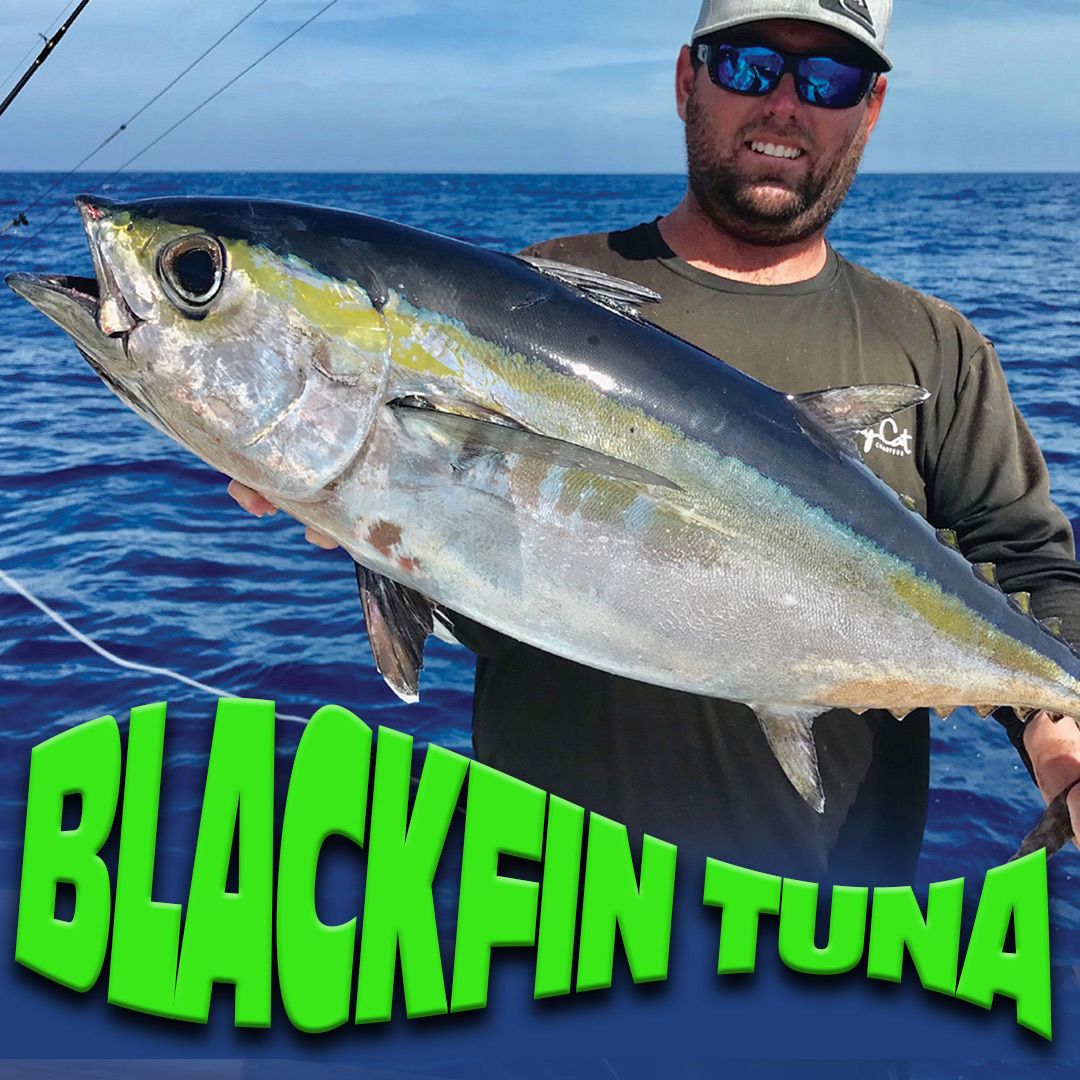
Blackfin tuna, abundant and delicious

South Florida offshore anglers have their pick of species in May, and many of them put blackfin tuna at the top of their fish wish list. Even though the grouper season opens on May 1, and fried grouper is delicious, those fish can be difficult to catch.

Blackfin tuna, however, are abundant this month. They can be caught with live bait, dead bait, and trolling lures, and they are exceptionally tasty grilled, or pan-seared on the outside and rare on the inside.

Unlike grouper, there is no minimum size limit for blackfins, although most of them range in weight from 10 to 30 pounds. The daily bag limit is two tuna per angler or 10 per boat, whichever is greater. That means two fishermen can keep 10 blackfins and six anglers can keep a total of 12 fish.

The first step in catching blackfins is finding water where they hang out. According to Capt. Skip Dana of Deerfield Beach, purple-blue water is ideal, but tuna can also be caught in green water. More important than the water’s color is the presence of baitfish.

“I tell people to find water that’s alive, where it’s got baits and activity,” Dana said. “If you find that good, alive water, the tuna will find you.”

When he fishes in tournaments, Dana will drift with live baits such as pilchards, sardines, and goggle-eyes on flat lines, which his crew casts out behind the boat, as well as live baits on kite lines, which splash on the surface suspended from a fishing kite.

“When the conditions are right, you want a full spread out,” said Dana, who also has his crew put chunks of sardines in the water to attract the tuna, but not too many chunks.

“I think some guys over-chunk,” said Dana, who uses frozen sardines sold by tackle stores. “Don’t get crazy. You want a slow, steady stream of chunks, but not too much.

“There are so many sharks, you can’t chunk that much, otherwise you’ll have sharks up in the chum, and triggerfish.”

Local anglers lose a lot of blackfins to sharks, often reeling in only the head of a tuna after it’s been chomped. So after hooking a tuna, it’s essential to reel in the hard-fighting fish as quickly as possible.

Capt. Bouncer Smith said anglers can also chunk for tuna using a 25-pound flat of herring or squid. “You can cut it up in advance or cut it as you chunk it,” he said.

Smith noted that even when your chunking attracts tuna behind your boat, the fish won’t always eat a bait drifted back on a hook. When that happens, anglers need to go lighter and smaller with their tackle. So if you usually fish with 30-pound leaders and size 5/0 circle hooks, you might want to downsize to 20-pound leaders with a 2/0 or 1/0 hook.

Dana said that most anglers would do fine using two spinning rods with 3/0 to 5/0 hooks. Using dead or live baits, he’d put one on the surface and the other down with a 1-ounce sinker and drift in 150-220 feet.

Be aware that multiple hookups can occur when the tuna are chummed up and in a feeding frenzy. That can result in crossed lines, so it’s important for anglers to pay attention to where their fish are headed so they can go over or under a fellow angler’s fishing line.

The time of day also can be a factor in tuna fishing success.

As Capt. Mario Coté of Hollywood pointed out, blackfin tuna have big eyes that allow them to take a careful look at a bait. He uses 20-pound conventional outfits with 15-foot leaders of 40-pound fluorocarbon, which is invisible in the water. He also likes to fish for tuna early in the morning, late in the afternoon, and on cloudy days, because that’s when the sunlight is less intense.

“If you were in the water on a sunny day and you had to look up to see something, it wouldn’t be easy,” Coté explained.

Coté fishes with live pilchards on two flat lines and on two weighted lines, one down about 50 feet and the other close to the bottom. He hooks the pilchards through the nose, although other anglers hook the baits toward the tail so the pilchards swim down.

Now is also a great time to catch a tuna from a kayak. Joe Hector of the Extreme Kayak Fishing tournament series uses live bait and jigs for blackfins. His live-bait outfit is straight 30-pound monofilament with a 2/0 to 3/0 hook on a medium-heavy spinning rod. “I know the 2/0 hook is small, but I’ve had way more tuna bites on a 2/0,” said Hector, of Deerfield Beach.

“They’re definitely deep as well, so I would definitely recommend taking a jigging rod and hitting the deeper wrecks and jigging your butt off,” added Hector, who uses a vertical jig, a long, heavy piece of metal with one or two hooks attached to it. “Start at 250 feet if you’re drifting in and 80 if you’re drifting out.”

No matter how you catch a blackfin tuna, and whether you marinate it in soy sauce or teriyaki sauce or sprinkle it with olive oil, salt, and pepper before grilling or searing it, you’ll forget all about fishing for grouper once you taste it.

May’s marvelous skies

What a month ahead for stargazers! The month of May offers a little bit of everything for us astronomy enthusiasts. There’s a meteor shower early in the month, a total lunar eclipse mid-month, and a parade of planets in the morning skies near the end of the month. Pretty cool!

This month’s challenge for beginners: It’s a great time of the year to follow an old saying and “arc to Arcturus.” Arcturus is the fourth brightest star in the entire night sky and has a beautiful orangish color (due to its relatively “cool” temperature).

First, find the Big Dipper by looking north. Then, follow the arc of its handle but extend the arc until you curve to Arcturus. If you continue the arc, you can then “speed on to Spica,” which is a brilliant-white star (due to its relatively hot temperature) located in Virgo.

This month’s astrophotography challenge: Take your pick — you can stay up late for the eclipse or wake up early for the planets. Either offers the opportunity for beautiful pictures with or without a telescope. Good luck!

Sky highlights this month:

  • May 6. Eta Aquarids Meteor Shower. This is a reliable meteor shower of a medium rate. This year it will be at its best due to moonlight not being a factor (a waxing crescent that evening, which will set early). For best results, view from a very dark location after midnight.
  • May 15–16. Total Lunar Eclipse. The full eclipse begins at 11:29 p.m. local time. Look for the Moon’s slight reddish hue as sunlight passing through Earth’s atmosphere gets scattered onto it. The eclipse maximum occurs at 12:11 a.m. The full eclipse ends by 12:54 a.m.
  • May 15–16. Full Moon. Of course, it’s also a Full Moon, because you can only have a lunar eclipse during a Full Moon. This one was nicknamed the “Flower Moon” by some ancient Native American tribes for the time of year when, obviously, many flowers are in bloom.
  • May 22–29. Conjunction Week! OK, that’s not an official title — just one I made up — but I think it’s apropos. In the morning skies of late May, we will be treated to a parade of all the naked-eye planets (Mercury, Venus, Mars, Jupiter, Saturn) and a crescent Moon (some nights). It should be magnificent and worth setting the alarm clock for a pre-dawn walk.
  • May 30. New Moon. This is the best time of the month to venture out to a dark area and view/photograph deep-sky objects (nebulas, star clusters, galaxies, etc.). Please consider joining the South Florida Amateur Astronomers Association for information on the best places for sky-watching (www.sfaaa.com).

It’s a terrific month for astrophotography. If you post any cool pics, be sure to tag the Parklander® and me on Instagram (@theparklander and @jeterk1971)— We’d love to see your work!

Loving life at Loxahatchee wildlife refuge

Where can you find 250 species of birds, 60 species of reptiles and amphibians, 40 species of butterflies, many types of mammals, a ring of levees in an extensive dike system, an assortment of wet prairies and sawgrass ridges, and a 400-acre cypress swamp?

That would be at Arthur R. Marshall Loxahatchee National Wildlife Refuge, a huge, biodiverse, forested cypress swamp community at the northernmost part of the Florida Everglades. The refuge contains 226 square miles of everglade ecosystems. Loxahatchee is one of the largest urban wildlife refuges in the country, with more than 145,000 acres of land, and is one of three water conservation areas in South Florida.

The headquarters area, accessed from Lee Road in western Boynton Beach, contains the visitor center, the boardwalk trail, observation platforms, boat launches, levees, and more. This beautiful wildlife refuge also is adjacent to Parkland on the southern end. Some people go biking, to fish, or to boat. I recently went there to bird-watch, hike, and look for alligators with relatives visiting from the north.

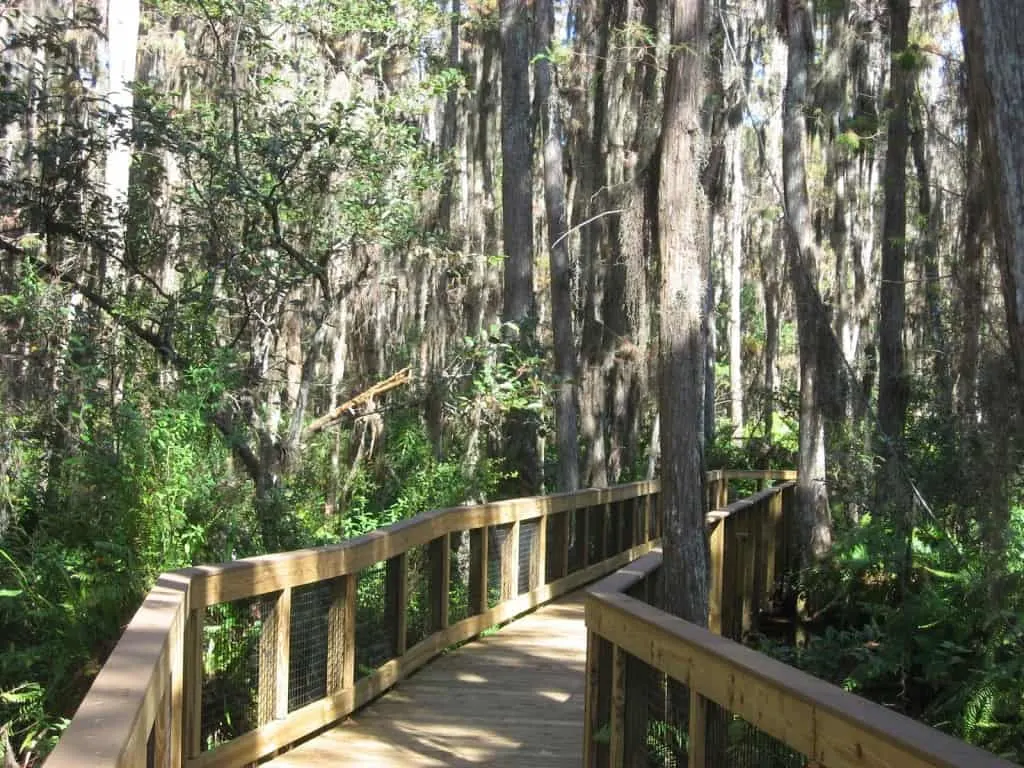
Behind the Visitors Center is the Cypress Swamp Boardwalk, a half-mile trail through the natural cypress forest. The cypress swamp features pond cypress trees with peculiar-looking “knees,” at ground level, that I’d never seen anywhere else, along with lichens, ferns, and all kinds of wildlife.

We started our visit to Loxahatchee on the boardwalk trail, and my group was impressed with the beautiful nature all around us. Many of the trees had silvery-gray Spanish moss hanging high from their branches. Some of it had landed on the boardwalk, and we got to pick it up and explore it closely, a rare thrill for my aunt from Maine.

After doing the boardwalk trail, we drove over to the Marsh Trail, which has its own parking lot.  The trail is about 0.9 miles in length, and it follows a square path. We set out to walk along it and take in the peaceful setting. Just as we reached an observation tower about halfway along the trail and started to climb its steps, the sky opened up and rain drizzled down, followed by a quick downpour. It was lucky timing for us, as we stayed dry under the wooden roof of the tower. We watched as two separate groups of people made a quick dash from other parts of the trail to take cover with us. We all enjoyed looking out over the bucolic vista in the rain.

Just as quickly as it started, the rainstorm stopped, and we climbed down the steps to continue on our little hike. After finishing that part of the refuge, we headed over to the final stage of our outing: to climb up on a levee and walk along the trail there.

We had never been on a levee before, and we looked up the definition: “a continuous dike or ridge (as of earth) for confining the irrigation areas of land to be flooded.” There was a long, flat trail up there that was flanked by water on either side. Birds were singing all around us as we walked. We continued down the endless trail, past the canoe and kayak rentals, and enjoyed the striking views. We took photos of the landscapes and used a smartphone to identify some of the birds we saw. We watched someone fly fishing. We walked along the quiet levee until we decided to turn around to come back. The area was open, vast, and empty, and we enjoyed the solace on this nice Friday morning.

There is much more one could do at Loxahatchee National Wildlife Refuge. I’ll be going back and trying more activities there. I recommend you check it out some time.

Embarking on an airboat adventure

When I first moved to Florida back in 2016, I was a New York transplant — a city girl through and through. My idea of the Everglades was a humid, mosquito-infested swamp, and airboat rides an overpriced tourist trap that posed little interest. Today, I’m an Everglades convert happy to admit that I was dead wrong. The Everglades is a majestic place unique from everything else Florida has to offer.

My conversion happened during my very first airboat ride. Just as Aladdin introduced Jasmine to a whole new world in “Aladdin,” I was fortunate enough to meet a man who did the same for me — he took me on a magic airboat ride through the Everglades at night, introducing me to a whole new world that has become one of my favorite places.

The diverse “River of Grass” is home to hundreds of different species of plants, birds, snakes, turtles, fish, frogs, and the American alligator. Gliding across the top of the clear, shallow water, airboats are the perfect way to pass through this beautiful terrain. No matter what time of day you venture out, you’re sure to see something different.

Reaching speeds upward of 60 miles per hour, airboats are equal parts sightseeing and thrill rides that can easily turn a hot summer day into a cool, enjoyable run. Under the morning/midday sun, you’ll have a crystal-clear view of the scenic sawgrass marshes and floating hydrilla, the greens dynamic against bright blue skies. Stare below the water’s deceptively clear surface and you’ll likely see garfish, bass, bluegill, and a number of other fish.

Cruising across the Everglades at sunset, you’re bound to see ibises, anhingas, egrets, and purple gallinules taking flight, soaring against the deep pink and orange sky. Considered one of the top 10 birding locations in the world, the Everglades is home to more than 360 different bird species. Be wary though — the transition to sundown is when you are likely to encounter the most mosquitoes.

Once the sun goes down, the Everglades begins to come alive, which is why nighttime tours offer the best wildlife viewing. Gliding slowly down shallow passageways between tall grasses, you’ll see plenty of alligators, their eyes glowing red from the airboat lights. Airboats can quickly pull up right alongside gators, giving you the ultimate safe, closer encounter. Once the water moves, these creatures dive beneath the surface, hiding under floating mud — one of the places they store a kill they cannot finish eating in one sitting.

One of the most enchanting parts of a nighttime experience is to shut off the loud engine and take a few moments to immerse yourself in your surroundings. Above you will be a stunning night sky laden with stars. Close your eyes and you’ll hear the low growling of gators and the trilling of frogs, a wild symphony that offers a peaceful escape from the day-to-day grind.

Public Airboat Tours

There are two outlets near Parkland that offer public airboat tours:

  • Loxahatchee Everglades Airboat Tours and Rides, 15490 Loxahatchee Road, Parkland. It offers a “Great Blue” 50-minute, guided airboat tour that costs $80 per adult and $45 for children between the ages of 3 and 12. Tours operate Monday to Saturday between 9 a.m. and 2 p.m. For more information, visit www.evergladesairboattours.com.
  • Everglades Airboat Tours at Everglades Holiday Park, 21940 Griffin Road, Fort Lauderdale. It offers daily one-hour tours starting at 9 a.m., with the last boat leaving at 4 p.m. Tickets cost $35.99 for adults 12 and older and $23 for children between the ages of 3 and 11. Everglades Holiday Park also offers animal encounters and gator shows run by the Gator Boys, stars of the “Animal Planet” reality TV series of the same name.

Private Airboat Tours

While they may be a bit pricier, private airboat tours offer a more intimate experience, along with the ability to see the Everglades at different times of the day, when the sun is no longer bearing down on you.

Everglades Airboat Excursions offers private two-hour sunset tours, which cost $425 for up to four people, and private two-hour night excursions, which cost $500 for up to four people. Groups larger than four can be accommodated for an additional $50 per person. All tours depart from the boat ramp at Francis S. Taylor Wildlife Management Area in Weston on Highway 27. For more information, visit www.evergladesairboatexcursions.com.

What to Bring/Wear

If you’re heading out on a daytime tour, you’ll want to bring water, sunscreen, a hat, sunglasses, and bug repellant. You may also want a cell phone neck holder if you’re planning on taking pictures with your phone. Most airboats do not have sides, meaning that, if dropped, your phone will likely slide off the deck and into the water (unfortunately speaking from experience on that one!).

If you’re embarking on a nighttime trip, make sure to check the weather forecast. The temperature tends to feel about 10 degrees cooler in the Everglades, with the wind from the propeller making it even chillier.

Diving for lionfish in April

The last day of Florida’s lobster season was March 31, and the seasons for grouper and hogfish don’t open until May 1, so what’s an underwater hunter to do in April?

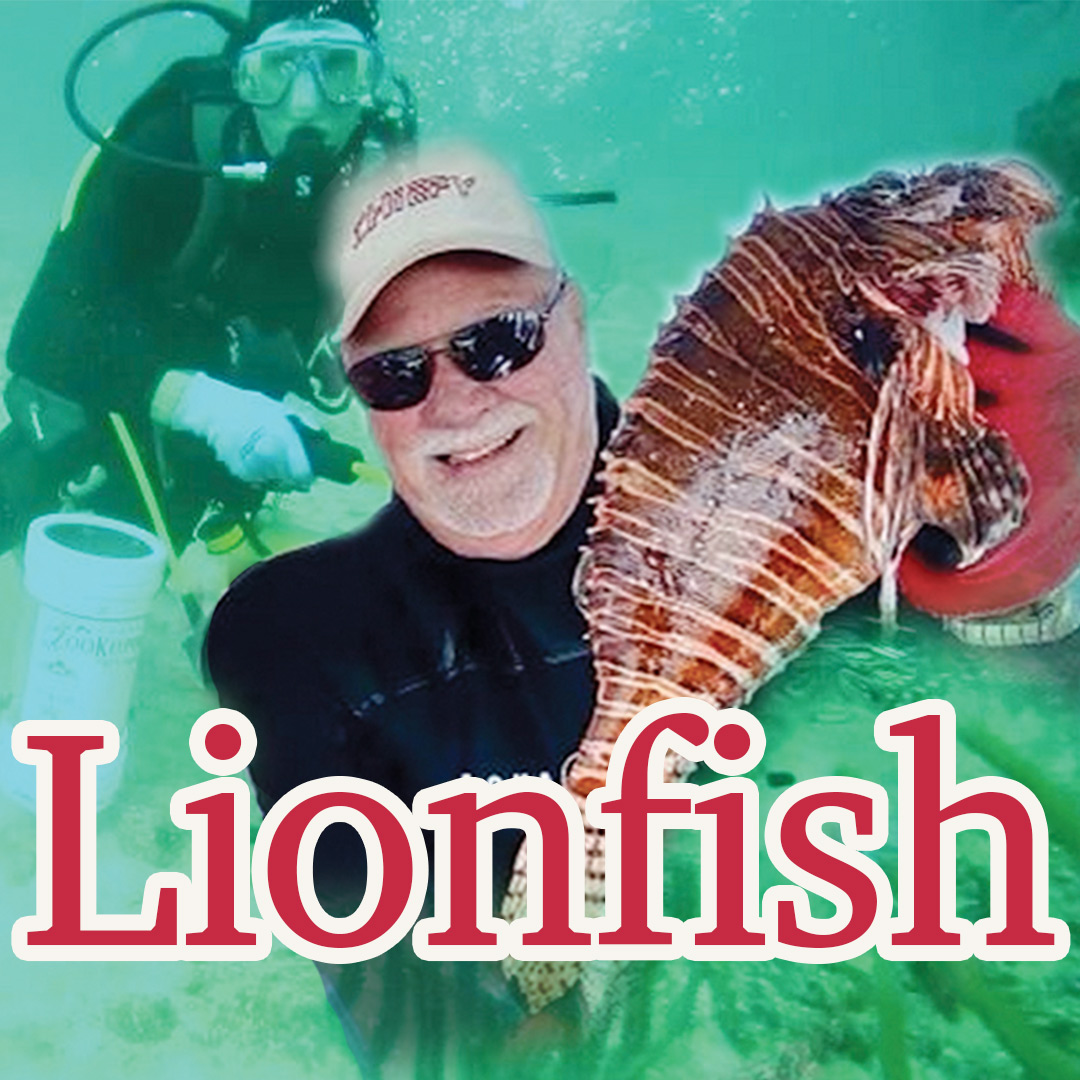
Spearfishing expert Jim “Chiefy” Mathie sets his sights on a great-tasting exotic fish.

“There’s really not a lot of species to go after because of the lack of opportunity for lobster, hogfish, and grouper,” said Mathie, a retired Deerfield Beach fire chief. “So we target lionfish.”

Native to the South Pacific Ocean, lionfish were first discovered off South Florida in the mid-1980s. The belief is that the lionfish were someone’s pets and when the fish outgrew their aquarium, the owner dumped them in the ocean. From there, the invasive lionfish have spread throughout the Caribbean, into the Gulf of Mexico, down to South America, and up the Atlantic coast to North Carolina.

The fish have no natural predators in those waters, which means bigger reef fish such as grouper don’t realize they can eat them. Lionfish feast on tiny grouper, snapper, shellfish, and other native species. Left unchecked, lionfish can take over a reef. That’s where spear-fishers come in.

Although lionfish are here to stay — researchers in submarines have documented lionfish in 1,000 feet of water off South Florida — divers with pole spears and spearguns do their part by reducing the lionfish population. The Florida Fish and Wildlife Conservation Commission is doing its part to combat the lionfish invasion by having no size or bag limits and no closed season. The agency has an informative web page at myfwc.com/fishing/saltwater/recreational/lionfish.

Mathie, who said he and his dive buddies had “an outstanding lobster season” diving primarily in 35 to 45 feet of water, noted that spear-fishers keep lionfish populations under control on coral reefs in those depths.

“We’ve seen a few lionfish, but in this location we do a very good job of harvesting lionfish in the shallow waters, just because it gets a lot of pressure from the divers. That’s actually a good thing because we’re kind of keeping them in check shallow,” said Mathie, author of the lobstering and spearfishing books “Catching the BUG” and “Catching the Spear-it!” that are available at local dive shops and online.

Deeper reefs that don’t receive that much pressure tend to have more and bigger lionfish, so that’s where Mathie and his Chiefy crew hunt.

“We change our tactics in April to head out into roughly the 80- to 100-foot depth. We call that the third reef or the east side of the third reef,” Mathie said. “It also gives us an opportunity to check out what’s going on out there, because lionfish and lobster like the same terrain. So those are areas that, when the season allows us, we can go back to for lobster. So it’s kind of a mixed bag for us from that standpoint. While you can’t take them, you can certainly explore and find some new locations.”

Lionfish are an ideal species for divers new to spearfishing because, as Mathie noted, they don’t swim around a lot, so they’re easy to shoot, especially compared with grouper and hogfish, which are the ultimate species for the majority of underwater hunters.

Given their small size — the state-record lionfish speared in the Atlantic Ocean was 18.78 inches off of Islamorada, and an 18.7-inch, 3.77-pounder shot last year off of Destin is the Gulf of Mexico state record — lionfish don’t require the use of big spearguns. Mathie and his crew use 3- to 4-foot, hand-held pole spears with three- or five-prong tips, which prevent a fish from spinning after it is speared.

Lionfish have 18 venomous spines, 13 on the top and five on the bottom, so care must be taken when handling them. Getting stung by a spine can cause intense pain. The pectoral fins, which are not venomous, give the fish its name because when they’re fanned out in the water, they look like a lion’s mane.

“Typically, after you spear them, you treat them like a bass. You put your thumb in their mouth and you hold them; that way you’re pretty much away from their spines,” Mathie said. “What we like to do is use a pair of paramedic (or trauma) shears to trim up those venomous spines. But there is an element of danger when you’re trimming them up under the water with shears.”

Mathie said a safer alternative is to use a Zookeeper, “a plastic tube with a one-way funnel. You keep the lionfish on the spear and stick the fish in there without having to touch it at all, pull the spear back out, and the lionfish stays in that tube.”

The hard-sided Zookeeper, which is manufactured in Sunrise, also keeps the spines from accidentally touching your body as you swim. They are sold online and at local dive stores.

This time of year, Mathie and his friends try to fill their Zookeepers, put the fish in a cooler when they get back in the boat, and fillet them at the dock.

“They’re excellent eating,” Mathie said. “They have a pure white fillet, no bloodline, a flaky texture, and almost a sweet taste. You can do anything with them. You can make ceviche or sear them in olive oil with salt and pepper and eat it right out of the pan, it’s that good.”

And that alone is a good enough reason to keep diving this month instead of waiting until May.

Shark Valley: the perfect place to see alligators, not sharks

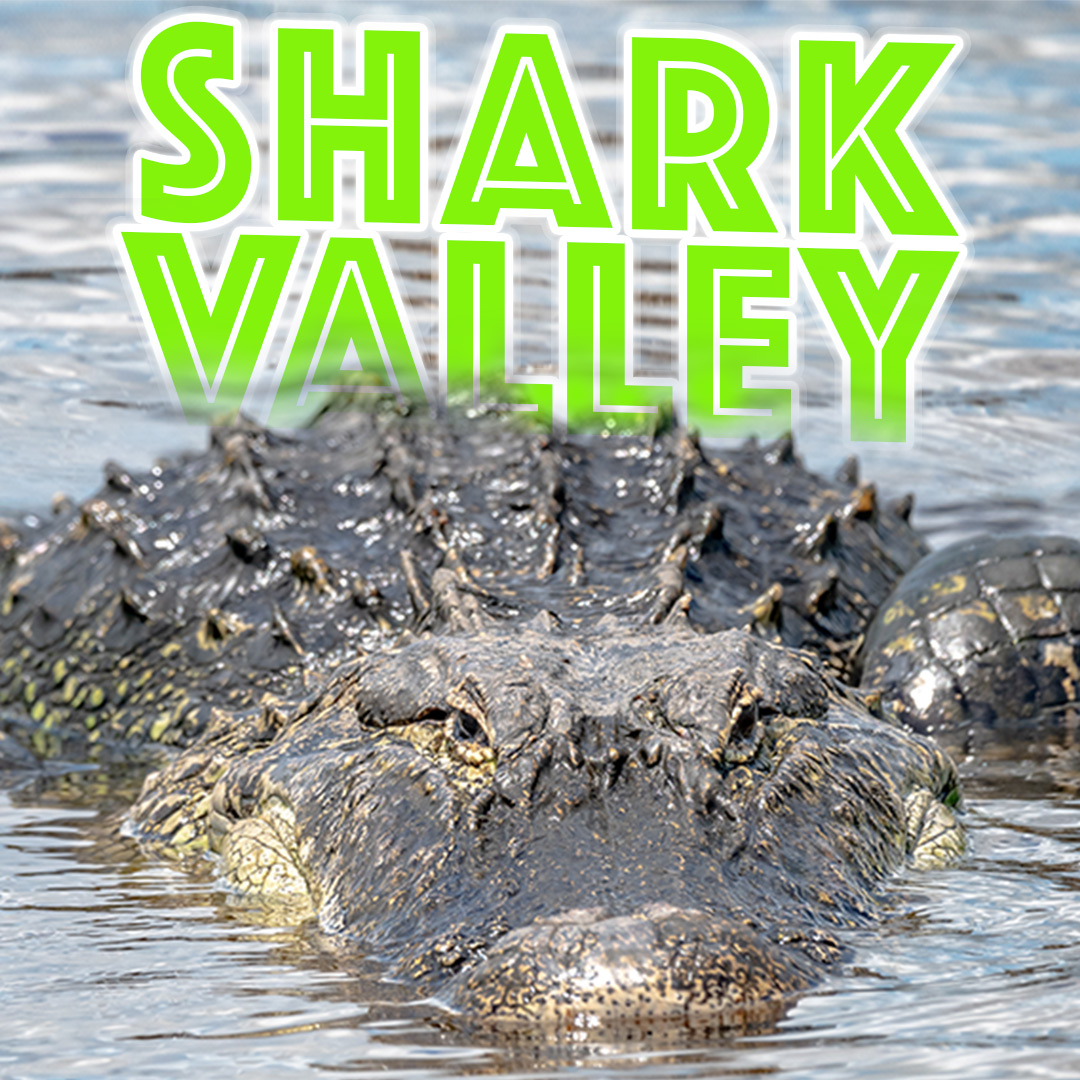
Don’t let the name fool you — you won’t find any sharks in Shark Valley. Named for its location at the head of Shark River Slough, this 15-mile loop trail is the perfect spot to get up close and personal with an alligator (from a safe distance, of course!).

Located inside Everglades National Park, right off U.S. Highway 41 (Tamiami Trail), this paved trail is perfect for biking, hiking, and bird watching. There are also guided ranger and tram tours for those interested in learning more about the Florida Everglades — the only place in the world where the American alligator and American crocodile coexist.

This diverse subtropical wetland, the largest in North America, spans more than 1.5 million acres across central and south Florida — half of its original size. Composed of nine diverse ecosystems, the Everglades is home to more than 360 different bird species, 300 fish species, 20+ snake species, crocodiles, alligators, panthers, otters, frogs, and many other mammals, reptiles, and amphibians.

Shark Valley sits right in the middle of the Everglades freshwater marsh and is an ideal location for viewing wading birds — from herons to egrets, ibises, hawks, owls, and anhingas, along with plenty of freshwater wildlife. But the one animal that cannot be missed along the first half of this trail is the alligator.

These majestic reptiles bask motionless in the sun right along the side of the pavement just steps from visitors. While this may seem like a dangerous scenario, these gators are used to people coming and going and rely on their natural habitat for food, meaning they do not seek out people or pets. As long as visitors do not engage in any reckless behavior, such as feeding or harassing the alligators — behavior that constitutes a criminal offense — Shark Valley is perfectly safe for both adults and children.

Midway through the loop, visitors can stop and rest at the Shark Valley Observation Tower. Standing 70 feet high, it’s the tallest structure in the park, with a viewing platform that offers scenic panoramic views of the Everglades.

For those interested in a more daring adventure, Shark Valley offers guided full-moon and new-moon bike tours. Accompanied by a park ranger, riders embark on a three-hour tour where they can embrace the magic of the Everglades and all its nocturnal creatures, including alligators, after dark. Upcoming tour dates include March 4, March 16, April 1, and April 16. Reservations are required and can be made through the Shark Valley Visitor Center at (305) 221-8776.

Shark Valley is located at 36000 SW 8th Street, Miami, and is open every day from 8:30 a.m. to 5 p.m. in mid-December to mid-April, and 9 a.m. to 4:30 p.m. in mid-April to mid-December. Bike rentals are available on-site.

For more information, tour schedules, and entrance fees, visit www.nps.gov/ever/planyourvisit/svdirections.htm.

Run4Beigel: Memorial fund helps send at-risk children to summer camps

Scott J. Beigel was more than a geography teacher and cross-country coach at Marjory Stoneman Douglas High School (MSD). Among the 17 souls who lost their lives that fateful day in February 2018, he was a man that impacted lives. Ultimately, he was a man who saved lives by unlocking his classroom so students could find shelter.

To raise money for the Scott J. Beigel Memorial Fund, the annual Run4Beigel takes place April 10 at Pine Trails Park in Parkland. It’s where his team trained and, after their initial meeting, he told them he knew nothing about cross-country running. The team was impressed by his candor, and by his wit. When asked how they could improve, he would simply say, “Just run faster.” According to his mother, Linda Beigel Schulman, he told the team, “You teach me about cross country, and I’ll teach you about life.”

The Format

Beigel won the love and admiration of his team. To honor his memory, they took to social media and within six days of his death organized the first Run4Beigel event. It drew nearly 500 people. This year’s event features the traditional 5K Run-Walk and 1-mile Fun Run, and a 10-mile Two-Person Relay has been added that requires participants to run 5 miles each. Run4Beigel is also being done virtually and runners from around the world will be participating in his honor.

“We expanded to accommodate those who want a bigger challenge,” said Doug Eaton, race director. “The multiple events add a competitive component that never existed before, and we hope to draw friends, family, the philanthropic community, and competitive athletes from running clubs.”

Eaton says the events are a good way to get involved in a wonderful cause. “Scott was a great human being who cared so much about people,” he said. “Honoring him shows the Parkland spirit.” T-shirts will be given to all participants, and winners will receive trophies and cash prizes.

“It’s really a celebration of his life, and there’s a lot of energy because the community comes together as one in his memory,” said Beigel’s mother.

The memorial fund is rooted in Beigel’s love for summer camp. “It was something close to his heart and that’s why my husband Michael and I partnered with Summer Camp Opportunities Promote Education (SCOPE),” she said. “It’s an organization that funds ‘camperships’ for at-risk, low-income children affected by gun violence, and it helps youngsters become empowered and more self-confident.”

The Full SCOPE

The organization does not run the camps, but partners are vetted to meet high standards. “The camps help the emotional needs of kids affected by gun violence by offering an environment that is acceptive and responsive to their needs,” said Executive Director Molly Hott Gallagher.

Beigel’s parents found a partner in SCOPE that was experienced in working with underserved youth and had working relationships with accredited camps. “When Linda and I met, we hit it off immediately,” said HottGallagher. “This relationship has been incredible … because of the focus on providing greater financial access so kids can attend camps they could not otherwise afford.”

SCOPE partners with more than 50 nonprofit summer camps. Last year, it provided more than 700 children with a camp experience. “Helping at-risk kids affected by gun violence was very important to Scott,” said Eaton. “Our goal this year is to raise at least $300,000 and help send 200 kids to camp.”

According to Hott Gallagher, some of the organization’s partner camps are free for all children, and SCOPE subsidizes additional costs for meals, travel, programming, and staffing. Since its inception, SCOPE has funded more than 25,000 camperships.

Applicants must be between ages 7 and 16, be enrolled in a public school or public charter school, and qualify for the Free and Reduced Price School Meals program. They must commit to stay in school. Inner-city kids exist in a world where chaos and crime are routine, and they’re more prone to exposure to gun violence. “Summer camp is very therapeutic because it gives kids a chance to be themselves and have fun,” said HottGallagher. “It’s a break from their daily routine, and it’s proven to be psychologically beneficial.”

An Insight

Beigel grew up in Dix Hills on Long Island, NY. He was a self-taught guitarist, runner, teacher, coach, friend, advisor, and jokester. He found his dream job at MSD because it allowed him to teach geography his way, not always out of a book, but about life’s experiences.

Despite his biting wit, he was a humble man who lived by the golden rule of treating others as you would like to be treated. “Scott really never knew how much people loved him,” said his mother. “The first day he was at Douglas, he called to tell me he was the worst teacher in the world. Students who had doubts about him were the ones who loved him the most. Wherever Scott went, he impacted lives.”

Beigel loved to mentor kids and to be a champion for the underdog. He volunteered to teach in Cape Town, South Africa and returned home without any baggage. He told his mother that in America kids worry about what kind of athletic shoe to buy, but over there, kids were lucky to have shoes. “Mom, I left all my clothes for them, because I knew it was something they could really use,” he said. That was the essence of Scott Beigel.

Lingering Pain

“The scar tissue from what happened four years ago hasn’t gone away, but it’s made Parkland an even tighter-knit community,” said Eaton. “We still feel the pain of that day, and in Scott’s memory, we want to make things better. It’s a way in which our community can give each other a collective hug.” The 17 will always be remembered.

For Beigel’s legacy, this quote by Mahatma Gandhi is appropriate: “Life isn’t always about grand gestures, but when living by your values, you can make a difference.”

You can follow Run4Beigel on Instagram and Facebook. To sign up, go to www.run4beigel.com.

 

Falling for February skies

From the Heart Nebula in Cassiopeia to the Rosette Nebula in Monoceros, there is a lot to love about the night skies of February.

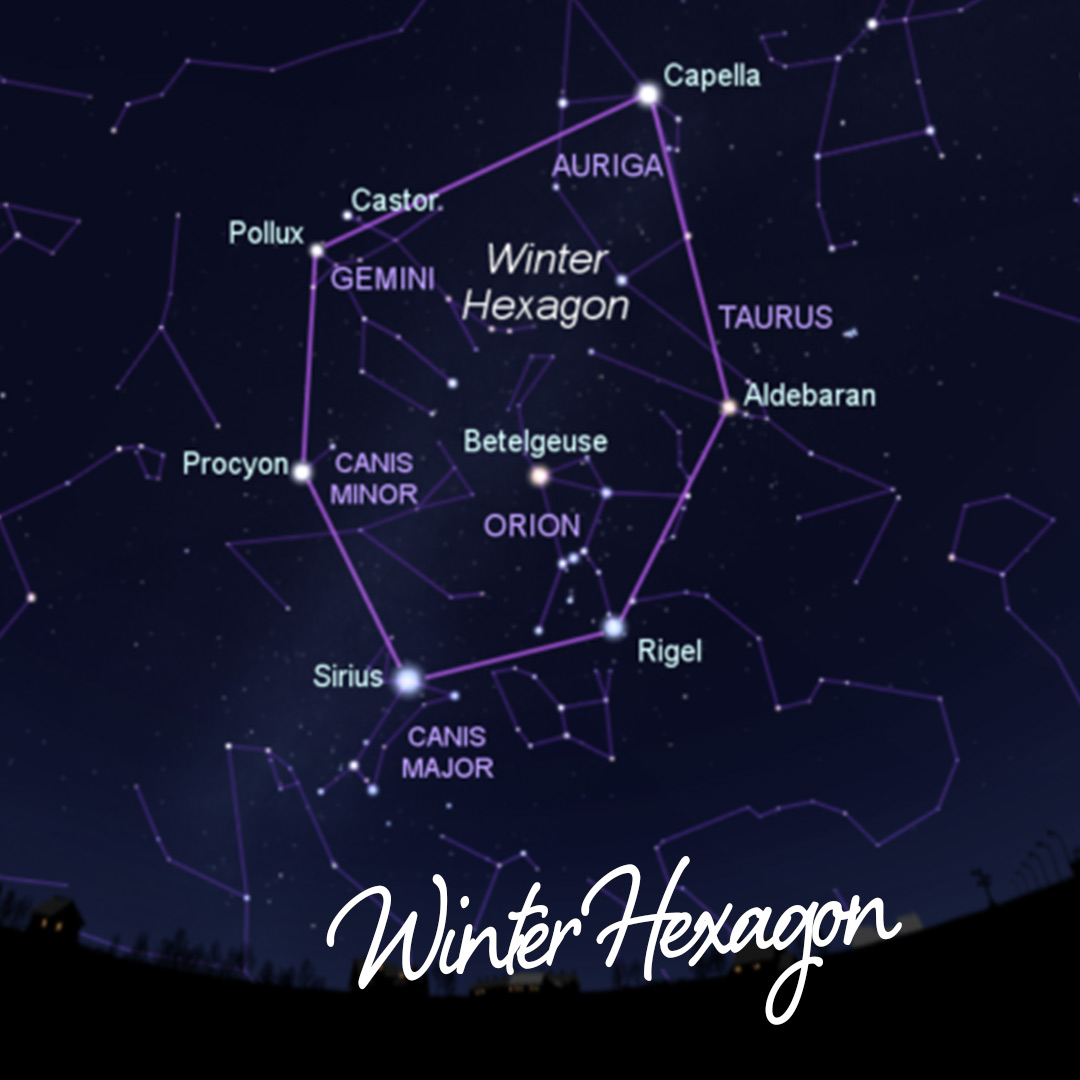
This month’s asterism challenge for beginners: the Winter Hexagon. An asterism is a picture in the sky that is not an official constellation — it might be a small “picture” within a constellation (Orion’s Belt within Orion, for example), or it might consist of stars from two or more constellations. The Winter Hexagon falls in the second category as it includes bright stars from several prominent constellations.

Starting with Sirius, the brightest star in the night sky, move clockwise to the hexagon’s vertices at Procyon, Castor and Pollux (a single vertex), Capella, Aldebaran, and Rigel. Connecting Rigel and Sirius completes the hexagon. Good luck!

Celestial highlights this month:

  • 1 — New Moon. It’s the best time of the month to look for Deep Sky Objects. The temperatures should be comfortable, so take a telescope or binoculars and get out to a dark location.
  • 2. Just after sunset, Jupiter and a very thin crescent Moon should make a beautiful pair in the Western sky. This “conjunction” will place them within about 4 degrees of each other.
  • 9. Venus reaches its peak brightness, as seen in the morning sky just before daybreak.
  • 16 Full Moon. It’s nicknamed the Snow Moon by some ancient Native American tribes.
  • 16 — Mercury Mornings. Little Mercury is hidden by the Sun’s glare most of the year, but in mid-February, it will be about 26 degrees above the horizon just before the Sun rises. This is one of your best chances to see it this year.
  • 27. There will be a conjunction of Venus, Mars, and the crescent Moon in the Eastern sky before dawn. They will appear in a straight line low on the horizon.

Not just love is in the air this February. Here are some interesting launches:

  • The United States Space Force is planning two launches this month using a powerful Falcon Heavy rocket from SpaceX and an Atlas V 551 rocket from United Launch Alliance. We haven’t seen a Falcon Heavy launch since June 2019, so it is a long-awaited treat! No specific launch date has been set as of this writing.
  • There is also a tourism mission planned by a private company called Axiom, which will use a Crew Dragon capsule on a Falcon 9 rocket. Again, no launch date has been set as of now.

Hope you love these winter nights, stargazers!

New year’s nights

Congrats on completing another journey around our local star! For the record, you traveled about 584 million miles (940 million Km) around the Sun at an average speed of about 66,000 mph (30 km/s). Alas, your FitBit probably didn’t even give you credit for that… 😊

This month’s constellation challenge for beginners: Orion. One of the most recognizable constellations in the entire sky, Orion the Hunter is a great reference point from which to begin surveying the winter sky. Orion’s Belt is an asterism of three bright stars in a line that is hard to miss. At a roughly equal distance above and below the belt are two of the top 10 brightest stars in the night sky — reddish Betelgeuse above and bright-white Rigel below.

This month’s telescope challenge for beginners: the Orion Nebula. There is a tiny smudge just below Orion’s Belt, forming part of his dagger, which is an enormous star-forming region. It can be seen with the naked eye, so even small telescopes will reveal it as a fuzzy little cloud (“little” because it’s 1300 light years away!). And for slightly larger scopes, look for four very luminous, newborn stars very close together at the heart of the cloud. They are in a somewhat trapezoidal arrangement and, thus, are called the Trapezium.

More celestial highlights this month:

  • 2 — New Moon. We start out 2022 with some particularly dark skies (minus the Moon’s glow) — enjoy!
  • 3/4 — Quadrantid Meteor Shower. With only a crescent Moon out, this should be a nice meteor shower to see from dark skies. Best seen after midnight, but, as always, no binoculars or telescope needed — just lay back and enjoy some “shooting stars”!
  • 4 Perihelion. Believe it or not, this day marks the closest that Earth will be to the Sun in 2022. Earth’s orbit is nearly a perfect circle, so our slightly varying distance from the Sun during the year has a negligeable effect on our seasons. Remember, it is Earth’s 23-degree tilt that produces its seasons.
  • 7 Mercury at its greatest elongation. We don’t get many chances to see Mercury compared to other planets (it hangs out near something called the Sun). But this evening will feature our Solar System’s fastest-moving planet at about its highest possible point above the Western horizon after sunset (still relatively low in the sky, though).
  • 17 Full Moon. This moon was named the Wolf Moon by early Native American tribes.
  • Throughout January. Various launches are planned from Kennedy Space Center, though none seem to have a confirmed launch date as of the writing of this article.

Enjoy the brilliant and bountiful winter constellations and happy hunting in Orion. Wishing you and yours a pleasant journey on your next trip around the Sun.

Fish for fresh grouper before year’s end

The grouper season in South Florida closes for four months on January 1, so time is running short to catch one of the hard-fighting, great-tasting fish.

The good news is that now is the best time of the year to catch grouper according to the legendary Capt. Bouncer Smith, who retired after 54 years of running fishing charters in Miami Beach.

Live-baiting around coral reefs and wrecks is the most popular way to catch grouper. Boaters can either anchor up-current or drift or troll with their baits.

“Probably the most consistently productive bait that is readily available is pinfish,” Smith says, noting they can be caught on hook and line or in a pinfish trap. “With that being said, if you caught live ballyhoo and slow-trolled them in 15 to 50 feet of water, wherever you find a reef edge, they’re very, very effective.”

But, adds Smith, there’s an even better live bait for grouper — a baby bonito of 1-3 pounds.

They can be caught trolling a homemade, Sabiki-like rig consisting of some small spoons and bonefish jigs with a small trolling lead in front of them. Meanwhile, Smith says, your grouper fishing rod is already rigged with a 9/0 triple-strength circle hook and a 120-pound leader about 20 feet long, tied to a three-way swivel with a 1- to 3-pound weight attached to a short piece of monofilament tied to the bottom of the swivel. His preferred mainline is 80- or 100-pound monofilament because the line stretches without breaking when you apply maximum pressure on a grouper to prevent it from heading back into a reef or wreck.

“You’re trolling those little lures around all the wrecks out to 200 feet, and at some point, you’ll catch baby bonitos, which are very prolific in the fall,” Smith says. “As soon as you catch a baby bonito, you hook it through the upper lip and you drop it down on the upstream side of the wreck. And you better have all the drag you can afford.

“That live bonito is the No. 1 black grouper food you can drop down. It’s a great bait anytime, but the little bonitos are very common in the fall and the black groupers get common in the fall.”

Another tried but true, but seldom used tactic that works for grouper is to troll dead baits along coral reefs, which was perfected more than 50 years ago by Capt. Buddy Carey of the famed Pier 5 charter fleet in Miami. Smith says the technique is still effective and not that difficult to master.

“The grouper see something going by that looks like it might be edible and they’re out to get it,” Smith says. “They come charging up off the reef.”

Smith trolls skirted ballyhoo, using a planer to get the bait near the bottom where the grouper hang out. A planer is a small, rectangular, weighted piece of metal that is attached to the mainline of a fishing outfit at one end and to a long leader at the other end.

When it is deployed, the planer, which comes in different sizes that travel at different depths, glides down through the water behind the boat. Depending on the size of the planer and how much fishing line is put out, the bait can be presented at a depth that will attract the attention of any fish in that zone.

Smith rigs the ballyhoo on a 7/0 triple-strength 3417 Mustad J hook at the end of a 100-foot length of 100-pound monofilament leader attached to the planer. He uses dual-speed Penn International reels, size 30 or larger. In low gear, the reel can pull a grouper away from a structure. Then, the high gear setting enables an angler to get the fish quickly to the boat, before a shark can bite it.

“The grouper on occasion will come up and hit the ballyhoo on top of the water, but basically you want the bait about 10 feet off the bottom,” Smith says. “If it’s real close to the bottom, they’ve got the advantage of getting back into the bottom. And if it’s too high, then a lot of them will say, ‘Oh, that one’s too far away.’ But generally speaking, they come charging up to get that morsel going by.”

Smith says that anglers can learn how to precisely troll for groupers by practicing with a planer over a sandy bottom. When the bait starts hitting the sand, mark the fishing line and record the RPMs of the engines. The next time you troll, run at the same speed and let out the same amount of line, and you’ll know how far down your bait is running.

The grouper season closure, which runs through April 30 in Atlantic waters, was implemented in 2010 to allow the populations of black, gag, and red grouper to increase in number and in size, as well as to protect the fish during their spawning seasons.

The minimum size limit for black and gag grouper is 24 inches and reds must be 20 inches. Anglers can keep a total of three grouper per day, but only one can be a black or a gag. The other two, or all three, can be red grouper.

Follow Capt. Bouncer’s advice and you’ll be able to enjoy several delicious meals of fresh grouper for the holiday season. Otherwise, you’ll have to wait until May.