
Mariko Kusumoto, Take Akari sculptures grace the Morikami
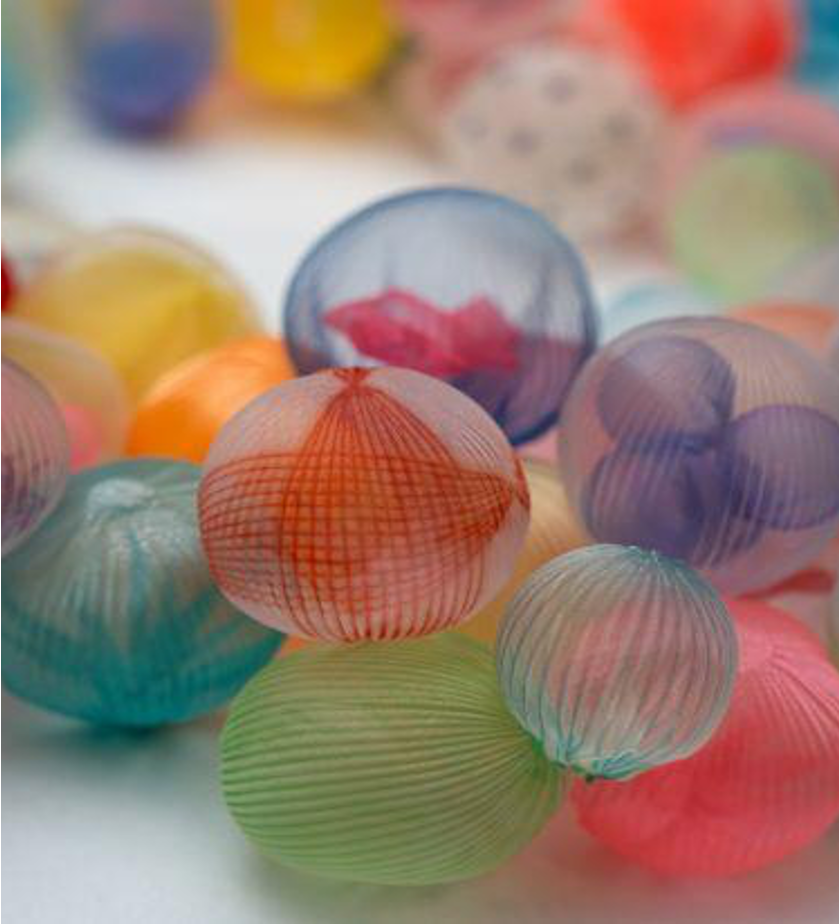
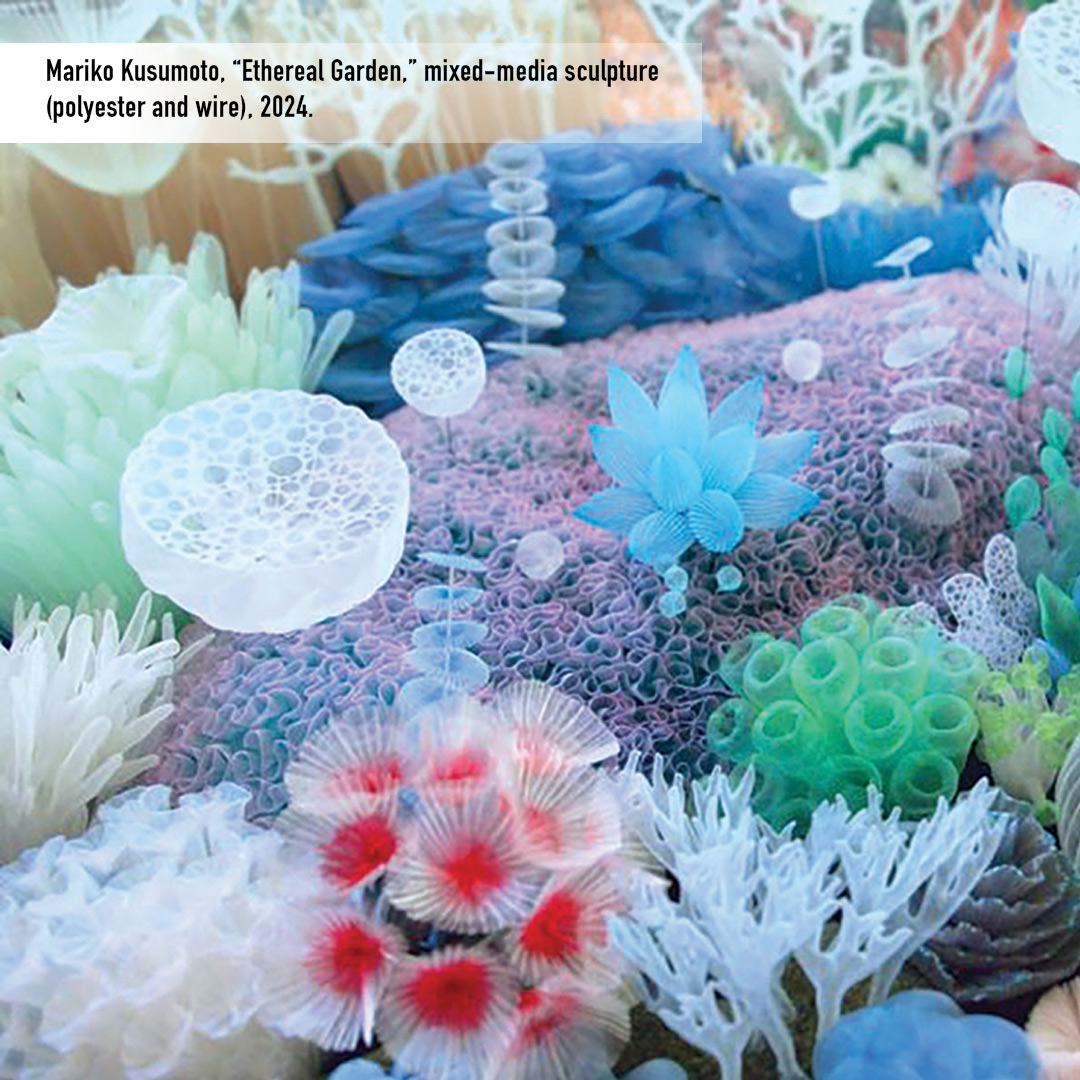
Mariko Kusumoto, “Light as Air,” fiber-based, translucent, and crafted through tsumami‑zaiku techniques.
The buoyant sculptures of Mariko Kusumoto. Occupying the Morikami Museum and Japanese Gardens’ main gallery through April 5, expect an immersive, contemplative experience where light and proximity matter integrate. Fine detail is prevalent and parallels the authentic, methodical organization characteristic of a kimono. When viewed closely, the work is consuming.
Mariko Kusumoto. This Japanese-born artist is known for her delicate, floating fabric sculptures that blend traditional Japanese craft with contemporary installation. She creates whisper‑light fabric sculptures that seem to hover between craft and contemporary artistry. Raised in a 400‑year‑old temple as the daughter of a Buddhist priest, Kusumoto developed a keen attunement to subtle light, tactile surfaces, and the hush of carefully ordered space.
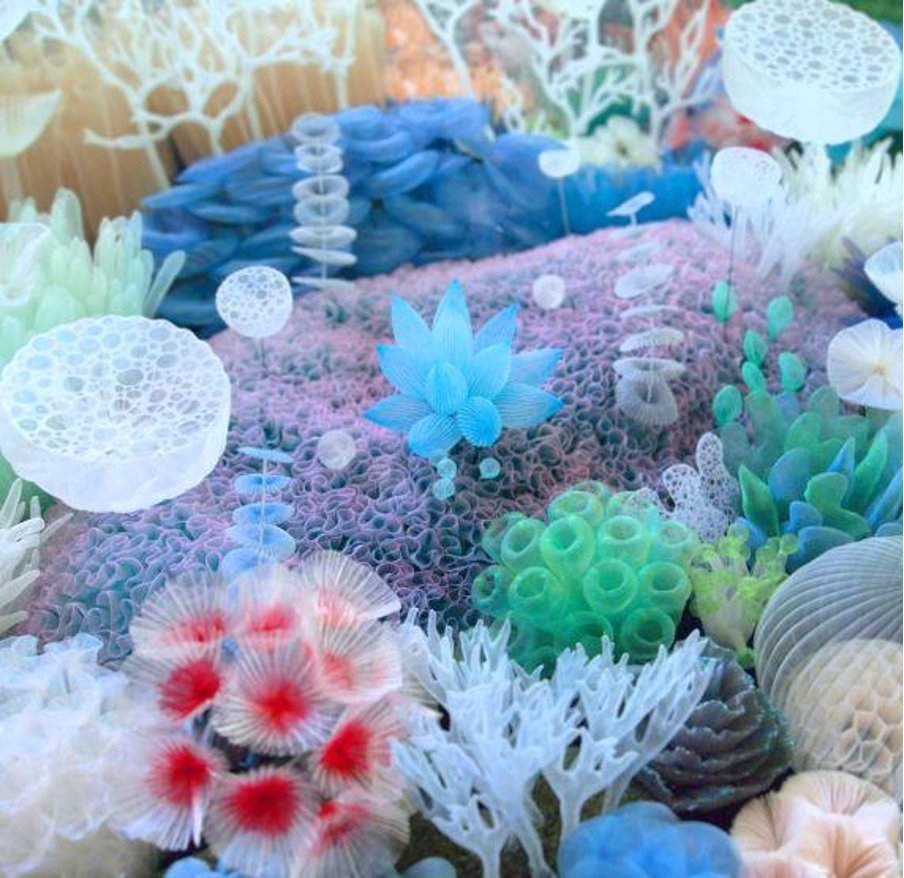
Mariko Kusumoto, “Ethereal Garden,” mixed-media sculpture (polyester and wire), 2024.
Kusumoto’s “Ethereal Garden” is an intricate, modular installation evoking underwater ecosystems through fabricated coral, sea anemones, and marine flora. The work explores themes of biodiversity, emotional fragility, and poetic buoyancy through textile manipulation and sculptural choreography.
Kusumoto’s practice is intensified by time‑honored Japanese handicrafts, especially the delicate folding and pinching of tsumami zaiku, with modern sculptural thinking. From tiny, exacting manipulations, she builds larger, translucent forms that evoke drifting blossoms, jellyfish, or underwater plants, inviting viewers to watch how shifting light and gentle motion reshape surface, depth, and perception.
Marine biodiversity as emotional landscape. While inspired by real marine life, Kusumoto’s forms are not literal replicas. Instead, they’re imaginative hybrids, blending both botanical and anatomical references, color radiation and molecular symmetry, as well as subatomic weight and poetic buoyancy where fantasy meets biology.
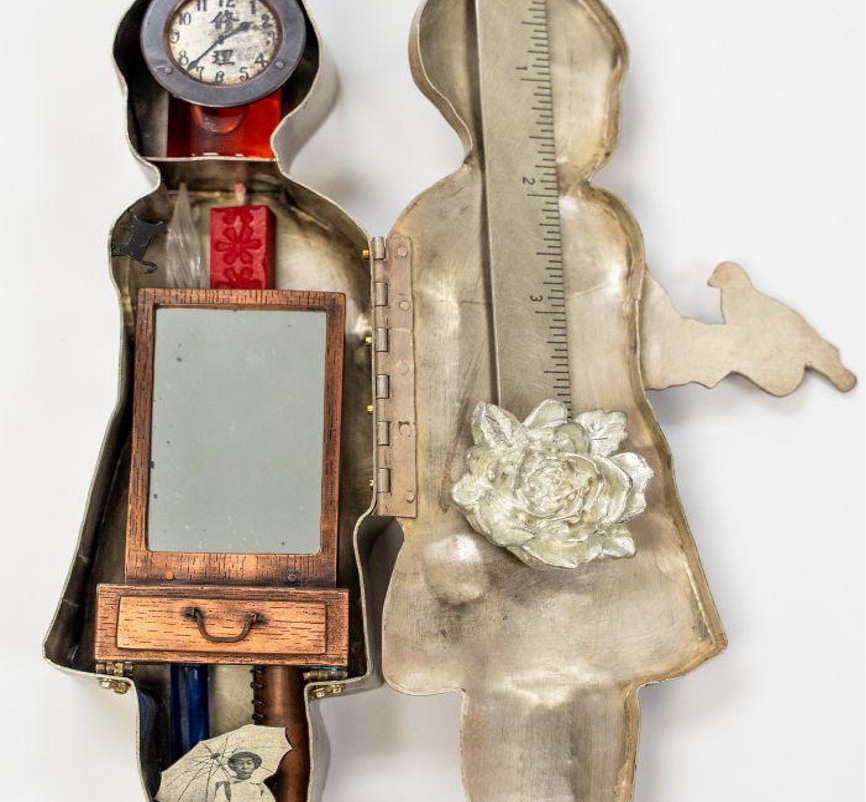
Mariko Kusumoto, pencil cases, 2011, mixed-media sculpture (hinged human‑form containers with embedded objects).
Mixed-media sculpture. Kusumoto, who is also a metalsmith and former printmaker, celebrates her earlier works with this sculpture, which features two hinged, human-shaped forms filled with miniature objects, including a clock, a ruler, a vanity, a flower, and cut‑out figures. They are arranged as internal “compartments” that explore themes of identity, memory, time, and personal ritual. It is a striking example of her narrative container series, where the body becomes a vessel for memory, identity, and symbolic layering.
Psychologically, the body represents a container for time, memory, and ritual. It is sociocultural, objectively gendered as a commentary on formation and subjective narrative—each of which, an artwork demonstrates a chapter in a personal or objective story.
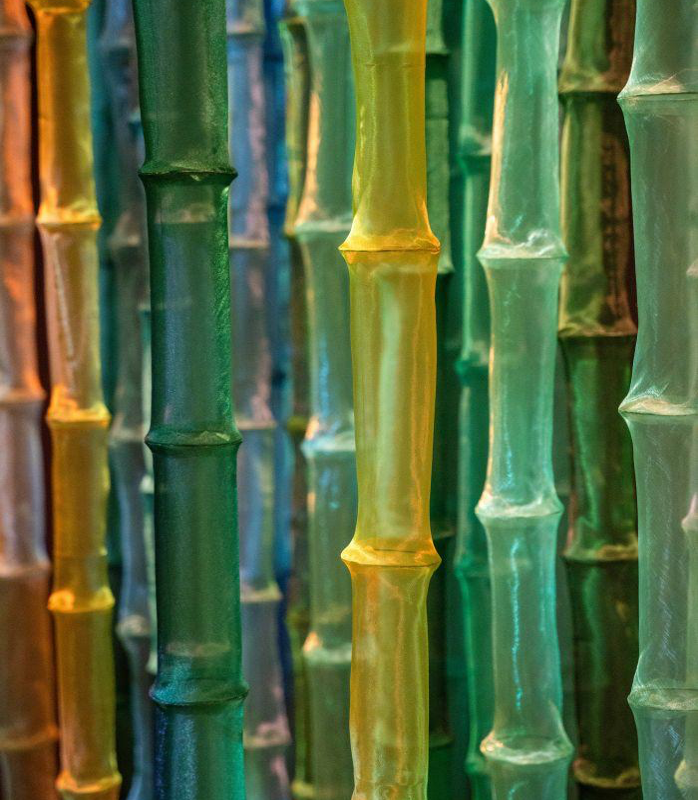
Mariko Kusumoto, “Bamboo Garden,” mixed-media installation (polyester and wire), 2025.
A bamboo-inspired aesthetic. In “Bamboo Garden,” a vertical arrangement of vibrantly colored bamboo stalks of green, yellow, blue, and orange is presented as an immersive sculptural display. The work explores repetition, texture, and chromatic variation, transforming natural forms into stylized patterns that evoke both serenity and visual rhythm. Handcrafted by Kusumoto, whose signature practice involves delicate textile manipulation and organic sculptural forms, it’s an originally crafted, site‑specific installation for Tiffany’s. Kusumoto was inspired by Kabuki theater for Tiffany’s six‑story flagship in Ginza, Tokyo. It is an elegiac homage to Kabuki, one of Japan’s most stylized and dramatic performance traditions. Kusumoto has also collaborated with other notable names, such as Elizabeth Arden, Jean Paul Gaultier, and La Mer, and is represented in several museums around the world, including the Victoria & Albert Museum in London and the Smithsonian American Art Museum.
Take Akari: Bamboo Lights. The Morikami’s “Take Akari: Bamboo Lights” exhibit features expansive, glowing bamboo sculptures curated by Akihiro Mashimo, celebrating tradition, craft, collaboration, and sustainable management. Mashimo, a master bamboo artisan known for revitalizing community‑based illumination festivals in Japan, brings a contemporary sensibility to this centuries-old material practice. He is a leading figure in contemporary bamboo craft and is recognized for his large‑scale light installations that merge artisanal technique with ecological awareness and community engagement. Mashimo’s practice centers on hand‑carved bamboo illumination and collaborative making, which has helped shape the modern Take Akari movement through his commitment to sustainable harvesting and local participation.
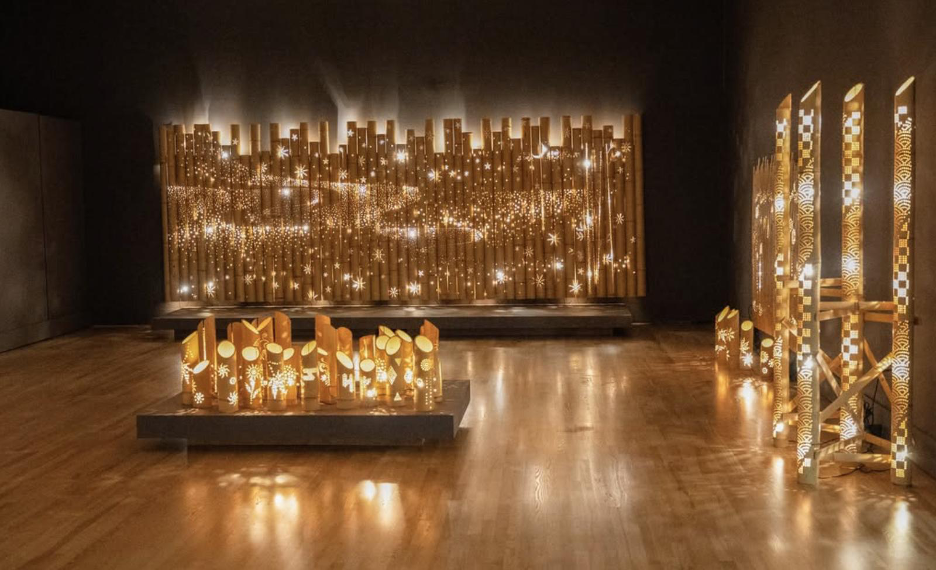
The Morikami Museum first debuted “Bamboo Lights” on July 7, 2024. Following the exhibition, the museum commissioned the illuminated bamboo installations crafted by Akihiro Mashimo for long‑term stewardship and preservation within its collection.
Tanabata is Japan’s Star Festival, celebrating the once‑a‑year meeting of the lovers Orihime, the weaver princess (Vega), and Hikoboshi, the cowherd (Altair). Vega and Altair are the two stars at the heart of the Tanabata legend. Legend has it that they fall deeply in love, neglect their duties, and then are separated by the sky deity (the Milky Way) as punishment. Moved by Orihime’s sorrow, the deity allows them to reunite once a year, on the seventh day of the seventh lunar month. This reunion is the heart of the Tanabata festival mythology. It is marked by hanging colorful wish‑strips on bamboo and local festivals held between July and August.
“Take Akari” literally means bamboo light. It uses cut and drilled bamboo tubes fitted with candles or LEDs to create patterns of light and shadow across gardens and public spaces. Take Akari began as a grassroots response to abandoned bamboo groves and the social need to bring communities together. Makers harvest overgrown bamboo, carve decorative perforations, and light the pieces to form “lightscapes” that are both aesthetic and civic.
This practice has grown into community festivals and site-specific installations that celebrate local craft, reconnect people with nature, and draw attention to bamboo forest management issues.
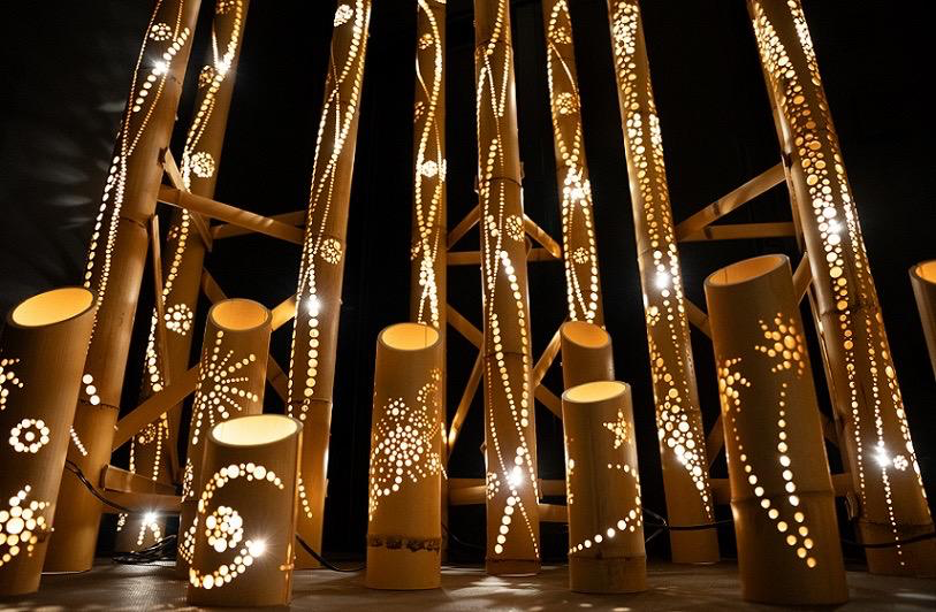
Visitors can experience the world of illuminated bamboo at the Morikami Museum.
Akihiro Mashimo. Born in 1977 in Yokohama, Mashimo is a Japanese bamboo craftsman and artisan recognized for his mastery of takezaiku, traditional bamboo craft. He grew up in Nagaoka, Kyoto Prefecture, where bamboo was a constant presence. He was formally trained at the Traditional Arts School of Kyoto, graduating in 1998. Mashimo is known internationally for demonstrations, workshops, and collaborations in the U.S., Italy, and the U.K., where he promotes sustainable bamboo practices and contemporary applications of traditional techniques.