Capturing invasive pythons in South Florida

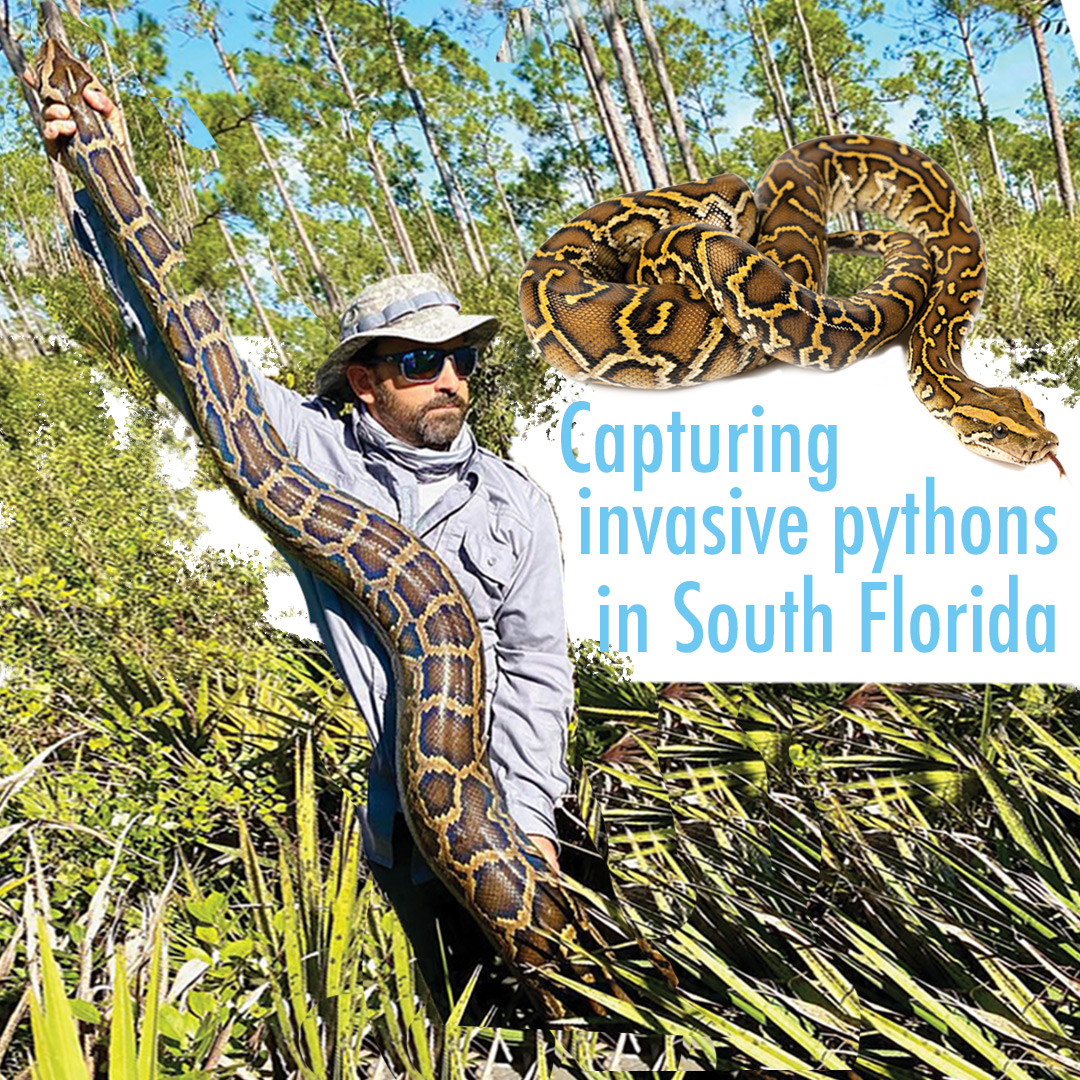
Parkland native Ian Bartoszek does not hesitate to hail Dion the snake as an MVP—“Most Valuable Python.”

After all, thanks to Dion, a “scout” snake, Bartoszek and his fellow biologists at the Conservancy of Southwest Florida removed five Burmese pythons during the last breeding season. “[Dion] had five girlfriends,” Bartoszek jokes.

However, Burmese pythons and their effect on South Florida’s wildlife are no laughing matter. The Burmese python is a large, nonvenomous constrictor that is an invasive species in Florida. You will find them primarily in and around the Everglades ecosystem. The snake represents a threat to native wildlife, but “they’re not interested in us,” Bartoszek says.

One of the snakes captured during this past breeding season was the heaviest Burmese python ever captured in Florida, according to Bartoszek. Specifically, it weighed 215 pounds, measured nearly 18 feet long, and had 122 developing eggs. A necropsy found that an adult white-tailed deer was its last meal.

“Imagine what else she ate over her life[time],” Bartoszek says.

The necropsy, which National Geographic documented, took place in March. Before the December 2021 capture, the largest female removed through the conservancy’s program measured 16 feet and weighed 185 pounds. At the time, it was the heaviest python captured in Florida.

Bartoszek, a 1995 Marjory Stoneman Douglas High School graduate, says that at first, he and his colleagues were unimpressed. “We all underestimated the weight,” says Bartoszek, environmental science project manager for the conservancy’s program. “When we brought her back to the lab and put [her] on the scale, there was a collective wow factor. When we looked, the scale read 215 pounds. We’ve lost count of how many large pythons we’ve captured over the years. To be honest with you, it’s just another big snake for us. There’s always a bigger snake out there.”

Ten years ago, the Conservancy of Southwest Florida started a radio telemetry project to track Burmese pythons in order to learn about their behavior. Since then, Bartoszek and his team removed more than 1,000 pythons collectively weighing more than 26,000 pounds from an area of less than 100 square miles outside of Naples.

Bartoszek and his team use radio transmitters transplanted in male “scout” snakes, such as Dion, to study python movements, breeding behaviors, and habitat use.

Since the conservancy’s python program began in 2013, necropsies have found dozens of white-tailed deer inside Burmese pythons. Also, data researchers at the University of Florida have documented 24 species of mammals, 47 species of birds, and two reptile species in pythons’ stomachs.

The breeding season for Burmese pythons runs from November through March. Last season, Bartoszek and his team removed 4,300 pounds of python from the study area outside of Naples. He says the previous season yielded about the same number.

Removing female pythons plays a large role in disrupting the breeding cycle, Bartoszek says. But that can be easier said than done. Indeed, Burmese pythons are “amazingly cryptic” and hard to locate, he adds. Furthermore, they expand their range each year. Parkland is on the edge of that range, the wildlife scientist says.

The public can report invasive animal sightings by calling 1-888-IVEGOT1. In addition, people can report sightings of invasive species on the IveGot1 app, available at the App store. The app is an integrated invasive species reporting and outreach campaign for Florida that includes the app, a website with direct access to invasive species reporting, and a hotline for instant reports of live animals.

Searching the Woods for Critters

While Bartoszek currently captures huge snakes, he recalled flipping over rocks as a child in the woods in search of critters.

“I always had the bug for turning over stones, seeing where critters were hiding,” he says.

In addition, Bartoszek’s father used to take him fishing. He says those experiences made him appreciate Florida’s wildlife more. As a college student at the University of Arizona, the Parkland native studied wildlife and fisheries science. He recalls coming home from school for the holidays during his college years and appreciating the Everglades and South Florida’s water world even more.

“You have to get away from it to appreciate it sometimes,” Bartoszek says.

After earning his degree, he landed an internship at the Conservancy of Southwest Florida. His responsibilities included working on projects for the Everglades restoration. Also, he recorded wildlife and became more aware of the area’s invasive animal issue. The internship led to Bartoszek’s employment with the conservancy.

Bartoszek says if you told him 11 years ago that he would track one of the largest snakes on the planet, he would not have believed you. He has encountered “some pretty incredible things.”

He says, “You really can’t make this stuff up.”

Cruising down the Intracoastal

Living near the water in South Florida has a lot of advantages. I got to experience one of the best ones this summer.

I took a two-hour, narrated yacht cruise aboard the Lady Atlantic on the Intracoastal Waterway, from Delray Beach to Boca Raton and back. The waters were calm and peaceful, the route was beautiful as we passed impressive mansions lining the shores, and the boat was mostly shaded and comfortable for our journey.

I had made reservations in advance (recommended) and boarded the yacht on a Saturday for the 5:30 p.m. sightseeing tour as part of a group of four couples. Lady Atlantic was docked at Veterans Park on East Atlantic Avenue in Delray. We planned to eat dinner at a nearby restaurant after we got back to town, although they sell food and drinks on board the cruise. We got in line early to secure a good spot on the middle deck (which is covered), and we grabbed a couple of small tables that were located at the stern of the boat overlooking the water, pulling up eight chairs at our prime spot. We were ready to cruise!

A server came around with paper menus listing the drinks and appetizers available, and we ordered something for everybody in our group. We also were located close to the inside bar, for those who wanted to go in and get a drink quickly.

At 5:30 our vessel started to move, turning slowly around to go south on the water and waiting for the drawbridge at Atlantic Avenue to go up at 5:45. As a two-year resident of Florida, it was my first time seeing the tall bridge spans standing up from the vantage point of a boat on the water, and I got a little thrill from finally getting to do that.

We slowly cruised south out of downtown Delray and toward Boca Raton, looking from side to side depending on what our narrator was telling us over the intercom about the sights on either bank of the water. There were many interesting, huge properties along the way, some with pools and elaborate yards and gardens, and we learned about some of the pro athletes who had mansions on the Intracoastal as we passed by them. It was easy to stand up and walk around to get good photos of the sights, as the waves were never rocky on our cruise.

As we made our way to Boca, we learned a little about the area’s history from our excellent narrator. My friends and I were also surprised to see how many houses along the way seemed to stand empty; we soon learned that these impressive homes were just one of a few properties that someone might own. Because we were doing this cruise in the summer, many homeowners were gone and probably staying up north. It also meant that everything in the area was less crowded — a nice bonus!

Like clockwork, when we got to our destination in Boca at 6:30 p.m., the vessel made a U-turn and we headed back the other way to complete the journey in two hours. We got to see the churning waters and the picturesque properties from the other direction now.

After we returned back to Veterans Park, everybody lined up to slowly disembark, with help from the staff. My friends said they wanted to do another cruise sometime, maybe to go north toward Manalapan Island, another option offered. We are hoping to see manatees in the water there in the wintertime.

Delray Yacht Cruises also offers 1:30 p.m. boat tours, holiday lights cruises during December, and private charter cruises. For more information, visit www.delraybeachcruises.com.

The meaning of the high holidays

I love the high holidays! I love being with family, friends, and community. And this year is even more special because after two years we will be together.

As a rabbi who prepares hours on end for these services, I know I have an advantage. And that comes from spending time with the liturgy and readings. As a result, I have come to see myself in the holy days.

I’ll explain.

It may sound strange coming from a rabbi, whose religion is deeply immersed in the idea of “tradition,” that I need religious celebrations and observances to inform and inspire me in the present.

Traditions help create connections to the past and deepen religious feeling, but our inherited traditions also need meaning that speaks to the needs or challenges of our times. I have learned that even our most ancient traditions can address life in the present.

The Jewish New Year, Rosh Hashanah, is the beginning of what are known as the High Holy Days. It is followed by the “Ten Days of Repentance.” These 10 days are meant for self-reflection and consideration of our own behaviors. They culminate on the holiest day, Yom Kippur, the Day of Atonement.

So, what can be said that’s particularly meaningful for us and our world today?

Central to the Ten Days is a notion of teshuvah, which literally means “return” and calls upon us to examine ourselves and see where we can improve. We might ask, “How can I be kinder, more patient, more forgiving, more giving in this world?” Looking at all of the disturbing events and issues in our world, we can easily be overwhelmed and feel helpless. But when personal reflection leads to change, we give ourselves agency to fix some of the problems of the world.

The most profound message of these holidays reminds us that the world begins with you and me! In a world that is so deeply divided, where there is so much violence against each other and our environment, where there is anger and hostility and such intolerance for the “other,” this ancient tradition tells us to look at ourselves and see what we can do to create change for the better.

I wish all a good, healthy, and meaningful New Year! Shana Tova.

David Steinhardt is a senior rabbi at B’nai Torah Congregation in Boca Raton.

The 26-mile horse trail that wasn’t

Parkland is known for its horse-loving history. In fact, when Parkland was incorporated in 1963, its residents fought to maintain a rural lifestyle where people were few and horses were plentiful.

According to the Parkland Historical Society — an organization dedicated to preserving local traditions and providing opportunities for the community to learn about Parkland’s heritage — Parkland founder Bruce Blount loved and raised animals and originally wanted the city to be called “The Ranches.” His intent was to attract residents who liked animals and country living.

But over time, the city evolved, with development changing Parkland’s agricultural lifestyle and creating a shift in attitude away from horses. As roads, shopping centers, and houses began to significantly alter the rural feel of the city, and infringe on land for horse trails, some residents lobbied to preserve Parkland’s horse-centric roots — even calling for the development of a county-wide horse trail.

Led by City Commissioner Mary Jane Sexton between 1986 and 1987, this ambitious project sought to create a 26-mile horse trail that would begin at C.B. Smith Park in Pembroke Pines and end at Tradewinds Park in Coconut Creek. The proposed path would wind north through Markham Park and then have riders following the Sawgrass Expressway toward Tradewinds Park.

Another proposed path (as detailed in Sexton’s 1987 letter to former Coconut Creek City Planner Craig Benedict) had the trail originating at Tree Tops Park in Davie and running north through the Everglades Conservation Area, up into the Loxahatchee Preserve. By building the trail along the levee alongside the Everglades, it would keep the horses away from traffic. This alternate route also included a trail connecting riders with Tradewinds Park via a path through Parkland and Coconut Creek that would require cooperation from local residents.

Sexton faced plenty of opposition to the plan — including that of non-horse-riding Parkland residents with homes along the cross-country trail’s proposed path, who were concerned about the cleanup of horse feces left along the trail. Without cooperation from these residents, connecting the trail to Tradewinds Park would prove difficult.

Despite continued efforts by Sexton and the South Florida Trail Riders, a volunteer horse-riding association, ultimately, the dream of a county-wide trail was never realized.

This article was made possible by archived newspaper clippings generously provided by the Parkland Historical Society. For more information, or to research more history about Parkland, visit www.parklandhistoricalsociety.com.

September skies: fall equinox and oppositions

Here are the sky highlights this month:

  • 10. Full Moon. The Moon will be located on the opposite side of the Earth as the Sun and its face will be fully illuminated. This phase will occur at 5:58 a.m. Eastern. This full moon was known by early Native American tribes as the Corn Moon because the corn is harvested around this time of year. This moon is also known as the Harvest Moon. The Harvest Moon is the full moon that occurs closest to the September equinox each year.
  • 16. Neptune at Opposition. The blue giant planet will be at its closest approach to Earth and its face will be fully illuminated by the Sun. It will be brighter than any other time of the year and will be visible all night long. This is the best time to view and photograph Neptune. Due to its extreme distance from Earth, it will only appear as a tiny blue dot in all but the most powerful telescopes.
  • 23. September Equinox. The September equinox will occur at 8:55 p.m. The Sun will shine directly on the equator and there will be nearly equal amounts of day and night throughout the world. This is also the first day of fall (autumnal equinox) in the Northern Hemisphere and the first day of spring (vernal equinox) in the Southern Hemisphere.
  • 25. New Moon. The Moon will be located on the same side of the Earth as the Sun and will not be visible in the night sky. This phase will occur at 9:55 p.m. This is the best time of the month to observe faint objects such as galaxies and star clusters because there is no moonlight to interfere.
  • 26. Jupiter at Opposition. The giant planet will be at its closest approach to Earth and its face will be fully illuminated by the Sun. It will be brighter than any other time of the year and will be visible all night long. This is the best time to view and photograph Jupiter and its moons. A medium-sized telescope should be able to show you some of the details in Jupiter’s cloud bands. A good pair of binoculars should allow you to see Jupiter’s four largest moons, appearing as bright dots on either side of the planet.

If you’d like to become more involved with astronomy in South Florida and meet like-minded people, the South Florida Amateur Astronomers Association (www.sfaaa.com) at Markham Park is fantastic, equipped with a state-of-the-art telescope, and the perfect way to take the next step in discovering our celestial sky. Happy exploring!

Celebrate Jewish culture at YI Love Yiddishfest

The 4th Annual YI Love Yiddishfest ’22 returns live this year, Aug. 30 to Sept. 4, bringing six days of cultural events, including concerts, plays, lectures, and live entertainment, after two years of online events due to the COVID-19 pandemic.

Founded by actor/comedian and Coral Springs resident Avi Hoffman (known for his “Too Jewish” trilogy), who’s CEO of the Yiddishkayt Initiative and YI Love Jewish, the first event was held in 2018 at the Colony Theatre in Miami Beach. This year’s events will take place in Broward County, Boca Raton, and Miami Beach.

“It’s a little bit scary, very exciting, and very ambitious to be back,” says Hoffman. “But I think we’ll do great.”

Hoffman says the event will appeal to everybody — “not just Jews, but anyone who is Jewish, knows someone Jewish, or has a curiosity about the Jewish culture or religion.”

Highlights of the event include the musical concert entitled “Stars of David: Story to Song,” based on the best-selling book, “Stars of David: Prominent Jews Talk About Being Jewish” by Abigail Pogrebin.

“Stars of David” adapts these real-life stories of Jewish personalities, including actor/director Stephen Spielberg, Bravolebrity Andy Cohen, shoe mogul Kenneth Cole, actor Fran Drescher, singer/pianist Michael Feinstein, and former Supreme Court Justice Ruth Bader Ginsburg, to name a portion of the 62 personalities featured in the book.

The concert will feature Hoffman, Shira Ginsburg, cantor at East End Temple in New York City, Carbonell-winning actor Patti Gardner, and local singer/actor Michael Harper, with musical director Caryl Ginsburg Fantel. Cantor Ginsburg is the niece of Fantel and daughter of Arthur Ginsburg, the former television chef and author, known as “Mr. Food.”

Additional live performers include the Canadian group YidLife Crisis, based on a web series of the same name, created by two friends, Eli Batalion and Jamie Elman, as a way of paying homage to the Yiddishkeit in their upbringing and to shed a Jewish comedic lens on the life in which they were raised. The two have collaborated with actor Mayim Bialik and fellow Canadian Howie Mandel.

Jewish rapper Kosha Dillz, who has performed with rapper Fat Joe and Nisim Black and whose raps about matzoh and Passover have gone viral, will bring his unique rap style to South Florida. Hoffman hopes that his appearance at the festival will attract a younger demographic.

Although Hoffman is modest about his performing contribution, for his fans, another highlight of the festival will be Hoffman’s latest and perhaps last in his “Too Jewish” trilogy performance when he debuts “Still Jewish After All These Years,” a culmination of his Jewish life and career.

Hoffman is also working on a memoir to be titled “Confessions of a Nice Jewish Boy.”

For Hoffman and his mother, Miriam, co-founder of the Yiddishkayt Initiative, a former columnist for the Yiddish edition of The Forward newspaper, a Yiddish playwright, and a past lecturer in Yiddish at Columbia University, it’s an honor to be a cultural emissary for the Yiddish language and culture.

The two teach Yiddish online, a language Hoffman says was predicted to die out with this generation. Instead, he says, Yiddish is flourishing and is everywhere. For examples, he points to Seth Rogan’s 2020 film “An American Pickle” and the Emmy-nominated Netflix series “Unorthodox,” and Billy Crystal’s Yiddish call and response at the 2022 Tony Awards where he had half the audience singing “Oy” and the other half responding “Vey.”

Coral Springs OB/GYN physician Bruce Zafran, who has been practicing in the city for 35 years and moonlights as a stand-up comedian, was watching old Jackie Mason comedy bits online when he got a pop-up message asking him if he wanted to learn Yiddish. He thought, why not?

Hoffman and his mother taught that Yiddish class, and while Zafran was familiar with Hoffman, he was surprised to learn they were neighbors in Coral Springs.

Not only did he sign up for the class, he decided to sponsor the Yiddishfest, along with his wife, Lesley.“Yiddish is a beautiful language,” he says. “Whenever you hear it, you just smile.”

Says Zafran, “I’m happy to help Avi and the Yiddishkeit cause.” He jokes, “Avi is the brains and brawn and I’m the pretty face.”

Zafran’s favorite Yiddish phrase? “Freylakh zol men tomid zayn,” or, “Happy we should we always be,” a phrase he used often at his son’s wedding last June.

“Without Bruce and other supporters like him, we couldn’t do what we do,” Hoffman says. “We need people who see the value in keeping this tradition alive and giving us the ability to bring it to the world.”

Says Hoffman, “Since 1885, when a million Jews emigrated to America from Eastern Europe, Yiddish has permeated and influenced American culture.

“We [the Jewish people] have been around thousands of years and we have contributed to mainstream culture over those thousands of years,” Hoffman says. “We as a people have a lot to offer. There’s a lot to be appreciated. Come, experience Jewish culture, enjoy yourself, have fun, and learn something new.”

And, he says, echoing Zafran, “farvas nisht — why not?”

The festival is held in partnership with Florida Humanities, Miami-Dade County, and the city of Miami Beach. It is co-sponsored by the Sue and Leonard Miller Center for Contemporary Judaic Studies/George Feldenkreis Program in Judaic Studies at the University of Miami, the Greater Miami Jewish Federation, the Betsy South Beach, the Miami Beach JCC, the Adolph and Rose Levis JCC, the Holocaust Memorial of Miami Beach, and the Jewish Museum of Florida.  

YI Love Yiddishfest ’22 runs from Aug. 30 to Sept. 4. For more information, visit www.YILoveJewish.org, email info@yilovejewish.org, or call (888) 945-6835.

DIY: Freshen up your garden decor

There’s nothing like some beautiful decor to enhance your garden — especially in Florida where we spend so much time outdoors. But over time, our garden decor — especially pots and sculptures — starts to look worn. Between sunlight, humidity, and other natural elements, they collect dirt and become discolored, making our gardens look more shabby than chic.

But there is a simple do-it-yourself hack for restoring these pieces that is sure to spruce up your garden in no time — a good, old-fashioned paint job!

What to Paint

Ceramic and terra-cotta pots, and stone garden sculptures, make great candidates for a new paint job. Many people discard these items once they start looking weathered, so if you’re driving around during a bulk pickup day, you may find some hidden treasures that can be easily restored with a simple cleaning and paint job. The Buddha statue (pictured) was a bulk trash find.

Prepping Your Object for Paint

Before you start painting, you’ll want to prepare your pots or sculptures by thoroughly cleaning them, as paint does not adhere well to a dirty surface. Pressure cleaning is a fast and easy way to make sure you knock all the dirt off. If you don’t have a pressure cleaner, use regular soap and water with a scrub brush. Rub the surface clean, making sure you get into every crevice.

Once you’ve washed the pot/sculpture, place it in the sun and let it dry. You do not want to start painting while the surface is still damp. If you’ve chosen a pot with a glaze on it, you’ll want to use sandpaper to roughen up the surface and then wipe it down with a damp cloth. Once dry, place the objects on top of newspaper or a drop cloth to prevent paint from getting on your floor.

Painting

Depending on your preference, you can use latex, acrylic, or spray paint. For rough ceramic surfaces, start with a latex primer. Tip: If you want to clear out your shed at the same time, use leftover paint and paint samples from Lowe’s or Home Depot. The samples are all interior/exterior and adhere well to pots and sculptures. Once you finish, allow 24 hours for the paint to dry.

To embellish your pot, use painter’s tape to create lines and patterns, or purchase a stencil you can paint over. If working with a rounded surface, choose a stencil that is small enough to fit flatly against part of your pot to avoid paint dripping through the stencil and ruining it. For those who are more ambitious, or good at freehand painting, there are unique pattern ideas available on Pinterest.

No matter what you decide to do, make it fun. Whether you take this on yourself or rope the whole family in, painting can be a relaxing way to get outside and de-stress. And once you’re finished, you can show off the fruits of your labor with a garden party.

Mortgage rates still historically low

Over the past two years, fixed mortgage rates have been the lowest they have ever been since Franklin D. Roosevelt came out with Fannie Mae in 1938.

There is only one reason why fixed mortgage rates dropped to the levels that they have been, and that is because of the COVID pandemic. Now that COVID is getting under control and we are at the tail end of the pandemic journey, fixed mortgage rates are back to where they should be. However, we are seeing panic from new buyers, and from homeowners looking to take cash out for home improvement or debt consolidation, because of these “high rates.”

The fact is, mortgages today are still some of the lowest 15-year and 30-year fixed rates in history.

It’s important to realize that (prior to COVID) in October 2018, fixed rates were at 5.25%, which is basically within a hair of where fixed mortgage rates are now. So we are actually on par for where rates should be; however, with the last 2 “COVID years,” we got spoiled with those steady rates in the 2s and 3s.

I recently surveyed 50 people and asked, “Would you want to go through another 2 years of COVID lockdown, hospital treatment shortages, loss of life, etc., in order to get fixed mortgage rates back to the 2 and 3% range?” Of those surveyed, 100% said, “No way, not a chance.”

Knowing why fixed rates got so low, and realizing that fixed rates are currently exactly where they should be (5% to 6% range), I think we can all take a breather and feel comfortable knowing that mortgage rates are still historically low and that this is still a great time to lock in an incredible rate.

Recently, a member of the Federal Reserve said that fixed mortgage rates in the 7.5% range are in the Fed’s comfort zone. So we have to assume that that is where we will gradually head to. Being that we are in a high-inflation environment, if our economy stays on this path, we could see fixed mortgage rates up another 1-2% by the end of 2022. When you take that into consideration, you will have to agree that today’s mortgage rates are a lot more attractive than most people think.

Whether you are looking to purchase a new home or take cash out to make improvements on your current home, most people have a timeline of 20 to 30 days to their closing. Your goal is not to compete and compare with the “COVID rates” that are in the past, because that is a battle you cannot win. Your only goal is to lock in on the best day of your purchase contract period or in the days leading up to your refinance. Putting together a strategy for locking in a rate on the best day of your contract period is all you can control.

Although we have had a steady rise in fixed mortgage rates since February, we still get those days and weeks where rates turn around and actually get better. If you lock in on the best day leading up to your closing, regardless of what that rate may be, you will win.

Ryan Paton is president of Capitol Lending Group, with 22 years of history helping South Floridians get the best residential mortgage available.

South Florida’s own Superman: a story of heroic resilience

We all know life tests you. But for Andres Molina, the past couple of years have been fairly grueling. In the face of constant setbacks and overwhelming obstacles, including full-body paralysis at the age of 37, Molina’s seemingly superhuman ability to remain positive is a testament to the human spirit.

Molina’s journey began in Virginia. When he was 17 years old, he lost his father to cancer. Born on the same day as his father, Molina took the loss very hard, though he credits the experience with helping him develop mental toughness. “That’s the worst thing that ever happened to me, so whatever else is gonna happen, it’s doable. It’s fixable,” he explains of his shift in mindset.

That outlook has been constantly challenged, beginning in Los Angeles. After summoning the courage to pursue his dream of acting, Molina faced rejection after rejection in California. “There were thousands of noes for a handful of yeses,” he says.

Still, he persevered, securing nonspeaking roles in “Days of Our Lives,” “CSI,” “Bones,” and “Law & Order,” among others. In 2012, he landed his first speaking role opposite Christian Bale in “The Dark Knight Rises.”

“I had to work so hard to get to this place. It makes you believe miracles can really happen when you have the right mindset and the right work ethic,” says Molina. “You believe in something and you never give up.”

But for every high, there was an equally tough low. It was years before Molina earned his next speaking role opposite Emma Stone in “La La Land,” which he was extremely proud of. Over the Christmas holiday, he took his entire family to see the movie, only to find out that his scene had been cut.

Instead of getting angry or down on himself, Molina called his agent and asked how they could capitalize on it. “My dad always said, if you’re not a part of the solution, you’re a part of the problem,” says Molina, who was determined to be part of the solution.

He had no idea at the time how crucial his resilience and can-do attitude would be in the next phase of his life.

Just before the start of the COVID pandemic, Molina’s mother was taken to the hospital. Molina immediately packed up his stuff and drove across the country to Parkland. Once in Parkland, he settled into a townhouse with his mother across the street from his sister. That’s when his world was turned upside down.

On August 25, 2020, Molina was outside on the patio when he suddenly fainted, falling backward and hitting his head on a flowerpot. He was unconscious for two full minutes. When he awoke, he couldn’t move. “That’s when hell clicked in. I couldn’t feel anything under my chin,” he recalls.

Molina was taken to Broward Health North where he was diagnosed with a C2 cervical spinal cord contusion. The good news was that he was not permanently paralyzed. But the road to recovery would not be an easy one. Molina spent nine days in the intensive care unit before he could even wiggle his toes. He was then transferred to the trauma unit and began in-bed therapy.

Because he was hospitalized during the pandemic, Molina was especially alone. Hospital policy only allowed one 30-minute visit per day from one relative. “You can’t move. You’re stuck with your thoughts and your energy,” he explains.

Thankfully, his sister pinned family photos and inspirational quotes on his wall. “One quote from the Rock, one of my role models, said you have three choices in life — give up, give in, or give it your all,” says Molina. “I stared at that quote for days before realizing, it’s not that you just jump in and give it your all. You have to give up, then you have to give in, and then give it your all. You have to surrender. And that’s something I was going through. I was angry and in denial. I had to surrender to give myself a chance to heal.”

On his first day of rehabilitation, the physical therapist explained just how lucky Molina was. “They told me I was less than one centimeter away from being permanently paralyzed, like Christopher Reeve. I lost it,” recalls Molina.

He then channeled that energy into his recovery. The first day in therapy, Molina was brought to the parallel bars. He couldn’t take one step on his own. He asked what exercises he could do in bed to speed up his progress, and then he practiced them relentlessly for hours — flexing, nudging, pressing down. The next day, he was able to walk 20 steps on his own, baffling the physical therapist.

The hospital told Molina it would be 4 to 6 months before he was walking. He promised them he would walk out of the hospital when discharged. Thirty days later, he did just that.

Convinced his journey could inspire others, Molina underwent training with French relationship expert Alex Cormont and started his own “love coaching” business in September 2020, coaching clients from his room while working on his own physical recovery. “To see them make progress, that motivated me,” says Molina of his clients.

Months later, when his agent called with a potential stand-in job, though his body was still sore, Molina jumped at the opportunity to get back into acting. It turned out that he was standing in for Henry Cavill, the actor who portrays Superman in the DC Extended Universe. “In the hospital, everyone kept telling me I could have been the next Christopher Reeve, and now I’m standing in for the current Superman,” he reflects.

Life then threw him another curveball. Born with osteoarthritis, Molina discovered he was already bone to bone on his left hip and would require a total hip replacement, derailing his recovery. “I just learned to walk again and would now have to redo everything from a wheelchair to a walker to a cane, stairs — all over again. Twice in 18 months,” recalls Molina. Determined not to give up, he underwent surgery in December 2021.

At this point in his journey, physically, Molina is almost back to where he was pre-paralysis. “I can’t run yet but I can speed walk, bike, swim, dress, drive, shower. I can do everything I need to do,” he affirms.

Mentally, he’s in an empowered space, having realized his purpose. “Acting was a passion, but coaching is my true calling,” enthuses Molina.

For more information, visit coachingwithandres.com.

… That our flag was still there

This July 4th we will be celebrating our nation’s birthday with gatherings, fireworks, and singing of “The Star-Spangled Banner.”

The good ole red, white, and blue are the colors that the Founding Fathers chose to represent our values. According to Charles Thompson, Secretary of the Continental Congress, the color white stood for purity and innocence; the color red represents hardiness and valor; while blue stood for vigilance, perseverance, and justice.

These values unified the 13 original colonies into declaring their independence from the British monarchy and victory in the War of Independence, and the continual growth and success for the past 246 years.

All of us have faced stress in recent years, some more than others. Many are still facing the challenges of caring for loved ones, the increased cost of living, rollercoaster investment portfolios, and anxiety for the future.

So this year, it is even more important to not forget that we, the people of the United States, are founded on perseverance and hardiness. This community has joined to hold each other after facing the evil of the MSD shooting. We have stood together with each other throughout the past couple of years of the pandemic’s ups and downs. We have lent a helping hand to each other when times were tough.

So when we sing “Gave proof through the night, That our flag was still there,” reflect on the resilience of our community. Quoting a former president, “The colors of our flag signify the qualities of the human spirit we Americans cherish.” So we should have faith that our common values, symbolized by the flag, will unite us and persevere through the tough times.

Finding his purpose – Local artist paints for charity, raises over $300,000

A man on a mission. That description sums up Tamarac resident Joseph Gormley.

Born in Scotland, Gormley, 47, moved to the U.S. in 2003 after he fell in love with a Florida woman, Erin Ruth. Now married 19 years, the couple has two girls, Hailey, 6, and Mackenzie Rose, 4.

Erin Gormley bought her husband his first set of paintbrushes as a Christmas gift 15 years ago. A new world opened up for him, whose day job is as a custodian at Bayview Elementary School in Fort Lauderdale.

Once Gormley realized his passion for painting, he set about using his talent to do good, auctioning off many of his artworks for charity. His first painting raised money for an 11-year-old Scottish girl with brain cancer who needed treatment in the U.S. After reading about her, Gormley sent a painting that he did of the Glasgow Celtics head coach, Neil Lennon, to her family.

In 2012, that painting sold on eBay for $8,000. “That was the moment I realized my art could make a difference,” remembers Gormley.

“I know why I have this gift of being able to paint. It’s not for me; it’s to help raise money for others,” he says. “My day job is for my family. And my artwork is for my community.”

In 2015, Gormley painted a portrait of former Miami Marlins baseball player Giancarlo Stanton for the Marlins Foundation, which raised $25,000.

In 2018, he painted a portrait of Anthony Rizzo, a Parkland native who played baseball for the Chicago Cubs and the New York Yankees, which raised $4,000 to upgrade the baseball field at Marjory Stoneman Douglas High School.

The same year, he worked with Joe DiMaggio Children’s Hospital to benefit the Conine Clubhouse, a no-cost residence for families with children undergoing cancer treatment, and helped raise thousands of dollars.

To date, Gormley estimates he has raised $300,000 for local charities, and he has no plans to stop. In 2019, he painted at the Parkland Cares fundraiser and donated the proceeds from his work to the foundation.

“Parkland Cares is very fortunate to have been one of the recipients when Joseph Gormley painted live at our wine dinner and donated the proceeds from his paintings,” Stacey Udine wrote online after the event.

“Every brush stroke gives Joseph the chance to inspire others, and we’re immensely grateful for his continued support of Parkland Cares,” she said.

In February, the prolific painter teamed up with 105.9 BIG radio DJ Doc Reno, whose charity, My Family Matters Foundation, raises money in partnership with the Joe DiMaggio Children’s Hospital Foundation to provide assistance to families who lose wages while caring for a child with cancer.

It was founded by Doc Reno in 2019 after he battled stage IV head and neck cancer. “How could I feel sorry for myself when next to me in the waiting room is a 7-year-old with brain cancer?” he says. “I saw what families were dealing with and wanted to do something to help.”

He continues, “Joseph is an amazing person — a true angel and a very gentle soul. I was blown away by his work. I’m thrilled he has offered his talents for this cause.”

Gormley painted live at Doc Reno’s “My Family Matters” golf tournament in February, at the Jacaranda Golf Club in Plantation.

Participants included former Miami Dolphins’ Bob Brudzinski and running back Ki-Jana Carter; radio disc jockeys Drew Heyman (Y100) and Paul Castronovo (BIG 105.9); rock drummers Nicko McBrain of Iron Maiden, Tico Torres of Bon Jovi, and Carmine Appice, former Ozzy Osbourne drummer; and many others.

With Iron Maiden being Gormley’s favorite band, he was thrilled to paint the portraits of the three drummers and auction them off with their signatures.

Other celebrities he has painted include Aerosmith singer Steven Tyler, Washington Commanders quarterback Doug Williams, and talk show host Ellen DeGeneres.

Gormley says he is raising his two girls to finish the journey he started and to leave a legacy behind.

“I’m very blessed,” says Gormley, who hopes to eventually raise $1 million for charity. “So many people struggle to find their purpose in life. I know my purpose — it’s to help and inspire others.”

For more information, visit josephgromleyart.com, myfamilymattersfoundation.org, or parklandcares.org.

Enjoying the beautiful, dynamic Marjory’s Garden

Marjory’s Garden is more than just a garden. It’s a safe haven for students and teachers, fauna and flora, and so much more.

Ground was first broken on this project in May 2016 after dozens of portable classrooms were removed from a field behind Marjory Stoneman Douglas High School (MSD). Following the suggestion of science teachers Kyle Jeter and Sean Simpson, the principal at the time, Ty Thompson, allotted a long strip of land next to the tennis courts for the purposes of a STEAM (Science, Technology, Engineering, Art, and Math) project. Mr. Jeter, Mr. Simpson, and others began brainstorming ideas and created a sketch of what would become Marjory’s Garden.

When you walk into the garden, the first things you might see are the flower beds with eye-catching zinnias up front. These specific flowers are perfect for two of the garden sponsors, Mr. Jeter and Mr. Simpson, who teach astronomy. This is because zinnias were the first flower to ever be grown in space! If you like that fun fact (or learning in general), you should keep walking past the flower beds to the outdoor classroom.

The outdoor classroom is exactly what it sounds like, with a handful of benches all facing a stage for optimal teaching (covered by shade for those hot Florida days, of course). Many teachers love using this area as a change of setting during school hours, especially the STEM teachers. In fact, in the 2022-23 school year, there will be a botany class taught by Mr. Davis, and he will use the garden.

The outdoor classroom is also where the school hosts its garden movie nights. The Climate Change Club, for example, recently watched “The Lorax” in Marjory’s Garden. Along with movie nights, there are many other special events held in the garden, such as Astronomy Nights and a “Not-So-Scary Halloween” event hosted by Mrs. Herzfeld and the spectacular MSD Drama program. As you can see, Marjory’s Garden is as versatile as it is beautiful, which is why it is split up into different sections, or zones.

The zones consist of multiple areas including vegetable and flower beds, a butterfly garden, and a “food forest” created by Mrs. Beaty. There’s also a corn and okra field courtesy of Lt. Col. Mark Anders, and a giant bamboo cone supporting bean-sprouting vines (designed and built by Mr. Davis). There is a “Reflection Garden” with a small fountain and 17 large, polished stones, donated and built by Brightview Landscaping in 2018.

The garden is an officially recognized wildlife habitat as well. It is home to countless species of fauna, including mice, butterflies, bees, sawflies, rabbits, iguanas, and, recently, baby birds. The “Everglades Zone,” designed by Mr. Garner, features indigenous plants such as sawgrass and is a prime example of how the garden is nurturing our Florida ecosystem.

Other amenities include the “Little Library” (donated by MSD Media Center specialist Diana Haneski), the “Kindness Rocks” stand (maintained by Roxanne Haubrich and many others), and an area for games such as chess and cornhole. Finally, and perhaps most uniquely, Marjory’s Garden is home to an observatory with an 8-inch Cassegrain reflecting telescope!

Besides being a beloved location by MSD students and staff, there are academic benefits to visiting the garden: Students can earn two service hours for helping out in the garden on Sundays (beginning at 9 a.m. sharp). There are always a variety of projects to work on, such as maintaining the garden, planting new flora, painting, construction, and much more. The most meaningful day to volunteer is on the Day of Service, an annual event hosted by MSD on the anniversary of the tragedy. Students not only earn service hours but also contribute very special and meaningful work to the garden.

Another great feature of being a student at Marjory’s Garden is the lunch held in the garden every Wednesday. On garden lunch days, there is always a faculty member present. Dr. McBride, for example, supervises the latter of the two lunch periods weekly, and Mr. Davis supervises the first. The garden lunch gives students a mental refresher and brain break from school and academics. During these lunches, students usually relax in the outdoor classroom or sit on the benches placed throughout the garden.

The garden also uses hydroponics, with a nutrient solution and tubes of flowing water to grow an assortment of plants, such as lettuce and peppers. The original hydroponics was created by Mr. Simpson in 2016; however, the garden is going to team up with Mrs. Reich and her STEM classes to create a new and better version of hydroponics in the future. The school is also installing electrical outlets and a permanent water valve in the front of the garden, for powering lights and other electronics at night, and of course, pumps for the hydroponics. This is an expensive task, however, so a lot of donors were recruited to get the job done, including Eagles’ Haven, Cutler-Rader, Hard Rock Classic Casino, Broward Health, and Roman Consulting. Without School Board member Lori Alhadeff leading the fundraiser, this could not have been accomplished!

Marjory’s Garden continues to be a vibrant and beautiful green space at MSD, thanks to the amazing students, staff members, community volunteers, and donors. The faculty leadership team consists of Lt. Col. Anders, Mr. Cochenour, Mr. Davis, Mr. Garner, Mrs. Herzfeld, Mr. Jeter, Ms. McAuley, Mr. Simpson, and Mr. Walsh. A special thanks goes to Ken and Sharon Cutler for supporting the garden from the very beginning. Mr. Cutler is currently the vice mayor of Parkland and Mrs. Cutler is a long-time MSD business teacher and DECA advisor. The school is also extremely grateful to all of the community and parent volunteers. Marjory’s Garden is a very enjoyable learning space for all, and it couldn’t have been created without the support of the whole Eagle family.

If you’d like to support this dynamic project, please go to https://gofund.me/cccf2fc7 for the GoFundMe, managed by former MSD teacher (and garden guru) Stephanie Beaty.