For more than 40 years, Busch Wildlife Sanctuary has been a leading voice in wildlife rehabilitation, conservation, and education. Set on 20 acres in Jupiter, the sanctuary features a state-of-the-art animal hospital and rehabilitation center and is home to approximately 150 native wildlife species, including otters, black bears, bobcats, foxes, cougars, and pelicans.
Each year, the hospital treats around 5,000 patients, and it’s equipped to handle complex cases with a computed tomography machine, blood diagnostic equipment, a laboratory, and a surgical suite. Busch Wildlife has a full-time veterinarian on staff, along with two rotating veterinary interns and a network of experienced veterinarians who generously donate their time.
That network can make all the difference. When Grayson, one of the sanctuary’s resident foxes, was diagnosed with a thyroid tumor and needed surgery, the staff veterinarian estimated the complicated procedure would take two hours. “We have a veterinarian in the area who is a retired orthopedic veterinary surgeon, so we reached out to him. He came over and had it done in 15 minutes,” recalls Amy Kight, CEO of Busch Wildlife Sanctuary, who is celebrating 22 years with the organization.
Busch Wildlife can only accept and treat native wildlife species, which presents a unique challenge in Florida, where invasive species such as iguanas, pythons, and Muscovy ducks are widespread. Kight estimates that 10% to 15% of the cases brought in are invasive species that the sanctuary cannot treat, though staff always provide referrals rather than turning people away.
Of the native species admitted, about 30% can be successfully rehabilitated and released back into the wild. For animals that recover but cannot be released and are deemed suitable for captivity, the sanctuary follows a thoughtful and collaborative placement process.
“We have a joint committee of animal welfare and animal placement where, each month, our veterinarian, our head of animal care, our education director, and other key staff sit down and go through the list to figure out a placement.” In some cases, animals are placed with other organizations. Disney’s Animal Kingdom, for example, has taken in raptors, opossums, and snakes for its education program.
This time of year—baby season—brings a surge in activity. The sanctuary often takes in about 50 new patients per day and fields calls from concerned residents who encounter baby birds, squirrels, opossums, and other wildlife in their neighborhoods.
“It’s a lot of chaos and education,” says Kight. “People tend to see a baby animal and think they have to go rescue it, which gives us the opportunity to say, ‘Please don’t do that.’ We have to first determine whether this animal really needs us, or whether it’s just a youngster trying to make its way in the world and we’re interrupting that life cycle.”
Some of these situations are preventable. During hurricane preparation, for example, tree trimming can inadvertently disturb nests where young animals live. The sanctuary emphasizes education around proper tree-trimming practices and encourages residents to consider whether displaced animals can be safely renested nearby.
Other cases are unavoidable, such as when a mother squirrel is killed by a car, leaving orphaned babies behind. “To get a squirrel from eyes still closed back to the wild takes 4 months,” explains Kight.
When orphaned animals—whether squirrels, owls, opossums, or others—require long-term care, staff take careful steps to ensure they are raised as naturally as possible. This helps prevent them from becoming habituated to humans, which is critical for successful release.
Precautions include wearing ghillie suits—specialized camouflage designed to resemble foliage—using puppets for feeding, and placing animals with foster mothers when possible, a method that has proven especially successful with owls and opossums. “Opossum moms are great,” says Kight. “As long as she’s producing milk, she’ll raise other babies.”
While the rehabilitation center itself is not open to the public, the sanctuary welcomes visitors seven days a week from 10 a.m. to 4:30 p.m. Admission is by donation, with no set fee.
Each year, Busch Wildlife Sanctuary draws tens of thousands of visitors through its gates. Its education programs include daily offerings such as Conservation Conversations in the amphitheater, as well as school field trips, guided tours, summer camps, Junior Naturalist programs, outreach presentations, and interactive exhibits designed to inspire curiosity and conservation action.
“We want people to really know what lives in their environment and how they can coexist with it,” says Kight of the educational programming. Rather than overwhelming visitors with large-scale environmental issues like global warming and microplastics, the sanctuary focuses on simple, actionable steps—such as planting native species instead of exotics that can harm local ecosystems. “You gotta start small,” says Kight. “Otherwise, when you start thinking about all the things encroaching on our environment, it starts to feel impossible.”
A walk through the sanctuary offers visitors the chance to meet its permanent animal residents. Among them is Freddie, a 40-year-old alligator who has lived at the sanctuary her entire life.
When Freddie was still developing, a child cracked her egg open prematurely. The child’s parents brought the egg to Busch Wildlife, but because of the early opening, Freddie never fully developed and cannot open her mouth all the way. Unable to survive in the wild, she has since become an ambassador for her species, giving visitors an up-close look at a Florida alligator.
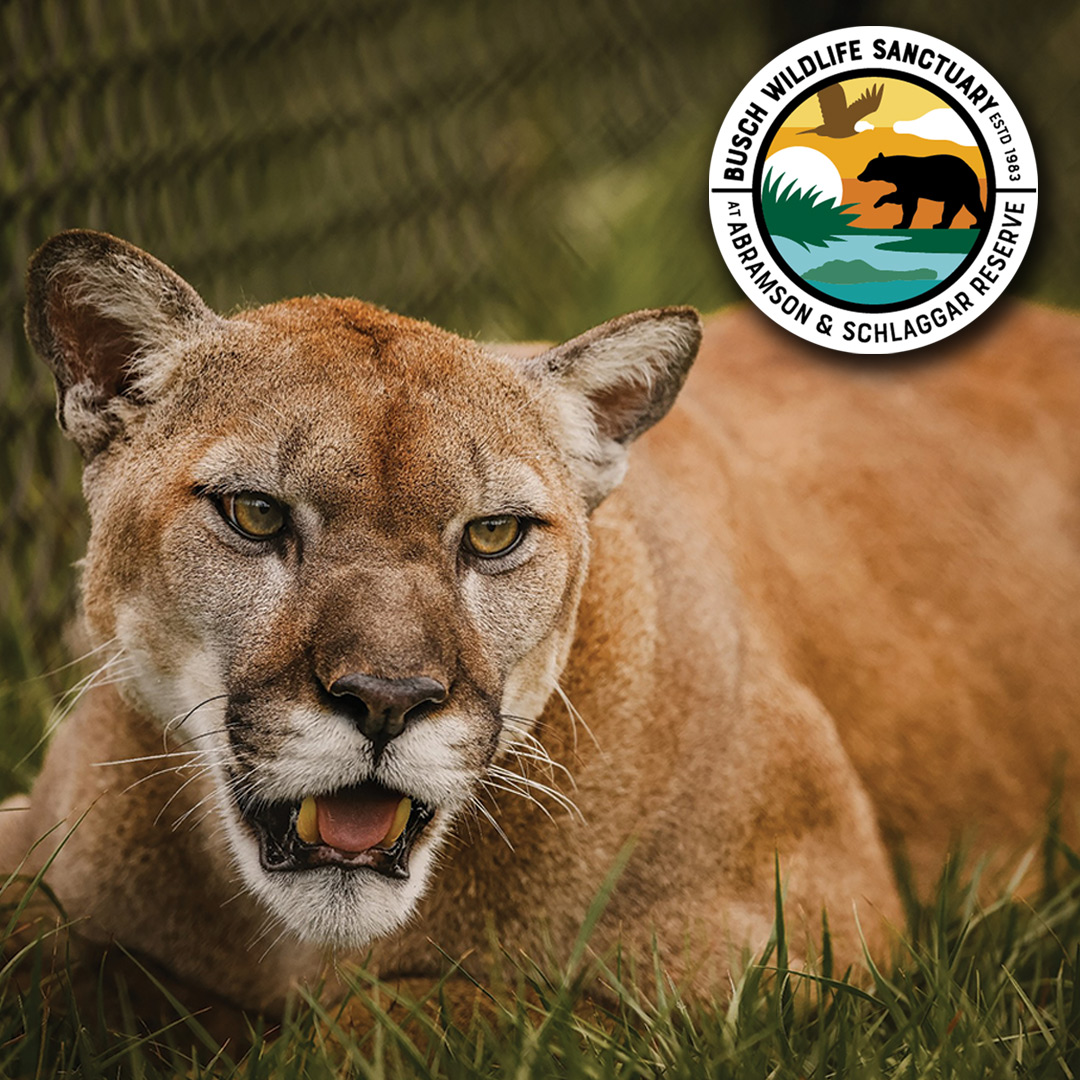
Another resident, Charlie the California cougar, has a cross-country story of his own. Declawed on all four paws and sold as an illegal pet, Charlie was first taken in by Conservation Ambassadors, a California-based sanctuary. From there, Kight and COO Christen Mason personally transported him to Florida. “We just got up one Saturday morning, grabbed Starbucks and a van, and got to California Monday afternoon,” recalls Kight. “Tuesday, we loaded Charlie in a kennel on our van, and it was 44 hours straight back to Florida. We timed it so we got back right when the staff was getting in on Thursday morning, so they could help us get him set up.”
At the time, Charlie was overweight and would have had to be transported as cargo if by airplane—an option the team wasn’t willing to consider. “It would have been too stressful,” explains Kight. “Also, you’re talking about an apex predator, so there were too many things that could go wrong. It was safer to have him in our hands.”
California cougars and Florida panthers are the same species, considered geographically separated. Charlie—despite being about 30 pounds heavier than a Florida panther—serves as a representative who helps teach visitors about conserving the Florida panther.
While long known as a family-friendly destination, the sanctuary has recently expanded its offerings to appeal to adults as well. New events include Wine Down with Wildlife, Yoga in the Wild, and music concerts. The next Yoga in the Wild session is scheduled for Saturday, May 16, at 9 a.m.
For more information, visit www.buschwildlife.org.