
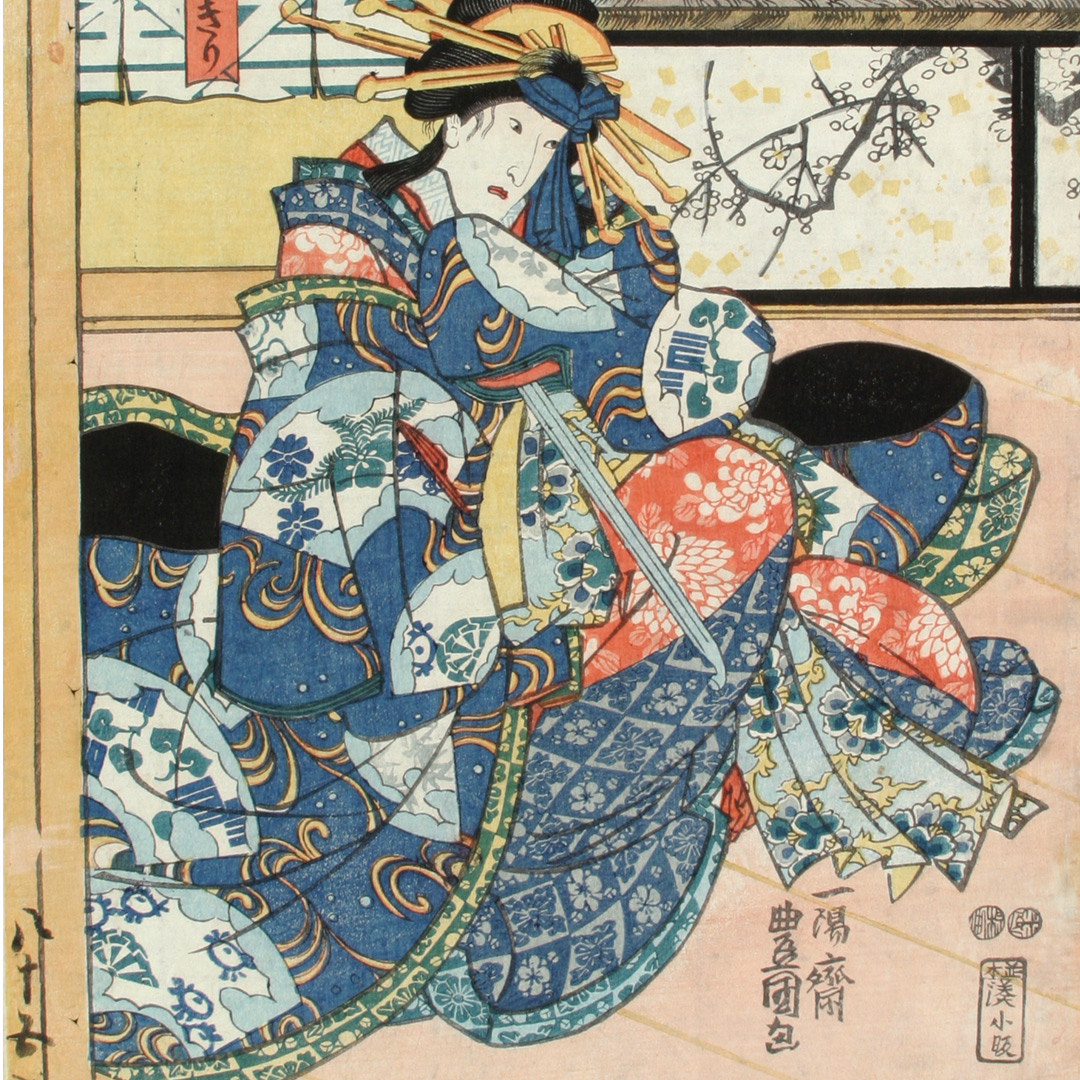
Japanese prints and the art of leisure, at Norton Museum of Art
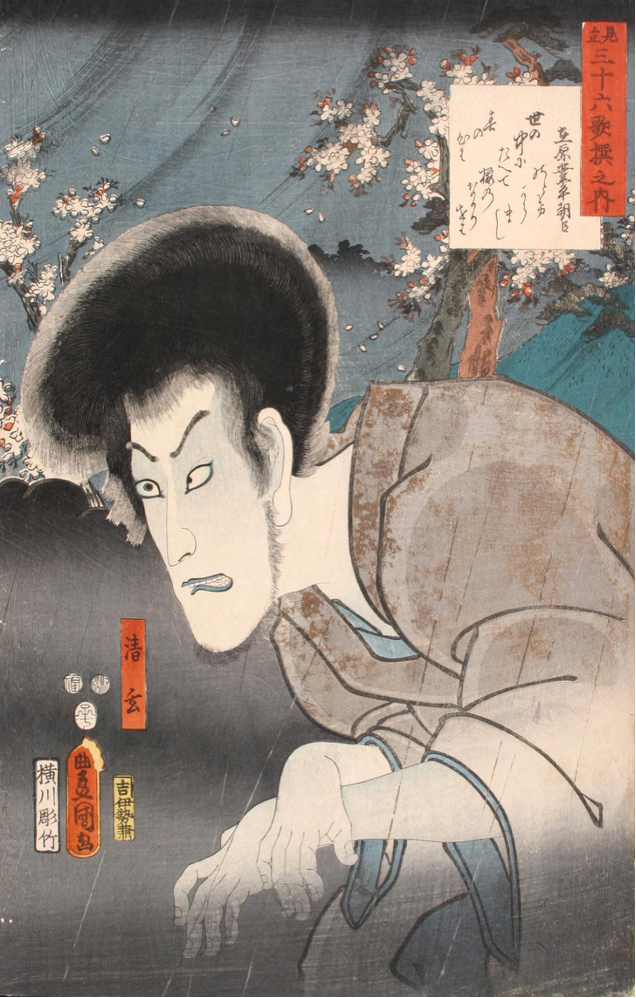
Utagawa Kunisada: Kabuki actor Ichikawa Danjūurō VIII (1823–1854) as the Ghost of Seigen with poem by Ariwara no Narihira (825–880). From the series “Witty Comparisons of Actors with the Thirty-Six Poets” (“Mitate sanjūrokkasen no uchi”), 1852, woodblock print, ink, and color on paper (14 9/16 x 10 in.).
In the bustling streets of Edo, Japan (1603–1868), centuries before movie posters or mass‑market lithographs appeared in the West, Japanese audiences encountered their favorite celebrities in a different form: woodblock prints. These vivid sheets sold for the price of a bowl of noodles and captured the drama, glamour, and emotional intensity of kabuki theater, with a level of detail that still astonishes viewers today.
Far from being simple souvenirs, these prints were the beating heart of a sophisticated entertainment economy. They were advertisements, fan merchandise, fashion guides, and narrative snapshots all at once. Moreover, they were produced through a process as intricate as the performances they depicted.
Unlike Western printmaking traditions, where the artist often worked alone, Japanese woodblock printing was a collaborative craft involving four specialists: the designer (Eshi), the block carver (Horishi), the printer (Surishi), and the publisher (Hanmoto). Each role was a discipline in itself, honed over years of apprenticeship.
Furthermore, in Japanese traditions, woodblock printing was the engine behind the ukiyo‑e, or “pictures of the floating world.” This world depends on exceptionally delicate papers, noting that their delicacy is not a weakness. In fact, it is the very reason that mokuhanga (the fully hand‑crafted, water‑based printing system that produced the ukiyo‑e prints) can achieve its signature luminosity, crisp detail, and atmospheric softness. These papers, also known as washi, are among the most-refined printing surfaces ever developed. Thus, their delicacy is the reason the Norton Museum of Art has held them in its archives for decades, now and only for the first time exhibiting them to the public. In fact, Norton’s very special exhibit, “That’s Entertainment,” consisting of donated works from Asian art history, is on view until July 5.
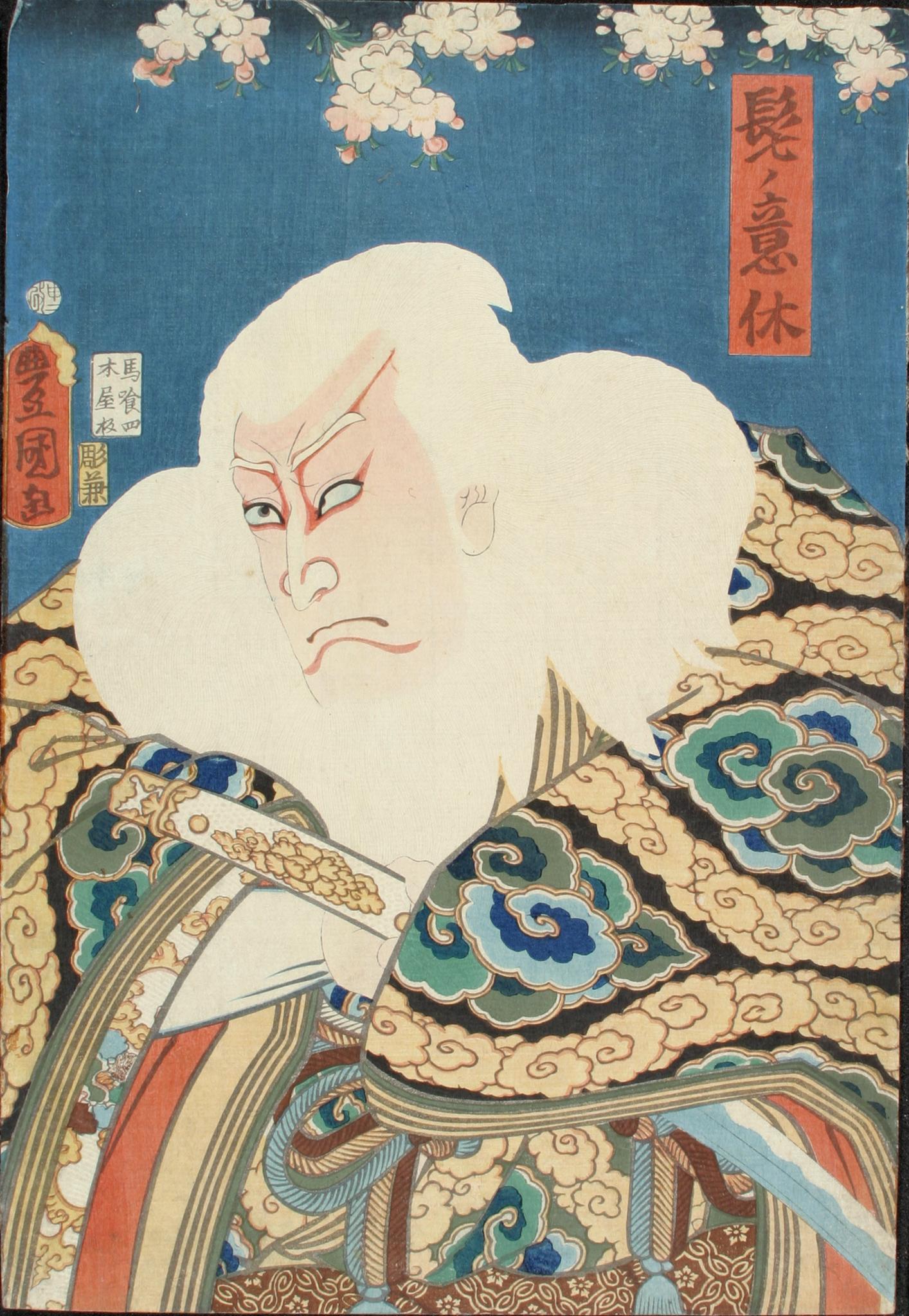
Utagawa Kunisada: Kabuki actor Ichikawa Hige no Ikyū, from the kabuki play “Yukari no sukeroku,” 1860, woodblock print, ink, and color on paper (15 1/2 x 10 in.).
Detail was everything. The finest ukiyo‑e lines—such as strands of hair, the shimmer of silk, or even the glint of a sword—were carved with a single knife, and guided by a hand trained to breathe consistently with the wood. Each color chosen required its own block, and sometimes dozens, each aligned with pinpoint accuracy. The printer then coaxed the image to life using water‑based pigments, brushed onto the blocks and transferred to handmade washi paper with a handheld baren. These pigments, such as the mineral blues, safflower reds, and soot blacks—as seen throughout the exhibition—were transparent, luminous, and capable of the soft gradations known as bokashi, a hallmark of Japanese print aesthetics that resulted in a world suspended between line and color.
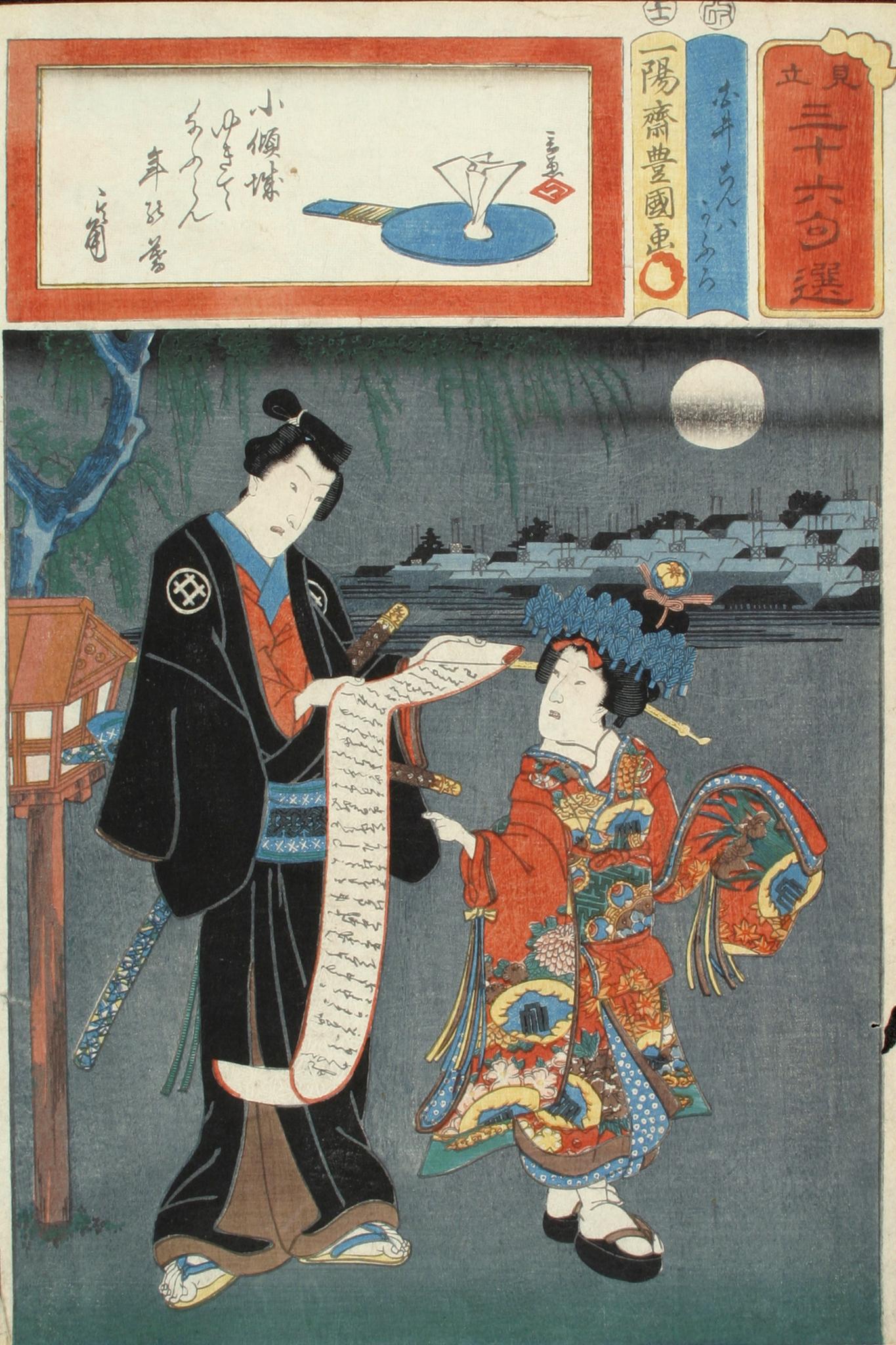
Utagawa Kunisada: Kabuki actor Iwai Kumesaburō III (1829–1882) as Shirai Gonpachi and an unidentified actor as a kamuro, from the series “Matches for Thirty-six Selected Poems with Kabuki Plays” (Mitate sanjūrokku sen), 1856, woodblock print, ink, and color on paper (13 5/8 x 9 1/8 in.).
Utagawa Kunisada (Japanese, 1786–1864), also known later as Toyokuni III, was the most commercially successful and prolific ukiyo‑e printmaker of 19th‑century Edo, producing more than 20,000 designs across his lifetime. He worked across nearly every major ukiyo‑e genre, from actor portraits to the kabuki scenes (theatrical compositions).
But to understand why his world was so visually abundant, one only needs to look at the prints of the “47 Rōnin,” the legendary tale that became kabuki’s most beloved blockbuster. The play unfolds across 11 acts, each with its own emotional temperature inclusive of political intrigue, secret vows, snow‑covered night attacks, tragic sacrifices, and the final, cathartic act of revenge. No single print could contain all of this in one illustration, so artists did not try. They instead exploded the story outward, scene by scene, moment by moment, and across hundreds of different illustrations shared with the public.
Like the kabuki play, “Toki ni minna minobu no goriyaku” (1857), Norton’s exhibition frames its unique collection within a broader story about how visual culture shaped everyday life in Edo. By bringing together actor portraits, bijin‑ga, festival scenes, and rare textiles, the works form a vivid panorama of entertainment itself in an ancient world where artistry, storytelling, and spectacle were inseparable from the rhythms of city life.
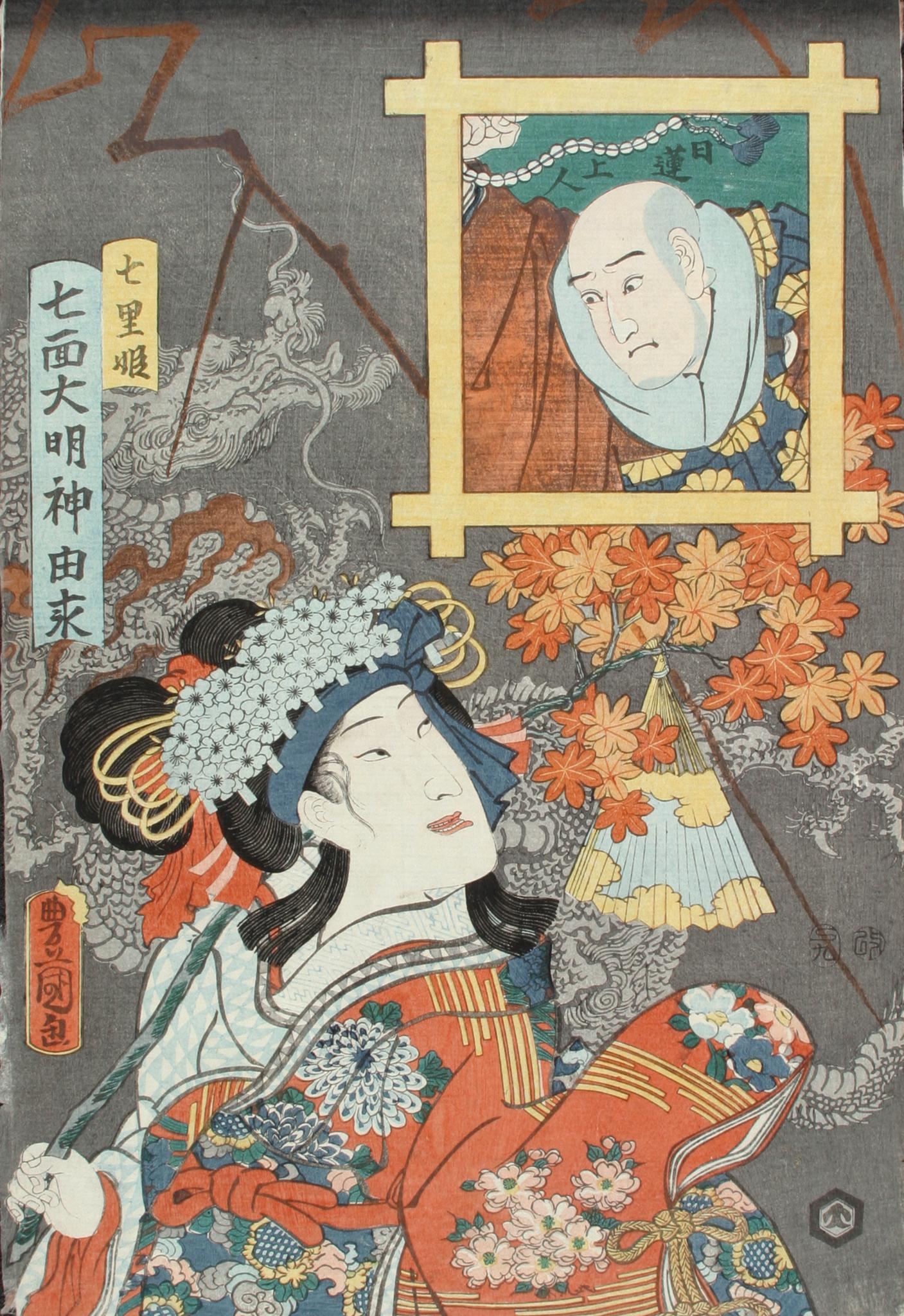
Utagawa Kunisada: Kabuki actors Nakamura Fukusuke I (1831–1899) as Princess Shichiri and Ichikawa Danzō VI (1800–1871) as Saint Nichiren, from the kabuki play “Toki ni Minna Minobu no Goriyaku,” 1857, woodblock print, ink, and color on paper (14 1/2 x 9 5/8 in.).
Also on display are other notable artists of woodblock prints, including Ishikawa Toyonobu and Toyohara Kunichika. Both were major ukiyo‑e print designers, but each lived a century apart and represents a distinct era of Japanese woodblock printing. Bridging these historical works to the present is the 21st‑century “Kabuki Costume for the Role of a Kamuro,” an embroidered silk piece on loan from the U.S. kabuki Ken Kyu Kai.
Today, these prints remain some of the most recognizable images in global art history. They are windows into a world where entertainment, craftsmanship, and mass culture intertwined with remarkable sophistication.
The works presented in portraits by masters like Kunisada and dramatic kabuki scenes are not just historical artifacts but the ancestors of modern visual media, in which the first posters, the first celebrity portraits, and the first mass‑produced art were created that people bought simply because they loved them. The woodblock prints are, in every sense, the theater on paper.