
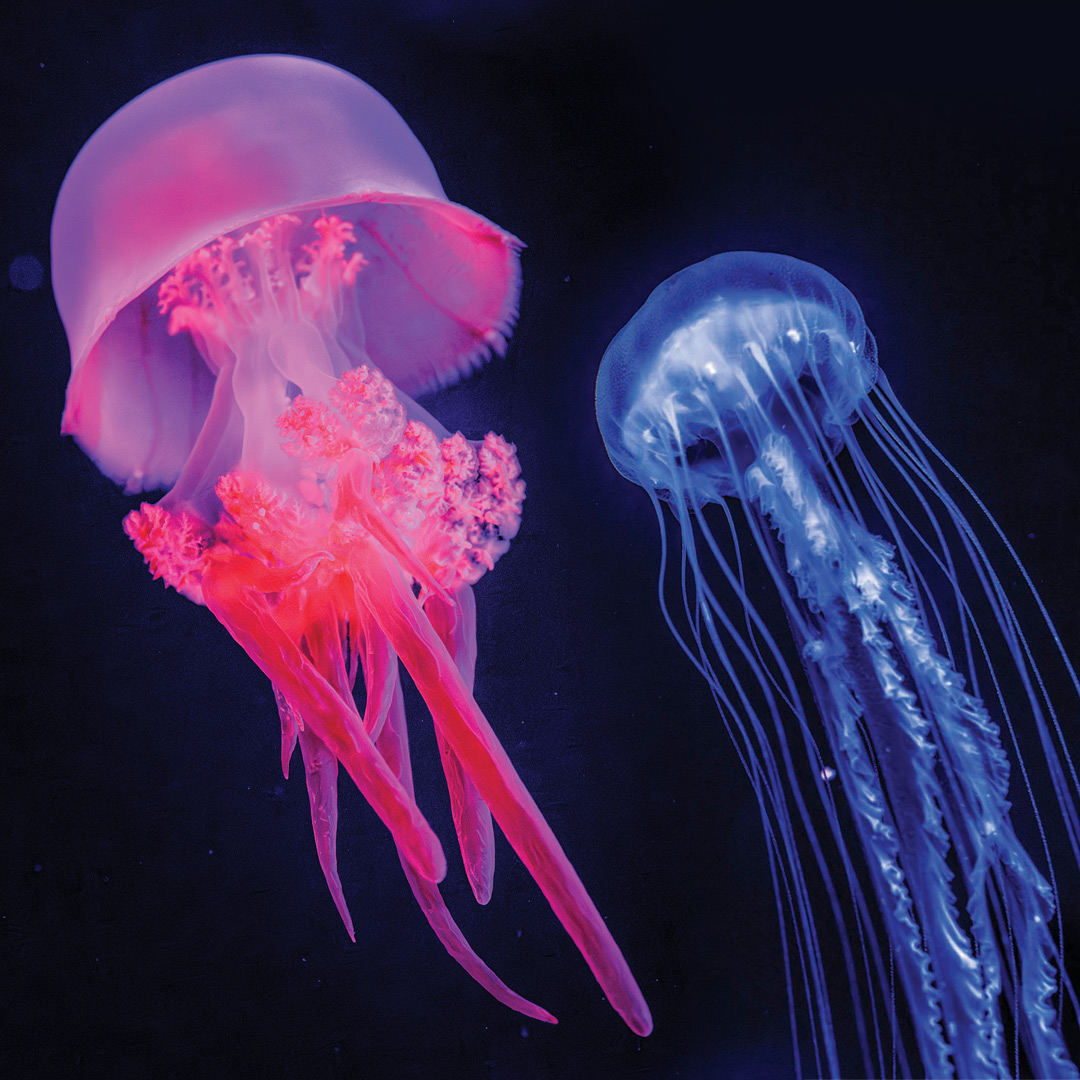
The Jellyfish Museum is the first of its kind in the U.S.—a museum dedicated solely to showcasing the world of jellyfish, with more than 20 species from seas and oceans around the world on display.
The museum was founded by Yana Yanovska and Alex Yanovskyi and is their second museum dedicated to jellyfish. They established the first in Kyiv, Ukraine’s capital city, in 2018. When the Russian-Ukraine War forced them out, they recreated their dream in Pompano Beach.
Walking into the museum is an experience in itself. Between the dark walls and colored lighting, the entryway feels like it’s leading you into a nightclub. But once inside, the glowing displays and immersive light projections will have you feeling like you’re in an ethereal underwater wonderland.
There are 21 tanks on the main level of the museum, illuminated by neon-esque shades of pink and turquoise. “Some of the jellyfish are so clear, you can’t see them, so we have to put lighting behind them,” explains Jessica Eisenbarth, community relations manager.
While the showcasing of these unusual creatures is stunning—there’s even a heart-shaped tank filled with moon jellyfish that has a hole in the middle where you can stick your head for a photo surrounded by jellyfish—the tanks require careful, 24-7 monitoring to ensure that the jellyfish survive. “The currents in their tanks, the water pH, and salinity all have to mirror their ocean environment,” explains Eisenbarth.
The Jellyfish Museum offers a meditative experience if you let it. One of the rooms is outfitted with bean bag chairs where you can sit and observe the jellyfish, a surprisingly relaxing experience. They have a slow, fluid way of moving, similar to the colored blobs in a lava lamp, only much more fascinating. “We want people to slow down,” says Eisenbarth. “There’s a calmness and an immersive experience that we hope everyone feels when they’re here.”
There’s also a lot to learn about jellyfish, both through watching them and through the educational and scientific displays the museum offers. “They have no brain, eyes, or central nervous system,” says Eisenbarth. And while most people associate them with being underwater nuisances that sting, jellyfish have a significant impact on the environment. “When you find large blooms of jellyfish, it’s actually an indicator that there’s changes in the ecosystem like water temperatures rising and lower oxygen levels,” explains Eisenbarth. “When you find it, it’s very important for scientists to take a look at why it’s happening.”
Because jellyfish have short lifespans of between 3 months and 1 year, depending on the species, the museum updates the ones on display every few months. When jellyfish first arrive at the museum, they go into quarantine in the laboratory on the second floor. Some, like the Japanese Sea Nettle, have been flown in from the far reaches of the Pacific.
One of the newest additions to the museum is the Fried Egg Jellyfish (aptly named, as it resembles a fried egg), which spent about a month in quarantine before going on display. These unique creatures are primarily found in the Mediterranean, Adriatic, and Aegean seas.
Also on display right now are the Upside Down Jellyfish, which are found in South Florida. These creatures spend most of their time on their back (hence the name). They need ultraviolet (UV) light to survive because they have an algae that grows inside of them, and the jellyfish need the algae to survive. This partnership works through mutualistic symbiosis, where both organisms thrive together. The algae provide almost all of the jellyfish’s nutritional needs, which is why they rest upside down to soak up the sun. At night, the team turns down the UV lights to mimic the natural rhythm of nature. These jellyfish are a favorite meal for sea turtles, which can eat their weight in jellyfish on a daily basis.
While a stunning visual display, the museum’s primary focus is education, especially for school groups. “We work very hard to make this an educational facility so that you learn about the biology, the anatomy, how they affect our oceans, how they affect us, and how they contribute to science,” says Eisenbarth. She emphasizes that while jellyfish are over 500 million years old and have survived four mass extinctions, we still don’t know that much about them.
The museum is working with scientists from the Smithsonian to help generate a curriculum that can be distributed to teachers after school-group visits. It also collaborates with researchers. One of those researchers is biochemist Dr. Angel Yanagihara, who developed “Sting No More,” a patented zinc gluconate–based formula that neutralizes box-jellyfish venom. “It works on all jellyfish stings that have been tested,” says Eisenbarth. The museum plans on carrying this jellyfish-sting antidote in its gift shop. “It works on fire-ant stings as well,” she adds.
Since opening in late March, the Jellyfish Museum has welcomed plenty of visitors and plans on expanding its reach through new social events, including magic shows, romantic evenings, and wellness events, such as sound healing. The 20,000-square-foot space is also available for private events.
The Jellyfish Museum is open seven days a week between 10 a.m. and 7 p.m. It offers discounted admission for Florida residents, senior citizens, children, active-duty military and veterans, first responders, medical personnel, and educators.
For more information, visit www.jellyfish-museum.com.