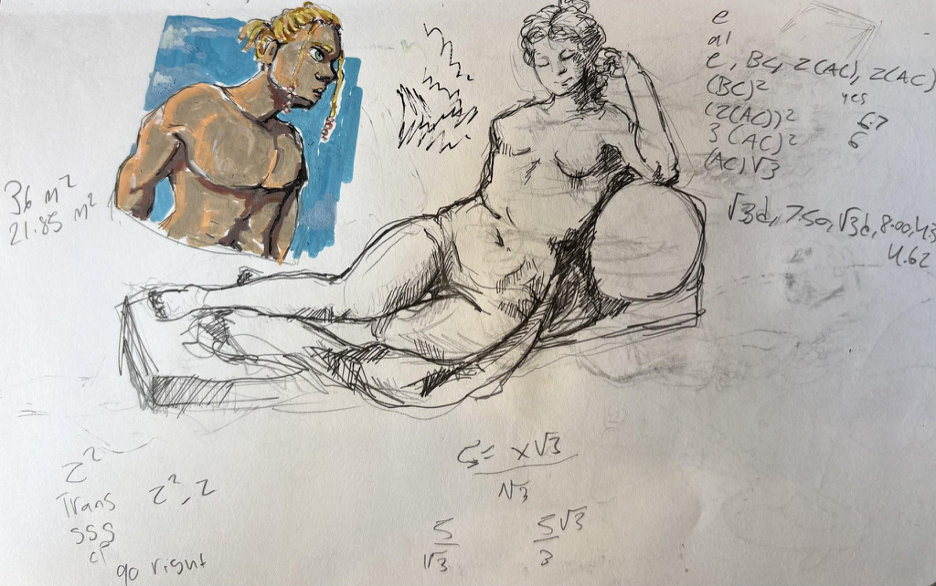
Sketches from Book #6 (2026). Bresset, J. Pencil on paper, paint pens on paper. 9” x 6”.
“Less is more” is one of those profound truths that reveals itself only to people who know how to look. Jihanna Bresset, just 15, is one of them. On a family trip to St. Augustine, a town that seems to curate itself through understatement and intentional simplicity, she recognized this familiar rhythm. It is this way of seeing that defines J. Bresset’s movement through the world. She observes, distills, and removes the unnecessary. In her art, simplicity becomes a discipline. Yet, the surprising part is that the work it produces often appears anything but simple. Her choices, rather, feel intentional, grounded in a sensitivity that exceeds her years, revealing an artist who understands that restraint can be its own form of power.
J. Bresset has always been a natural observer. Her instinct for noticing detail has shaped not only her talent but the way she communicates. Entirely self‑taught, she continues to expand her range, her work becoming more dynamic as she stretches into new subjects. This natural creativity has also influenced her academic life as she enters the 10th grade, where her excellence positions her to graduate among others at the top of her class.
A Parkland native, J. Bresset currently attends Marjory Stoneman Douglas High School. Her first exhibition took place at the ArtServe Impact Awards in Fort Lauderdale this past April, where she donated two recent works: Perspective, created with a piece of charred wood from a campfire, and Unfinished, a contrasting work that questions whether anything is ever truly complete. The reception to her work revealed something important: viewers responded not only to her technique but to the emotional intelligence embedded in her choices. Her ability to communicate feelings through material suggests an artist already thinking beyond the surface.
Her artistic integrity, however, has been with her since kindergarten. She began by drawing only people, and by fourth or fifth grade, her attention shifted toward anime. By middle school, that phase dissolved as she stepped away from any single influence, choosing instead to explore a style that felt entirely her own. Today, she is immersed in mythological figures—studying classical statues, comparing interpretations, and reading multiple versions of Homer’s Iliad to form her own point of view on ancient narratives. Her curiosity is not passive; she actively interrogates how stories evolve across time and why certain themes endure, developing a personal visual language rooted in both research and intuition.
Her sketchbooks—volumes #1 through #6—read like a visual autobiography. Each marks a distinct chapter in her development, and together they reveal the arc of an artist growing in real time. They show how her simple approach has unfolded into a more layered, complex visual language without losing its essential directness. Even her earliest pages show a sensitivity to proportion and expression that now feels like a signature. These books also reveal her discipline; page after page of studies, experiments, and revisions that demonstrate a young artist already committed to refining her craft.
Though she favors the basic pencil and paper, J. Bresset does not limit herself. She has explored acrylics, watercolors, oils, charcoals, paint pens, ceramics, and even digital art on the iPad. Her willingness to experiment suggests a creative maturity that will only deepen as she continues to pursue her artistic development.
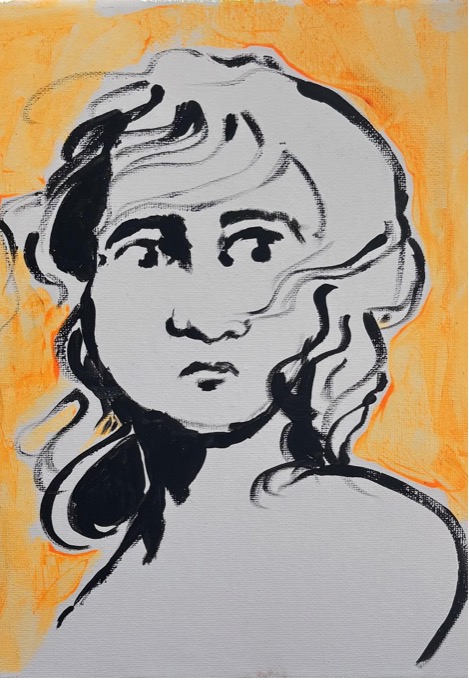
Windy. (April 2, 2026). Bresset, J. Acrylic on canvas. 10” x 8”.
In Windy, J. Bresset’s technique shows her command of gesture and constraint, using long, wind‑swept strokes to anchor the figure while lighter marks drift across the surface with atmospheric ease. She creates depth through contrast using transparent washes beside opaque gestures, allowing the composition to feel dimensional without becoming heavy. The quick‑drying acrylic preserves the immediacy of her confidence. The visible brush drag, directional movement, and subtle irregularities animate the portrait. True to her minimalist instinct, J. Bresset achieves layered emotional complexity with remarkably few marks, letting simplicity open into something richer and more alive.
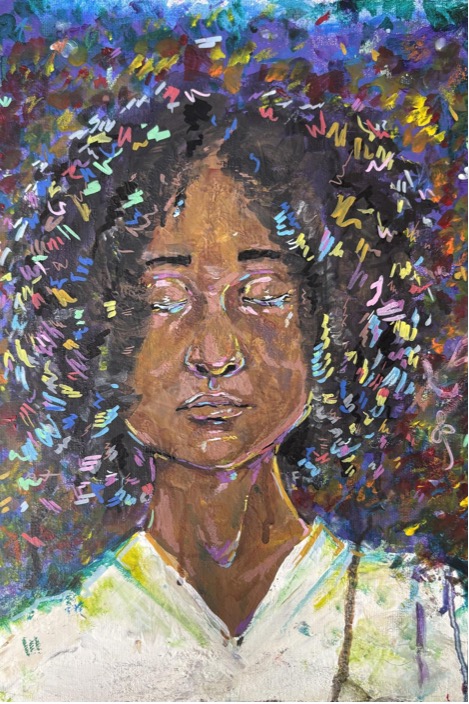
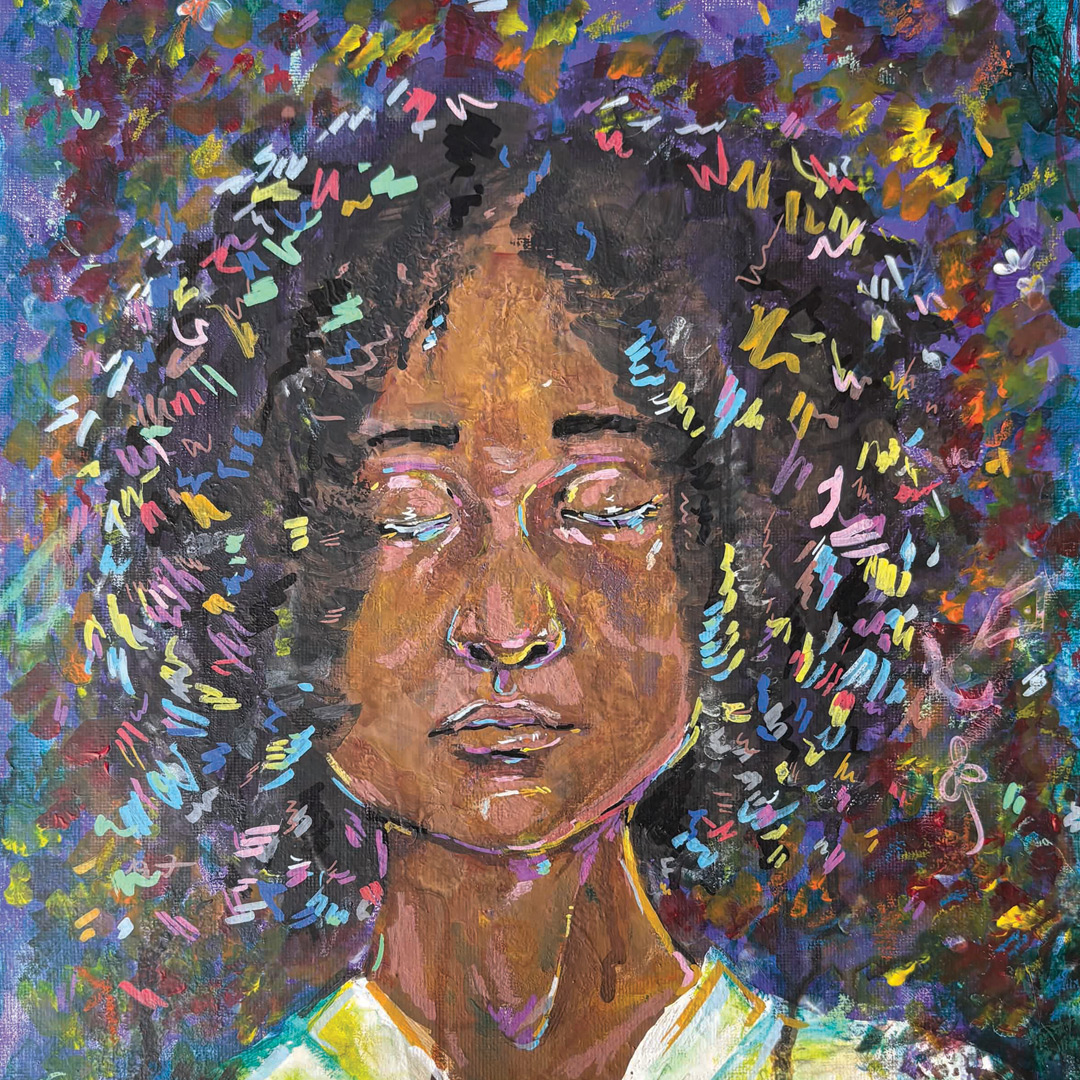
III. (est. summer 2025). Bresset, J. Mixed media, watercolor marker and acrylic. 12” x 9.5”.
IIIbrings a fictional portrait to life, infused with a sense of ease as J. Bresset shapes the figure through sweeping, multicolored passages that feel almost buoyant. The subject’s gentle expression, eyes at rest, conveys quiet optimism, as though wrapped in a moment of inner brightness. Around them, the hair unfurls in vibrant ribbons of color that guide the viewer inward, centering the face as the heart of the composition. Floating, confetti‑like tones reinforce the uplifting mood, allowing the piece to emanate emotional warmth and openheartedness. Softly washed areas enhance the facial features, creating contrast that lets the surrounding space breathe, while textured strokes across the shirt introduce a tactile counterpoint—an implied environment that curves around her before dissolving— as if suggesting the character exists within her own imagined “safe space.”
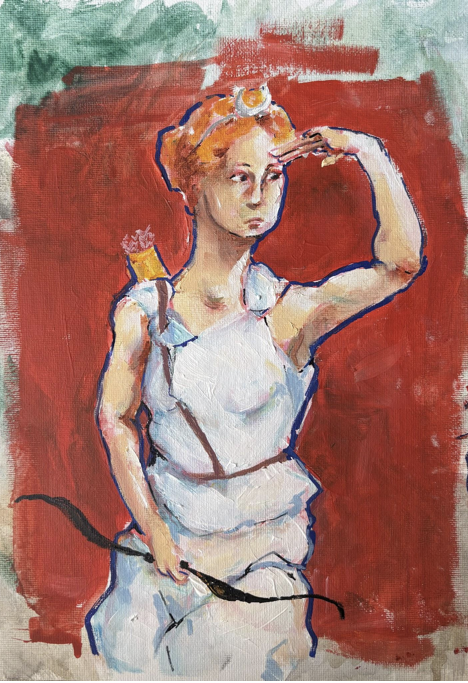
Diana. (est. January 2026). Bresset, J. Oil and paint markers. 14” x 11”.
This work is an instant reminder of J. Bresset’s unwavering commitment to figurative discipline and her emerging sense of narrative. Through assertive linework and vibrant, directional strokes, the figure appears in confident contours that define posture and intent. Behind her, saturated colors rise like ascending steps into an imaginative atmosphere. The scene feels playful yet boldly expressive. Cool complementary blues soften depth while outlining scale, sharpening the character’s purpose and guiding the viewer’s eye along her stance and gesture. The result is a composition of fluidity in a graceful sweep of narrative whim, reinforcing the presence of a guardian rendered with both elegance and story‑driven intention.
“If it happens, it happens,” J. Bresset explained of her process. “You can’t really make a mistake.” Her strength in figures makes drawing animals and other subjects feel effortless. In August of 2025, after injuring her shoulder, her first question was, “When will I be able to draw again?” That devotion speaks for itself—and hints at what her talent may become.