
Most people have heard of dyslexia, but did you know that there is a math version called dyscalculia? Many children, and even adults, struggle with it their whole lives, just believing that they are “bad at math.”
Dyscalculia affects how a person understands numbers, quantities, and how they relate to each other. It also impacts sequencing and working memory, just like dyslexia, which is why longer math problems can become so overwhelming.
The good news is that once parents and teachers know the red flags, dyscalculia can be much easier to recognize and address. With the right approach, students can completely change the way they think about math and, more importantly, the way they think about themselves.
So, what does dyscalculia actually look like?
A student might reverse numbers and write 16 instead of 61. They might solve a problem correctly and then bubble in the wrong answer choice. They may mix up math symbols, struggle to decide which fraction is larger, or have difficulty telling time on a clock.
In my experience, many students with dyscalculia have a much easier time adding and multiplying than subtracting and dividing. Counting forward is often easier than counting backward because of the sequencing challenge. Division can be a nightmare, because it may involve multiplication, subtraction, estimation, and what feels like a million steps.
The challenges do not stop when math class ends. A child may struggle to judge how long it takes to get dressed for school, follow a schedule, measure ingredients, keep score during a game, or read a map.
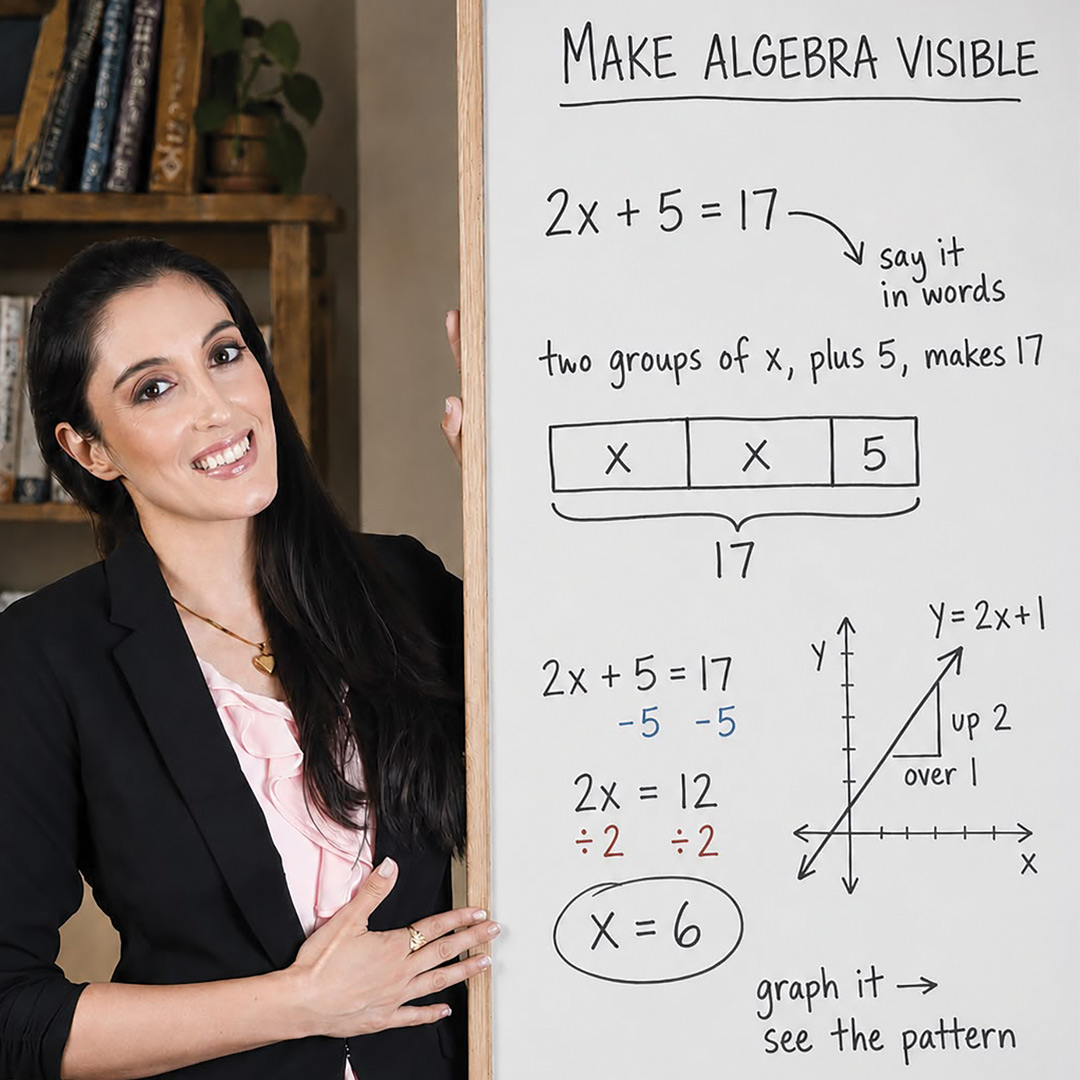
While there is no officially recognized dyscalculia intervention equivalent to the Wilson or Orton-Gillingham methods used for dyslexia, strategies that connect math to visuals, words, and real-life situations can have the same powerful effect.
This year, I worked with an 11th-grade student who had never passed a high-stakes exam. She had taken the SAT, CLT, and FAST repeatedly because she needed a passing score to graduate. By the time she came to me, passing felt impossible to her, and she was just going through the motions.
After I noticed the signs, I recommended she be evaluated, and she received an official dyscalculia diagnosis. From there, we began intervention.
Here’s what many people don’t realize: Students with dyscalculia are often very strong with language, and that’s the key to unlocking math for them. We turned math problems into drawing contests until this student could visualize any problem on her own. She rewrote numbers and symbols as words, and turned each equation into a sentence she could actually reason through. Once the math became a story, she could solve it.
A few weeks later, she excused herself from class to call me. She said she couldn’t even wait until she got home to tell me the news.
“I passed! I passed!” she shouted in the middle of the hallway. “I got a 4 on the FAST!”
I was thrilled that she passed, but what filled my heart the most was hearing the confidence in her voice. She had overcome something she believed she never could, and the way she saw herself had changed forever.
By the end of the school year, she was dividing difficult polynomials, carefully following the steps she had written down. You would never guess what she said next: “My brain just needed a system. This is actually fun now!”
What I have learned is that these students don’t need someone to just explain the same thing one more time. They need to learn a system of explaining it to themselves to see how capable they were all along.