What a Zoo! Sawgrass Wildlife Hospital’s Small Miracles

“We have a real Dr. Doolittle here,” is how Allan Rose, executive director of Sawgrass Nature Center & Wildlife Hospital in Coral Springs, describes Donna Fife, the hospital director. And with good reason.

His description reflects Fife’s dedication to saving wild animals and her skill in treating them, although she is not a veterinarian.  On the day of my visit in early February, about 50 animals were hospitalized at the center. Recent arrivals included three doves, a gopher tortoise, and a blue jay suffering spinal trauma. The blue jay was being given steroids and oxygen and fed through a tube. Its chance for survival, Fife guessed, was about 50 percent.

The two doves had broken wings, which hospital staff set and wrapped. Sometimes broken wings heal; sometimes they don’t. If a dove can’t fly perfectly, it cannot be released into the wild and will have a permanent home at the wildlife center. The gopher tortoise was treated for an eye infection. As a “keystone” species, the tortoise is valuable in our eco-system because its long tunnel-like burrows provide shelter for other endangered animals.

In addition to the hospital’s inpatient animals, Fife was caring for nine orphaned baby raccoons in her home. The babies have to be fed every few hours, so they couldn’t be left overnight at the hospital. “It’s like having my own babies,” Fife said. The outlook for them is good, and she expects they’ll eventually be released back into the wild.

Baby raccoon being bottle fed

One of the hospital’s patients hasn’t flown the coop. Ewok, an Eastern Screech Owl, lives at the center and now serves as an educational “ambassador” on school trips and events for wildlife education. When the owl arrived, its head tilted to one side. An examination revealed a detached retina in one of its eyes. Fife gave him a stuffed “mama owl” that he’d lean his head against to try to straighten it. “He still loves it and grooms it,” she said. Ewok is friendly enough that he also sometimes provides company for Rose, sitting on the executive director’s desk.

Screech owl being fed with tweezer

Besides medical treatment, “we give the animals a lot of TLC,” Rose said.

When injured animals arrive, Fife describes the work as detective work. “We go by what we see, smell, and feel.” Among the wildlife being treated during my visit was a possum found by the road about three weeks earlier. It was in such bad shape that “it looked like an alien,” Fife said. It was almost bald and had lost much of its muscle. The possum was treated with subcutaneous (under the skin) fluid injections along with rounds of antibiotics and nutritional supplements. At the time of my visit, the outlook for the possum was promising. 

Because possums eat rats, mice, ticks, and venomous snakes, they’re great to have in your garden, Fife said. They happen to be the only marsupial indigenous to North America. Even a dead possum is welcome at the hospital, Rose said, because it could have babies in its pouch. (As a marsupial, a possum’s very tiny babies crawl into the pouch after birth.) 

The possum, along with Ewok the owl and the baby raccoons, are just some of the nearly 1,000 injured or orphaned animals brought to the center and hospital in a typical year. Some people make great efforts to save wildlife simply because they love animals. Others, like Robin Reccasina, the center’s operations and education director, believe every animal has an important role in the ecosystem, and since humans are damaging it, we have a responsibility to help.

Not all animals are welcome at the center. Animals of an invasive species should not be brought to the hospital because they cannot be released back into the environment. They include iguanas, Muscovy ducks, and Egyptian geese.

Operating a non-profit organization almost always requires two things: money and volunteers. The Sawgrass center and wildlife hospital always needs the latter. The work isn’t easy, Fife said, and volunteers must be committed. Some who don’t handle animals are needed in the busy kitchen, which prepares meals for 100 or more animals of different species. Others transport supplies.

Money also is always welcome. “We rely totally on donations,” Rose emphasized. “We are unique. If you love animals, this is a great place to donate.”  To donate, volunteer, or learn more, call 954 752-WILD (9453), or visit SawgrassNatureCenter.org.

Striving for Peace – One Step at a Time

For more than a decade, area residents have literally taken steps to bring about peace.

Each time Coral Springs’ Silent Peace Walk participants gather, once a month, early in the morning, to walk for peace, leader Audrey Ehlin reminds them how small steps can lead to a larger impact. Specifically, peace within their hearts can lead to peace within their families. Further, a peaceful community can spread to neighborhoods, the nation and the world.

Ehlin, of Coral Springs, as well as others gather at 7 a.m. on the first Saturday of every month at the International Peace Garden, located behind the Coral Springs Center for the Arts. Birds chirp and one can hear the soft sound of tree branches swaying in the breeze, but for the most part, quiet reigns. Folks move forward in a single-file line for about 20 minutes. Ehlin estimated the walks attracts anywhere from seven to 20 people.

“I believe one person at a time can make a difference,” she said.

Making a difference was on Coral Springs resident Piero Falci’s mind when one day, back in 2006 or so, he was watching the news. A horrific scene was unfolding in the Middle East, as a conflict between Israel and Lebanon raged.

“I saw images on TV of this man, about my age, in a residential area where bombs had fallen,” Falci said. “His house had been hit by a bomb and neighbors were removing the rubble to retrieve the bodies of his wife and two sons. I immediately thought about my family. I, too, have two sons.”

Falci heard an inner voice: What are you going to do?

What can I do? he wondered. After all, he was halfway around the globe. “But I was deeply touched, and the command to do something persisted,” he said.

At the time, Falci also was reading books about peace. An idea sprang to mind: He should start a peace walk. When Falci approached Coral Springs city officials with designs for a monthly event at the International Peace Garden, “the idea was received with enthusiasm,” he said.

“Many people ask why we do it,” added Falci, author of the book Silent Peace Walk: From Inner Peace to World Peace. “It is our belief that cultivating inner peace will help bring peace to the entire world.

“We think a lot about the survivors (of tragedies), and their pain, and our heart aches for them. In a way, in the middle of the beautiful International Peace Garden, we bring to our awareness how fortunate we are for living in a safe environment, and we compassionately connect with those who don’t have the same safety and comfort.”

Elizabeth Velez, of Tamarac, has participated in the peace walk since 2011. She said doing so not only brings her inner peace, but lets her meet like-minded people who enjoy connecting with nature.

For Coral Springs vice mayor Joy Carter, each time she makes the trek, she notices something different within the garden – different colors amid the foliage, for instance.

Among the garden’s permanent features is a peace pole bearing the words “May Peace Prevail on Earth” written in several languages. “I find it’s a really good way to start my day,” Carter said. “It just brings a balance to my persona, my soul. It keeps you centered.”

Stacey Mandell

There must be at least two considerations to label something as art. The first is … there must be the recognition that something was made for an audience of some kind to receive, discuss or enjoy. … The second point is simply the recognition of skill.”

Brannon McConkey

At Stacey Mandell’s first solo exhibition, Letters to Our Younger Self, at the Miami Dade College Hialeah Campus Art Gallery, there could be no doubt in a viewer’s mind the artist was sharing, successfully, the way she experiences the world and that her work was an extension of her personality. Her unique art form encompasses words, emotions, culture, but also activities of daily life and current events.

“If Love is the Sun, Gratitude is the Moon”

Mandell uses shorthand words and phrases — whether actual Gregg shorthand, cursive writing, even Braille — as an abstract gestural form, in which the form’s meaning provides an abstract narrative on the canvas.

“I believe we have much more in common than we may think — love and gratitude, diversity and inclusion, identity and culture, encourage and nurture. Saying ‘please’ and ‘thank you,’” Mandell said. “These are expressions of the soul. We all share the same hopes, dreams, and fears. We all have good days and bad days.

“My artwork is the physical manifestation of the expressions of my soul,” she said. “My messages are the conversations contained in the artwork.” xhibition curators Noor Blazekovic and Alejandro Mendoza, in a joint statement, said they were fascinated how Mandell frames an idea and communicates it to an audience. “What sets her creative work apart from other human expression is that she is creating in the world of non-verbal communication — she uses different tools: shorthand, words, visual images, movement, ideas, and more — to create feelings, thoughts, images, and ideas in the audience to communicate her particular message that as creator she wants to share. The intent is to inform, move, and open the audience’s mind and perspective to seeing the world in a different light than before.”

This is not a blank steno pad” (48″ x 60″, Acrylic on Canvas. 2018)

One work that shows that “different light” is This is not a blank Steno pad, a 5-foot-high acrylic-on-canvas image of the familiar off-green paper notebook. We may know it’s called a steno pad, and many of us of a certain age understand these notepads, with the spiral at the top for easy page-flipping, were popularized in their use by actual stenographers — secretaries, court reporters, close-caption writers in yesteryear’s TV industry, and the like.

Mandell has more than a passing familiarity with proper penmanship. A devotee of punctilious handwriting since her mother taught her cursive in grade school in rural central Illinois, Mandell made her way in the world — in quite the circuitous way, as it turned out — depending on Gregg Shorthand. After graduating from college prepared to teach music and math, Mandell instead took a clerical job where she had to learn shorthand.

“Learning Gregg Shorthand was a turning point on my career path,” Mandell said. From there, she became a legal secretary and, later, jumped to law school, employing her shorthand skills at every point.

“Throughout my 20-year legal career, I utilized shorthand to take notes and draft documents,” Mandell said. During that span, she said, she became fixated on using shorthand to communicate different ideas in a very different way — to express herself as an artist.

Once she left lawyering behind and relocated to South Florida when her husband retired, Mandell decided to pursue that idea.

This is not a blank steno pad was her first work in her steno pad series. It’s as much a statement about her present as it is about her view of our present culture: Much like the absence of ink and scrawl on Mandell’s canvas, the very jobs it represents — or, at least, the job titles — are now part of the past.

Mandell’s steno pad is blank, she said, “because of technology; no one uses it for its intended purpose anymore. It represents the dying art of a beautiful, phonetic language.” Mandell said after she painted the pad of paper, she’d planned to add to it a number of life lessons — in shorthand, of course. “But every time I thought about writing on it, I stopped. I could not bring myself to write on this one,” she said. “I finally realized this one meant more than anything I could express with shorthand.”

Diving in as Grouper, Hogfish Seasons Open

South Florida anglers and divers look forward to the month of May because the grouper and hogfish seasons open May 1.

“Opening day is a Wednesday,” spearfishing expert Jim “Chiefy” Mathie said. “If you’re a diver or underwater hunter, you may want to take that day off from work to get out there and get an early jump on grouper and hogfish.”

The grouper season in Atlantic waters has been closed since Jan. 1 and hogfish season closed on Nov. 1 in local waters. Scuba divers like Mathie could only look and stare at black, gag and red groupers and hogfish as they hunted for other fish and lobsters. When the seasons open, they’ll be targeting what many people consider to be the tastiest fish in the ocean.

The same goes for offshore anglers, especially those who fish on local drift boats like Capt. Skip Dana’s Fish City Pride at Hillsboro Inlet Marina in Pompano Beach. Dana will run trips focused on grouper fishing the first few days of the season. Until then, anglers on his boat and others have had to release every grouper and hogfish they’ve caught.

“We’ve been catching quite a few groupers,” Dana said. “We’ve also caught quite a few hogfish this past winter using dead sardines or squid.”

In addition to closed seasons, grouper and hogfish have restrictive bag limits. Black and gag groupers must measure at least 24 inches and reds must be 20 inches. Anglers and divers can keep a total of three grouper per day, but only one can be a black or a gag. The other two, or all three, can be red grouper.

The limit on hogfish is one per person per day, a minimum of 16 inches long. Previously, the season was open all year, the daily bag limit was five fish and the size limit was 12 inches. Mathie, of Deerfield Beach, has seen an improvement in the hogfish population from Pompano to Boca Raton since the regulations were instituted in 2017.

“We definitely are seeing a lot of big males,” Mathie said, explaining that male hogfish that are big enough to shoot have a long snoot with a dark stripe down the forehead. “Every dive, we’ve seen at least one big male, and in all depths — shallow, medium, deep. Their typical behavior, in particular the big males, is they’ll have a harem of females.”

Mathie is the author of Catching the Spear-it! The ABC’s of Spearfishing, which is sold by most area dive shops as well at Chiefy.net and other online retailers. Among the many tips in the book is to always keep in mind the 3 R’s — recognition, regulation, and range. In other words, be able to identify the fish, know the size limit and be close enough to shoot it with your speargun.

Spearfishers must check off the 3 R’s relatively quickly with black and gag grouper. Unlike hogfish and red grouper, which often try to hide behind a sea fan when a diver approaches, blacks and gags don’t usually stick around.

“You land a black grouper, you’ve done well, because they’re always on the move,” Mathie said.

A member of the South Florida Spearfishing Club (Spearfishing.org), Mathie and his dive buddies start the season hunting the west-facing side of the third reef. The top of the reef is about 50 feet below the surface and the bottom is 60-65 feet.

“The structure holds a lot of fish, and that’s where you see the bigger fish,” said Mathie, who also hunts for grouper and hogfish around wrecks at 65 feet. “Last year we did those areas for almost the whole month of May because we were finding big fish. We didn’t always get them, but we saw a lot of fish. After that, we went to the deeper wrecks in 110, 120 feet.”

Dana fishes wrecks from 75-240 feet for grouper. (GPS coordinates for Florida’s artificial reefs are available on the Florida Fish and Wildlife Commission website, MyFWC.com.) Dana said wrecks in 75-120 feet are good for gag grouper. Blacks are on the same wrecks and deeper ones. Reds can be as shallow at 30-40 feet around rockpiles, ledges, and grass patches, as well as on wrecks.

He added that heavy tackle is needed to quickly get hooked grouper away from wrecks. If the fish get into the ruins, odds are good your line will break.

“I’d use at least 50- or 60-pound monofilament or braided line with an 80- to 100-pound leader and a 7/0 or 8/0 circle hook,” said Dana, adding that anglers might use sinkers ranging from 2 to 16 ounces, depending on the strength of the current, to get their baits to the bottom. “I really like live pinfish for bait for grouper, but you can use two or three dead sardines on a hook, a goggle-eye head or a fillet of bonito. “Let the line spool out and feel for the bite. If you’re fishing a wreck, you want to be up current and upwind of the wreck so the bait will drop on the wreck. When you get the bite, there really is no drop-back or feeding the grouper. Just lock up the reel and pull hard to get the fish off the bottom and away from the wreck.”

No Limits for Parkland Native with Autism

Haley Moss would be the first to tell you she’s unique. The Parkland native, now 24, was diagnosed with autism when she was 3.

Moss would also point out that being different isn’t necessarily a bad thing.

When she was diagnosed with high-functioning autism, her parents were told that raising a child with autism spectrum disorders (ASD) has many daily challenges. They were warned she might never live on her own or even develop the ability to work a minimum-wage job.

Moss has not let that diagnosis, or her disorder, limit her. The Pine Crest School alum, who resembles a petite Natalie Portman with bangs, has written multiple books, including A Freshman Survival Guide for College Students with Autism Spectrum Disorders: The Stuff Nobody Tells You About. She also recently earned a law degree from the University of Miami and, in January, became the first openly autistic person admitted to the Florida Bar.

An active advocate for those with ASD, Moss told the South Florida Sun Sentinel in February that her passion for helping others was one of the reasons she became a lawyer.

“A disability generally is not all-encompassing, it is just part of who someone is, not everything they are,” Moss told the newspaper. “Everyone is unique, everyone has strengths and weaknesses, and everyone has talent.”

Honored as one of South Florida’s Young Leaders in Philanthropy, Moss also is a recipient of the Council for Exceptional Children’s Yes, I Can! International Award. At February’s Unicorn Children’s Foundation’s Unicorn Ball, held at the Polo Club of Boca Raton, Moss received the Occhigrossi Family Youth in Service Award, which recognizes young people who advocate for those with special needs.

Already a seasoned writer and champion for people with autism, Moss has since launched her career in the legal profession, according to the Sun Sentinel. Offered a job even before graduating, Moss now works for the law firm Zumpano Patricios, based in Coral Gables. For information on ASD, visit the National Institutes of Mental Health website at NIMH.gov.

Church Icons: More Than a Season of Faith for St. Mark’s

For the Rev. Mark Leondis, the icons of saints leading into the sanctuary at St. Mark Greek Orthodox Church are family. And as you would with beloved family members, the senior pastor at the golden-domed Boca Raton church pauses in conversation to acknowledge them — a few whispered words of greeting to St. John and a kissed-fingers tap for St. Mark.

Leondis only once neglected such familial obligations. As a young deacon visiting a church in Dallas, Texas, during Holy Week, Leondis was rushing through on some or other important errand. A volunteer at the church stopped him short. “No matter how much of a hurry you are in,” the man said, “always venerate the icon before entering the Church.”

“We don’t worship the icons themselves,” Leondis explained, gesturing to some of the 100-plus paintings and mosaics adorning St. Mark’s, from the entryway to atrium to sanctuary. “These are reminders of what these people achieved and what they represent.”

What the artworks represent often depends on the believer, Leondis said. So, while one parishioner has an affinity for Mary, another feels moved by St. John the Baptist. Children love the stories the paintings depict, while elderly churchgoers appreciate the traditions the art reinforces. For some, the paintings inspire faith; for others, they serve as reminders of spiritual journeys, struggles, and values.

Eastern Orthodoxy’s icons, as much as the faith’s holy anointing oil, musical chanting, readings of the Psalms, and the incense wafting from swaying gold censers during church services, “incorporate all of the senses,” Leondis said. “They help lift us to heaven and continually inspire us to treat each other as we treat the icons themselves.”

Opened in 1997, the sanctuary at St. Mark’s was consecrated in 2014, after a significant portion of the church’s current iconography — painted over a span of 10 years by New Jersey-based artist Laurence Manos — was completed. Leondis, St. Mark’s pastor since 2011, said the overall brilliance of the artwork is itself a constant source of revelation for him.

St. Mark’s is one of the rare Greek Orthodox churches brightened by the sun streaming in the chapel’s expansive windows. South Florida’s bright sunlight pours in from east and west, seeming to set aflame the generous halos of gold leaf and the rich reds and blues that suffuse Eastern Orthodox iconography. Leondis said work on the final stage of paintings for St. Mark’s, estimated to cost more than $1 million, is set to begin in June.

Parkland Buddy Sports Golf Classic

Parkland Buddy Sports will host its seventh annual golf tournament on Sat., May 11, at Boca Lago Country Club in Boca Raton.

“Our Parkland Buddy Sports family has been providing fun, safe programming for our special needs children, their families, and our community since our inception in 2002,” Parkland Buddy Sports president Andy Zaukas said. “This tournament is our primary source of fundraising, with the hope that our fee-free sports programming will continue to grow and succeed.”

The mission of Parkland Buddy Sports, a 501 C (3) non-profit organization, is to provide quality sports programming for children and young adults with special needs in an inclusive, empowering, challenging, and caring environment where the emphasis is on having fun, making friends, and realizing their potential. The structure of a shared experience allows participants and volunteers to create a no-limits environment void physical, social, and cultural barriers.

The sports programs consist of weekly activities and/or games. Each player is paired for the entire season with their own “Buddy,” who in most instances is a student volunteer. Through the shared encouragement of all the program’s Buddies, the players with special needs and their families are able to experience the joys of their athletic endeavors.

The 1:30pm shotgun-start golf tournament will consist of up to 144 players in teams of four. The cost per player is $125, which includes golf, tournament prizes, a gift bag, and buffet dinner in Boca Lago’s VIP dining room. Specialty holes will be available, including a hole-in-one par 3, where golfers will be shooting for prizes courtesy of Infiniti of Coconut Creek. Other specialty holes will be available. Mulligan cards will be on hand for players to purchase.

Sponsorship opportunities may be obtained at several monetary levels, ranging from $500 to $5,000. T-Sign hole sponsorships are also available for $100 per hole. The Parklander is the official magazine sponsor. Other corporate sponsors include Connect Credit Union, The Eppy Group, Holman Enterprises, and Pepsi. Trophies and prizes will be awarded to the top teams. There will be a silent auction and raffle; prizes include hotel stays, signed sports memorabilia, attraction tickets, restaurant gift certificates, and more. If you are interested in assisting the charity or golf tournament committee with your time and/or donations, call Linda Brown at 954-288-7201. For more information on Parkland Buddy Sports, visit ParklandBuddySports.org or search Facebook for Parkland Buddy Sports Inc.

It’s Not Easy Being Green

Kermit the Frog had a different “green” in mind when he sang the blues about the perils of his amphibian color on Sesame Street. But for many of us, “being Green” in an altogether different way isn’t all that easy either.

These days, what exactly does “Green” mean?

Basically, it means leading more environmentally friendly and ecologically responsible lives, so we protect natural resources, ourselves and the planet. I’m sure by now, most of us have seen, heard, or read about the many ways this can be accomplished: by recycling, using solar energy, electric or hybrid cars, picking up trash, collecting plastics in our waterways, using alternate energy sources instead of fossil fuels, etc.

The long list of “easy” fixes quickly becomes not-so-easy when it comes to details. For example, in building and development, there is a system called LEED, which stands for Leadership in Energy and Environmental Design. It’s the most widely used green-building rating system in the world. It’s also used for virtually all building projects, whether commercial, community, or home.

But is it worth it? And does it really work, or matter? As I have found out, most things in life have no clear-cut, black-and-white, yes-or-no answers, and that is true here as well. To get a building or project LEED-certified, there are courses to study, exams to take and proposals to be shown and accepted. If all of that is completed, a building or project will receive a plaque stating it is LEED-certified. The buildings must show certain levels of efficiency in resource usage such as water and electric, and none of this is cheap. The initial cost is $600 just to register and certification fees can range from $2,250 to $22,500 based on the project size. On top of that, complying with all the requirements necessary can add millions of dollars and hours of paperwork to the projects. On the plus side, LEED certification can mean tax breaks, grants, and the ability to charge higher rents.

Being LEED-certified sounds great on paper, but the bottom line is this: as in many things, reality doesn’t always live up to theory’s expectations. While some LEED buildings have shown lower resource usage rates, others have shown rate increases. LEED certification, after all, is based on proposals of anticipated resource use and not actual usage once a building project is completed. Therefore, is it worth it to have your building or project LEED-certified? A definitive answer remains elusive.

As another, more familiar example: Do hybrid cars produce lower emissions than gas-only vehicles? Obviously. Do they get better gas mileage? Sometimes. But it’s not always a significant difference when compared to the price differential of similar models. Total electric cars use no fossil fuels and produce no emissions, which are great assets. However, since there are not enough of them on the road, there isn’t an accurate way to determine the difference in electric consumption a nation of them might make. The same can be said of solar panels. As for recyclables, there is absolutely no argument of any sort that doing this is a bad thing.

Cleaning up our oceans, lakes, and waterways, plus keeping our landfills limited to those items that decompose and can/will/might be used to produce products that will go back into our soil is great. But what portion of these post-consumer materials will be reused in manufacturing? Again, theory is rosier than reality in answering this question. We have been recycling so much and have shipped so much of it to foreign countries, China being the main importer, that we now find ourselves without places to send these materials. China has stopped importing “foreign garbage,” which includes many types of plastics and paper. We also have run out of recycling plants and are now depositing what is and might be recyclable back in landfills. Recycling, however smart and necessary, remains shot through with problems, beginning with the fact that a lot of us don’t understand whether what we throw in the recycling bin is really recyclable.

So where are we in this quagmire? Does “being green” mean there’s reason for hope and change? Or is it all hopey-changey bunk? What you decide depends on your environmental outlook and what you want and expect of and for future generations. It also depends on your pocketbook. The difference in cost between hybrid cars and their gaseous counterparts can take years of driving to recoup, let alone seem significant. The same with LEED-certified buildings, electric cars and solar panels. No, being Green isn’t easy. But here’s my take in black and white: any steps forward in making this planet more sustainable, keeping our precious natural resources for generations to come, is worth whatever it takes.

Autism: By the Numbers

When the Centers for Disease Control and Prevention (CDC) began tracking the prevalence of autism in American children, comprehensive data from 2000 and 2002 showed 1 in 150 kids were found to have autism. By last year, when the CDC released results from its most recent findings, autism rates had again jumped. Of the 8-year-olds from the study’s broad-based regional survey areas, 1 in 59 had been diagnosed with autism spectrum disorder (ASD).

In real numbers, here’s what that means: CDC tracking suggests that in 2000, roughly 26,700 kids across the U.S. were found to have ASD; the most recent data indicates that number grew to 72,375.

Autism rates, which increased steadily from 2000 to 2010, according to a 2018 report from Johns Hopkins University’s Bloomberg School of Public Health, had held steady, at 1 in 68, in the two sets of findings from 2010 to 2012.

Researchers and CDC officials pointed to myriad factors that appear to have a role in the increase in autism rates. One big takeaway from recent findings is the increase in autism prevalence among white children as compared to black children in previous reports.

“Although we continue to see disparities among racial and ethnic groups, the gap is closing,” Li-Ching Lee, a psychiatric epidemiologist at the Bloomberg School and one of the CDC survey’s principal investigators.

Lee and other experts say a primary factor in these increases and in the growing rate of ASD prevalence is that children are getting diagnosed at younger ages, often as early as 2 to 3 years old.

Autism, which appears as early as infancy, is a range of closely related disorders that share some core symptoms. ASD causes delays in basic developmental areas, such as learning to talk, play, and interact with others. Signs and symptoms of autism vary widely, just as some children with ASD suffer only mild impairment, while others may struggle with debilitating physical and cognitive challenges.

According to the CDC, children on the autism spectrum may vary in the severity of their impairment, but all struggle to some degree in three areas: verbal and non-verbal communication; relating to others and engaging in the world; and having flexibility in their thinking and behavior.

Opinions differ among doctors, parents and experts about autism’s causes — and about how to best treat it. But all agree, and research reinforces, that acting early and seeking intensive intervention for children showing early signs of autism is the best path toward the best outcomes. For more info, visit www.CDC.gov/ActEarly

The National Women in History Month: Truths untold

With this year marking the 32nd anniversary of the making of Women in History month and with all the excitement going around, it’s hard to believe women’s history was once considered an insignificant topic. However, in the present era, it is a momentous celebration for both women and girls.

How did Women’s History Month originate and who was responsible for it? To make a long story short, Women’s History Month happened due to the efforts of pioneers who, with their confidence, passion, and humility, brought to light the contributions of women throughout our history.

Women’s rights have been associated with the month of March for more than a 150 years, starting on March 8, 1857, when female garment workers in New York City protested against their poor working conditions and low wage.

Later, on March 8, 1908, women needle workers in New York held a similar protest, with guidance from Mary Harris Jones (aka Mother Jones), Lucy Parsons, Clara Lemlich, and Elizabeth Gurley Flynn. It is in honor of the efforts of these four women that March 8 is observed as International Women’s Day.

Nevertheless, this isn’t how Women in History Month started.

In 1972, history teacher Molly Murphy MacGregor fielded a question from a male pupil about the definition of the Women’s Movement. MacGregor didn’t have an answer for him then, so she said, “What a good question. Let’s discuss it.”

As the question kept ringing in her ears, she rushed home, determined to find answers. Paging through countless college history textbooks, she found the information in only one, with a single chapter describing the first Women’s Rights Convention in 1848.

The realization came to MacGregor that women had been omitted from media, books, and classrooms. She began questioning herself about the reality of the situation and the real story that women wanted to tell. MacGregor decided to change the course of her life and joined the Education Task Force of the Sonoma County (California) Commission on The Status of Women as a volunteer.

MacGregor helped establish a local women’s history week, which was celebrated in schools and organizations based on a specific curriculum. The urge to have women’s contributions to America listed in history expanded from here.

MacGregor, along with activists Paula Hammett, Mary Ruthsdotter, Better Morgan, and Maria Cuevas, founded the National Women’s History Project in 1980. By 1986, the group had helped persuade 14 states across the U.S. to celebrate March as Women’s History Month. One year later, the month was set aside nationally as a time to honor women’s accomplishments and contributions. From labor protests of the past to local activism in the here and now, women’s journey from the grassroots to National Women’s History Month has been inspiring. So, this March, let’s celebrate the countless women who have earned our recognition.

The Vaping Issue

Since the introduction of e-cigarettes in 2004, their popularity has grown exponentially, especially among teenagers and young adults.

Initially, e-cigarettes were used as a form of smoking cessation therapy. Though they contain nicotine, they do not have the tar and toxic gasses that are associated with combustible cigarettes. E-cigarettes were an innovative way to get people to quit smoking, and they’re easily accessible. But this accessibility introduced young people to e-cigarette use.

For many young people, vaping is an introduction to nicotine and may be a gateway to traditional cigarettes.

Vaping has become rampant and, for experts, the trend is disturbing. The 2018 National Youth Tobacco Survey showed staggering increases in middle and high school students using e-cigarettes and other electronic nicotine delivery systems (ENDS). From 2017 to 2018, there was a 78 percent increase in e-cigarette use among high school students and a 48 percent increase among middle school students, reversing the strides made in recent decades in the fight against youth nicotine addiction.

Since vaping is a relatively new technology, there are still questions about the e-cigarette liquid and its long-term effects. We know nicotine harms the developing brain but have little understanding of the potentially damaging ultrafine particles and heavy metals that also are found in e-cigarettes.

With its increase in popularity, there have been multiple regulations in an effort to curb and eventually eradicate vaping in teens and young adults.

In 2014, a law was passed that bans people under age 18 from purchasing and possessing e-cigarettes and other nicotine-dispensing devices, but that did not solve the youth vaping problem.

More recently, a ban on indoor vaping was passed in November. This amendment makes the use of e-cigarettes and other nicotine-dispensing products allowed only in homes, bars, and hotels that permit it, thus treating vaping like cigarette smoking. However, this ban does not address the youth vaping crisis.

The Federal Drug Administration has been tireless in its attempt to keep e-cigarettes and other ENDS out of the hands of young people. A major component of its plan is to curb the marketing of tobacco products aimed at youth. Many purveyors of e-cigarettes and other ENDS have designed marketing campaigns to appeal to teens and young adults. Bright ads and flavored products are created for and aimed at young people to get them addicted to nicotine.

In compliance with the FDA crackdown, Juul, one of the leading manufacturers of e-cigarettes, announced in 2018 that the company will no longer sell its flavored products in retail stores. These products are now only available on Juul’s website to buyers who are over 21. One puff of a Juul has the equivalent amount of nicotine of one pack of cigarettes.

The FDA released its Comprehensive Plan for Tobacco and Nicotine Regulation in 2017 and held a public hearing on Jan. 19 to discuss efforts to eliminate the use of e-cigarettes and other tobacco products by young people. The FDA proposes a nicotine product standard that would lower the nicotine in cigarettes to a minimally addictive or non-addictive level. This could decrease the chances of future generations becoming addicted to cigarettes and could make it easier for current smokers and vapers to quit. The FDA is also looking into regulating flavors in e-cigarette and tobacco products, including menthol. FDA commissioner Scott Gottlieb has vowed to take whatever action is necessary to stop the harmful trends associated with vaping.

Parkland Speaks: Collecting Lonely Thoughts

Writing, at its best, is a lonely life.

Ernest Hemingway, in describing work that won him a Nobel prize in 1954, knew this sentence seemed contradictory — “alone” is not how we usually describe life’s transcendent moments.

Parkland Speaks: Survivors from Marjory Stoneman Douglas Share Their Stories (Random House Children’s Books, paperback, $17) is one of those rare books that reveals how the solitude required of writing can elicit heartrending reflections and devastating truths.

Anna Bayuk, one of the collection’s 43 contributors, was a junior at Douglas on Feb. 14, 2018, when a shooter attacked the school, leaving 17 dead and as many injured. That afternoon, she found herself bunkered in a classroom, clenching the hand of a classmate she “only half knew,” listening to gunshots in the distance, hearing footsteps in the hallway.

“you are staying quiet, no, quieter, no, silent

you are staying silent.

for a moment, i was not silent.

there was a plastic walmart bag full of valentines from

     and for the people that i care about on my lap.

and when i shifted it off to the side so that i could move

     my legs even an inch

it was the loudest thing i had ever heard …”

Passages like this, breathtaking in their imagery and revelation, don’t happen in front of local TV cameras and newspaper reporters. They come when you’re alone with your thoughts; and that mulling — that essaying — can crystallize with the solitude writing requires.

Each piece in Parkland Speaks, whether recollection, photo, sketch, speech, or scratch poem, comes from a Douglas student or teacher. The collection’s editor, Sarah Lerner, teaches journalism at the high school and serves yearbook advisor. Those two roles overlap here in a nexus through which the collection is focused and shaped, but only expansively directed. And the result is by turns gut-wrenching, depressing, ponderous, hopeful, and joyous — sparkling with such a range of thoughts, images, and emotions, it can be exhausting.

Much the way the teens here, and everywhere, normally are. Even as not-normal as these young people now feel.

Both with intention and inadvertently, the young writers of Parkland Speaks reveal their falls from innocence. Each, like Alice tumbling down the rabbit hole, bruised, dusty, and dazed but able to stand up, take stock, and take tentative steps forward.

Rebecca Schneid, now a senior at Douglas, reflects in the aftermath of 2/14 on the bewilderment of being chased into adulthood — first by the shooter, then by the media and politicians, then by the world of anonymous jeerers and gawkers known to every victim of adolescence.

In “A Zoo Animal,” a free-form piece in the style of a spoken-word jam, Schneid says, “I don’t even know myself.”

Sometimes I think that I am fine,

that I’ve lost some of that sheer pain and wrath;

that I’m on a path

toward healing and success,

toward not moving on really, but growing

from the distress …

She is not fine, of course — who would be? And that’s the point: given the circumstances, feeling so not-normal is, well, normal.

Definitely, it’s the new normal at Douglas High.

That new normal, even a year later, is still in flux.

The final pages of Parkland Speaks serve as proof. In “Meet the Contributors,” everyone has moved on. Some still attend Douglas High, now upperclassmen; others have gone off to college. Each’s trajectory toward whatever their futures hold remains on path despite what they went through.

But the way of those paths has been hosed down and is still wet with their experiences and takeaways from Valentine’s Day 2018. The footing is slippery as they try to navigate between who they were before that day and who they are now.

But make no mistake — forward is where they’re going. Whether as community organizers or organizers for Dance Marathon, as varsity water polo players or budding civil engineers and pediatricians, as yearbook editors or ebook authors.

Parkland Speaks isn’t about reliving the past. It’s proof of life in the now. A testament to resilience and hope — the very essence of MSDStrong.

teeberg is the Parklander’s contributing editor.

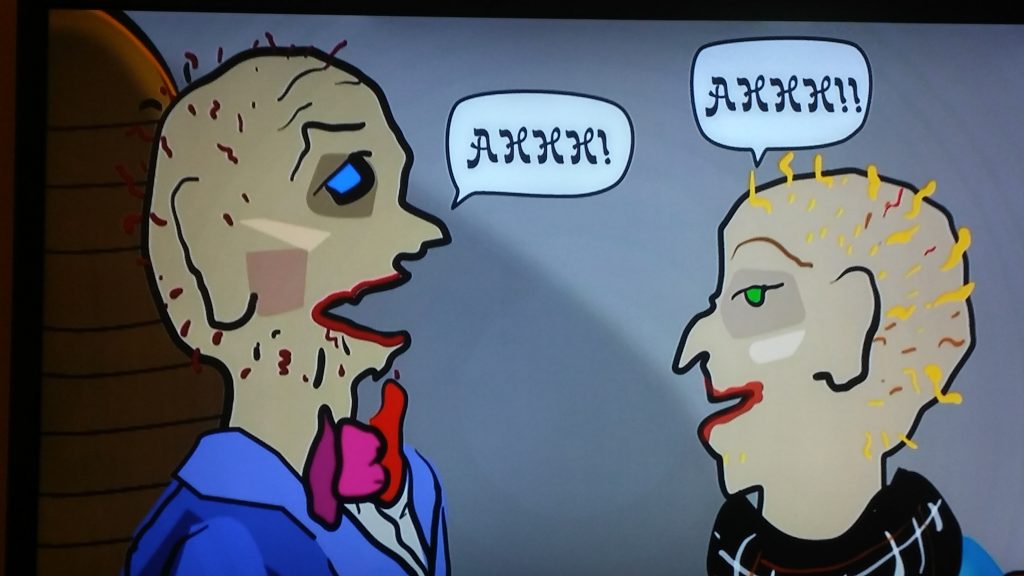
Cutline: Artist Madalyn Snyder, one of the contributors for Parkland Speaks, wrote about her experiences on Feb. 14, 2018, for the collection. A junior at the time, Snyder was cutting out paper hearts and goofing off with her buddy Guac on Valentine’s Day, as the pair waited for class to end. Minutes later, they heard gunfire and Snyder said her own heart sank. In the chaos of evacuating, she and her classmates came face-to-face with the shooter and Snyder was saved only when her teacher pulled her to safety. The teacher, Stacey Lippel, another of the book’s contributors, was injured in the incident when a bullet grazed her arm. Snyder’s friend and classmate, Joaquin “Guac” Oliver, was later named among the 17 victims who died in the shooting. (Illustration by Madalyn Snyder, courtesy Random House Children’s Books.)